It's not that easy being green
In 2006, Pitchfork published a review of the album Shine On by Jet with a 0.0 score. The entire body of the review was an embedded video of a monkey peeing into his own mouth. I confess Wicked: For Good makes me feel so depleted that I’m tempted to pull the same stunt here. But, truthfully, as jaded as I felt while I watched it, this isn’t a 0.0 failure of a film. It’s something perhaps more frustrating in its own special way: an expensive wasted opportunity; an intermittently watchable endurance test.
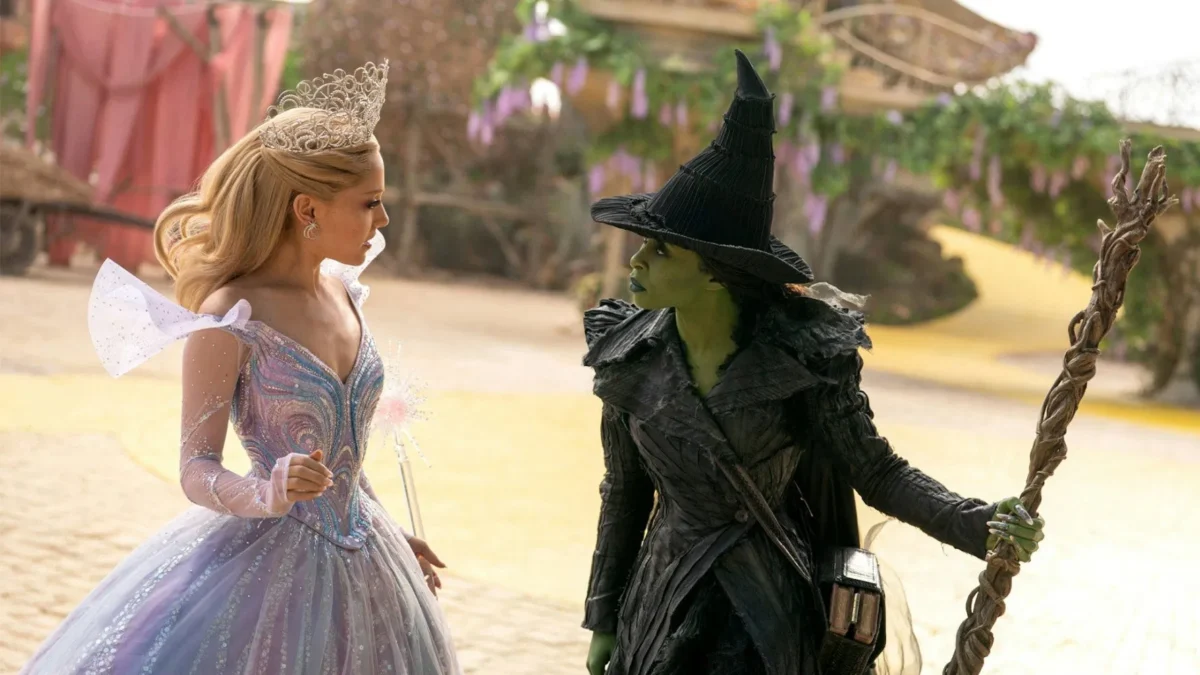
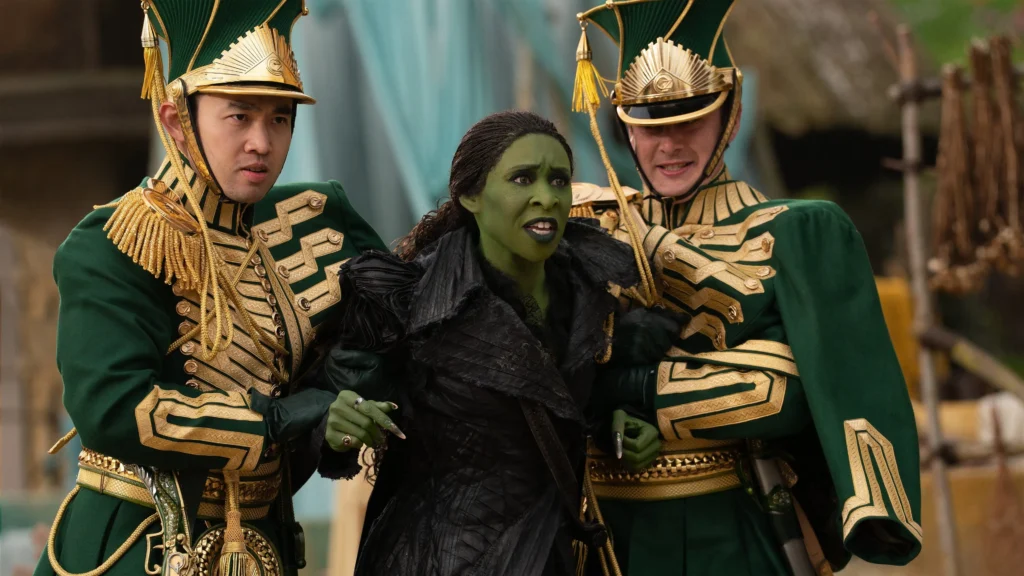
For Good picks up days or maybe weeks after the first film left off, with Elphaba (Cynthia Erivo) now fully branded as Oz’s Public Enemy #1 and Galinda (Ariana Grande) serving as the friendly face of the regime as she reckons with her friend’s heel turn. The Wizard (Jeff Goldblum) is still using steampunk tech to deceive Oz’s masses while his administration consolidates power, and Madame Morrible (Michelle Yeoh) is a key cog in the propaganda machine as the head of Dear Old Shiz (I get second-hand embarrassment every time I type or say it) and the chief weather magician. Part One was the campus movie, with new friends, new rivalries, and a discovery of the wicked ways of the world, while Part Two is the culmination of that setup with Oz-wide consequences. The chicken dances and dorm room bickering dry up, and everyone starts using words like “treachery” and “martyr” (and “Dorothy,” as it were).
That tonal shift isn’t automatically a problem. Sagas build and darken; see Harry Potter’s successful arc in this regard. The stage show has the same structure of a lighter opening half and a darker closing half, though nearly all attendees more fondly remember the lighthearted moments of the first act than the portentous second act. What is automatically a problem is that the script sucks and the tone is a self-serious slog. I always took the stage play to be self-aware of the outlandishness of high politics in the goofy world of Oz. You can see its cheekiness especially in the way it shrugs away Dorothy’s story just when you expect it to become the central point. Alas, we get no glaze of irony in either of the Wicked movies. (Though at least the film does repeat the stage musical’s disinterest in Dorothy’s quest; Grande mispronouncing “Toto” is one of the biggest laughs of the film. And speaking of Dorothy, her slippers are silver, presumably for copyright reasons, as the 1939 film is not in the public domain, and it just looks wrong.)
The whole thing might have worked a bit better if it had followed the Yellow Brick Road of common sense and adapted the musical into a single film. The decision to split Wicked into a duology is the kind of adaptational choice that makes sense only if your guiding artistic principles are filling a release calendar and padding corporate coffers. Truly; who thought this was five hours worth of narrative? Wicked: For Good a death march through Oz. Scenes stretch. Beats repeat and exhaust. Characters have slow-motion conversations stating and restating themes. By the time the movie arrives at moments that should be the tragic payoff of the story, you’re more tired than devastated.
The most obvious symptom of this bloat is the compulsive need to retrofit every bit of Wizard of Oz iconography into neat little origin-story boxes (and this is somewhat ironic, as it avoids actually depicting Dorothy’s quest). By the time the film concludes, we get dramatic introductions of the Tin Man, the Scarecrow, the Wicked Witch of the East, the Cowardly Lion, and the famous tornado, as if we’re ticking boxes on an IP to-do list, and it’s lamer every time.
But there are parts of the story I actually kinda like, maybe just because I’m a dork for teen melodrama: When For Good focuses on the web of romantic intrigue and longing as the motivation of its characters, it has some pulpy fun, and even occasional emotional heft. The story functions as a love pentagon — Nessarose (Marissa Bode) loves Boq (Ethan Slater), who loves Galinda, who loves Fiyero (Jonathan Bailey), who loves Elphaba, who only cares about taking care of her sister, Nessarose. These tensions all ricochet off one another in various configurations, which turns out to be a far more effective narrative engine than any of the speechifying about freedom and fear.
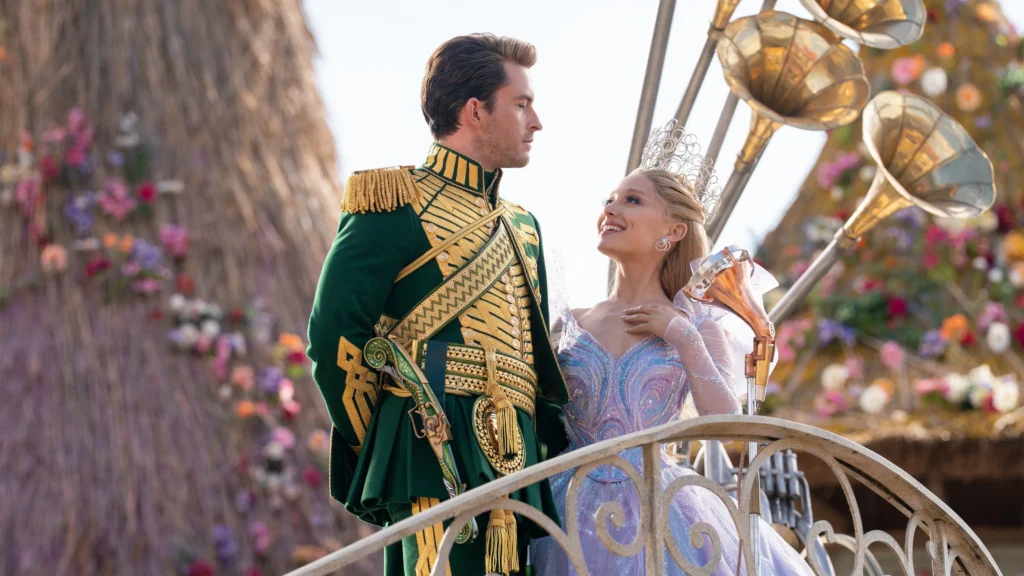
Each potential pairing has a distinct charge, but by far the most compelling thread is the near-textual queer longing between Elphaba and Galinda. The movie is not subtle about it: at one point Elphaba literally shoves Galinda into a closet. Later they part with “I love you”s that seem a little more than sisterly. Erivo and Grande have genuinely great screen chemistry despite approaching the material from different angles — Erivo is all soft intensity, while Grande exudes tremoring performative brightness which is cracking at the edges.
Grande, in particular, does impressive work modulating Galinda from Part One’s giddiness into something more complicated and fragile. It’s the most dramatic material that Grande has ever been asked to handle, and I mostly bought it. (Something I must get off my chest: I’m not inclined to pass judgment on women’s bodies or the pressure placed on actors to maintain a certain look, but Grande is so distractingly skinny that it looks unhealthy; rib cages and collar bones should not be so pronounced. The dresses she wears really call attention to her narrow figure, which the ‘90s would have labeled “heroin chic.” And maybe I’m just projecting, but I found it to bleed into her performance’s energy a few times; in some of the close-ups, Grande has a bit of a pallor and weariness in her face.) Erivo is also good, though the performance here is more closed-off and steely than in Part One. This matches the story, of course, but it means you miss some of that earlier vulnerability that made her magnetic in the first half.
But I’ve been talking around the film’s truly unforgivable sin: for a musical, the numbers are sparse and abysmal. When they do show up, the tunes are anemic, forgettable, and poorly staged. Something like five of the stage musical’s most iconic numbers come from the film’s first act, and therefore the first Wicked movie. This is one of the major reasons it was extremely stupid to split the movie into two halves; as the musical orange has been fully squeezed dry here. Chu and co weave in a few original numbers to try and juice the soundtrack, but it still feels stingy on the tunes.
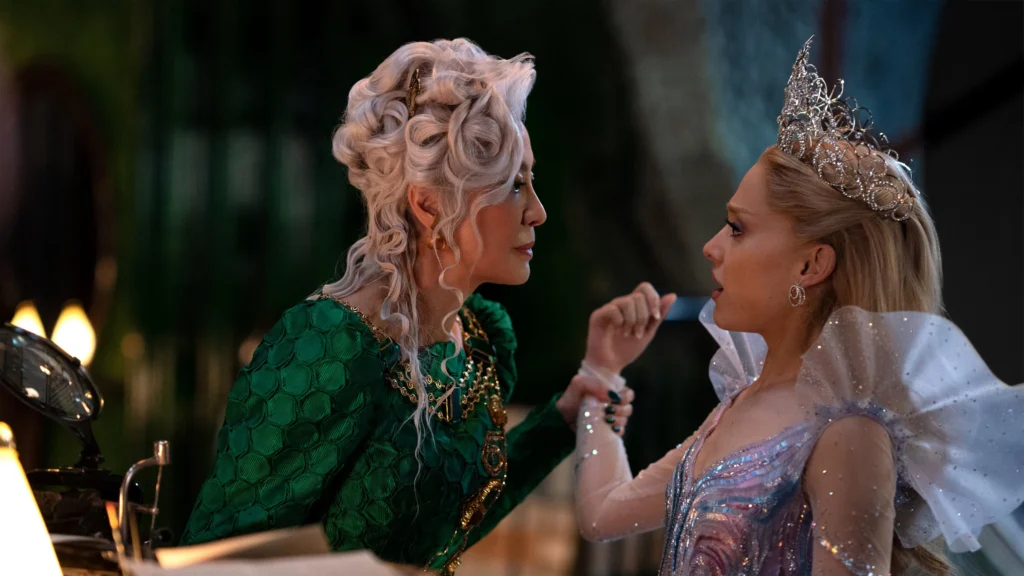
I could pile on… and I will, for one more paragraph. The first film’s cinematography sins — desaturated color grading; overused backlighting and lens flares; unholy digital gloss; etc. — remain a problem this time around, and are not aided by a heavy use of slimy CGI. I do think the cinematography is slightly less bad in For Good, probably thanks to some post-production after the feedback on Part 1. But much, much worse in Part 2 is the direction; the camera is as disciplined and coherent as a Labrador puppy. (Critic Adam Nayman calls it “world-historical”-level bad, and I’m not going to bother pushing back.) Michelle Yeoh, a nuisance in the first film, offers movie-crippling catastrophe of a performance as a major villain and political player this time around. She has a thousand yard stare and can barely get through lines. It’s like she’s speaking a different language; and, given all the stupid Oz jargon and lore, I don’t blame her. She kinda is speaking a different language.
For Good is not quite a monkey-peeing-into-its-mouth failure. It has a lot of good production, the cast brings real commitment, and the central relationships offer some intriguing dramatic material. But the Wicked duology is ultimately a major missed opportunity to bring some campy, propulsive fun to the screen. I just really want them to be enjoyable, you know? Movies are fun when they pursue the joy — nay, the magic — of music and colors and theatricality. Instead, the Wickeds offer up a laborious runtime, toilet paper scripts, a self-congratulatory tone, and an all-around slog of an execution. “For Good” is as much as a lie as anything the Wizard says.
Is It Good?
Not Very Good (3/8)
Dan is the founder and head critic of The Goods. Follow Dan on Letterboxd. Join the Discord for updates and discussion.