
Past the point of no return
There is a paradox at the heart of Andrew Lloyd Webber’s empire that Joel Schumacher’s 2004 Phantom of the Opera makes impossible to ignore: everything that made the stage show a phenomenon is precisely what makes the movie unnecessary. The spectacle of Phantom on Broadway — the chandelier crashing, the boat gliding through candlelit mist, a body swinging from the catwalk — is staggering because human beings are pulling it off live, eight shows a week, in real time, before our very eyes. Reverse-engineer it into a movie, where spaceships can dogfight… and ocean liners can split in half… and dinosaurs can eat lawyers… and suddenly a guy in a rowboat surrounded by fog machines doesn’t hit quite the same way. (And we’ve seen it plenty of times, anyways.) Any filmed adaptation of a Webber show will be hindered as such; ironically, their spectacle-forward presentation makes them less likely to translate to screen, because cinema can already do it better.
But when that organ riff kicks in, those big, churning, Bach-esque chords the size of a cathedral, something in my chest responds whether I want it to or not. Webber’s melodies are unkillable. He exerts. You can dismiss his shows as gaudy, shameless and slightly inhuman without crossing over into charming camp, and plenty of people do. But something in his tunes and stories knocks you on your butt no matter how much you try to resist.
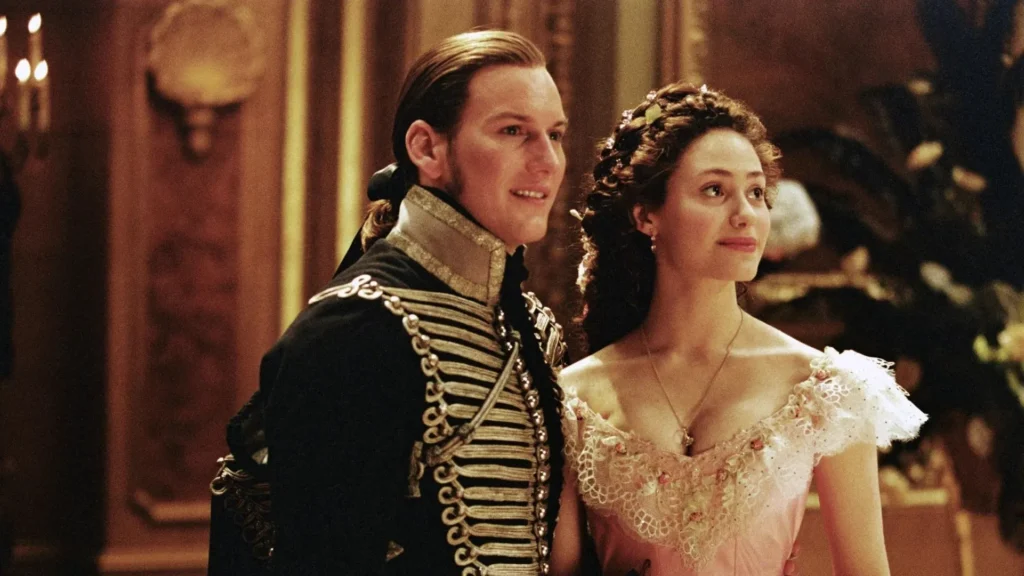
And you will resist. This adaptation is a pretty illegible and incoherent take on a pretty flat and simple story, to be frank. It’s not doing the source material (or the source’s source material, a much-adapted 1910 novel by Gaston Leroux) many favors. This Phantom (Gerard Butler) is a disfigured musical genius who lives in the lake beneath the Paris Opera House (which really exists, though not this attractively). He manipulates the theater’s owners to follow his whims, and he grooms the ingenue Christine (Emmy Rossum), an orphan who also lives in the opera house, to be a star. When Christine reconnects with her childhood sweetheart Raoul (Patrick Wilson), now a wealthy patron, a love triangle between the Phantom, Christine, and Raoul rots into coercion and violence. The story shares DNA with Beauty and the Beast and The Hunchback of Notre Dame, a part of that noble tradition of French ugly dudes pining from the shadows for beautiful maidens, the ugly anti-heroes flawed even as they perceive real problems in society.
But Phantom of the Opera, at least in this screenplay, only scratches at the contradictions lying within those themes rather than fully unspooling them. This version, which exists more as a romantic melodrama with some murders than a romantic horror, is just a mess of underdeveloped characters and stodgy dialogue, leaving little interest about where Christine’s heart lies: with the dangerous, passionate outcast, or the dashing nobleman. It never really earns the chemistry or tension required to make the love triangle land the way it’s written here, to tear our hearts in half the way Webber positions the doomed romance: the Phantom is just too overwrought and unsympathetic for this kind of telling, Christine too flat, Raoul too bland. The chemistry is all flat, fairy tale romance without pulse. You have to bring your own subtext if you want much to chew on. The more traditional horror spin on the story puts the nightmarish currents of the story more front and center.
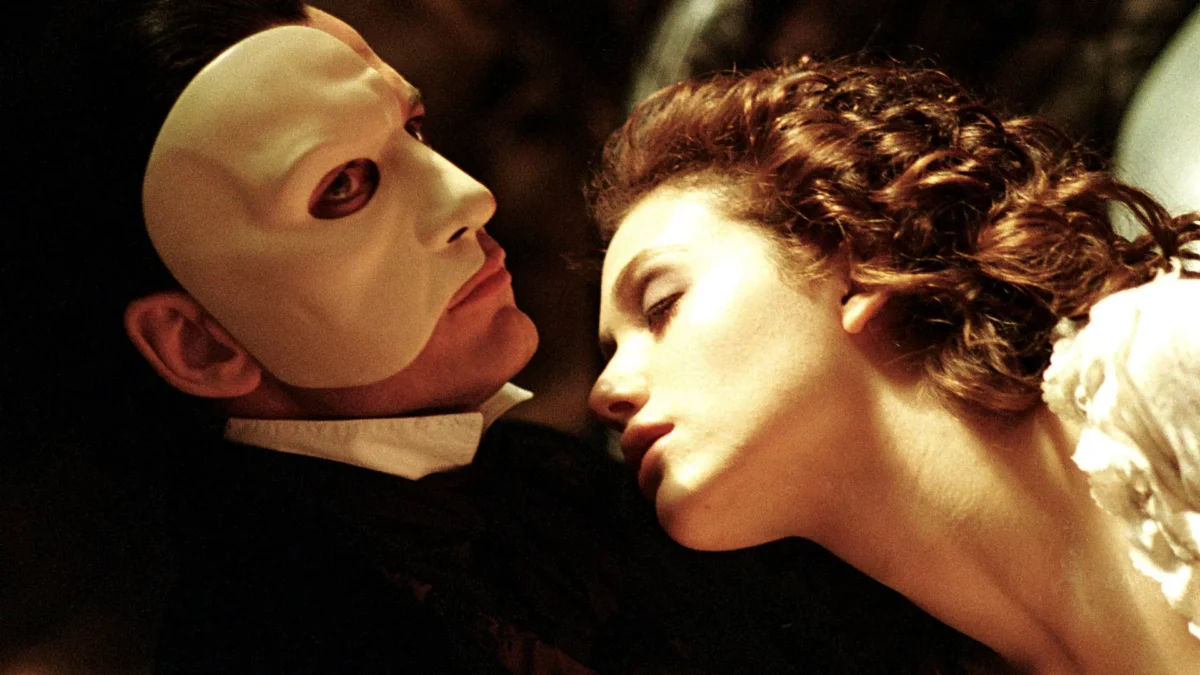
Schumacher reportedly wanted a “rock and roll guy” for the Phantom regardless of vocal ability, and that’s how you end up with handsome Butler wearing a quarter-face mask and straining through songs written for Michael Crawford’s operatic tenor. The unmasking itself, one of cinema’s all-time great images in the 1925 Lon Chaney version, is a total non-event here. By the time we get a full prosthetic reveal late in the film, it amounts to some scarring on a conventionally attractive man. Who could love a monster such as Gerard Butler? Rossum, to her credit, brings adorable, wide-eyed sincerity to a role that doesn’t have much psychological depth, though the fact that she was seventeen during filming adds an uncomfortable layer to the romantic material that’s ripe with lust.

The structural choices are also muddled. On stage, the chandelier crashes at the end of Act One: that’s your defying gravity moment, your big curtain-dropper. But 21st century movies don’t have intermissions (unless you’re The Brutalist), so Schumacher relocates the chandelier drop to the climax, where it gets mixed up in the chaos of the finale. It robs the moment of its singular, turning point impact. This disconnect is emblematic of the movie’s broader problem of sloppy plotting.
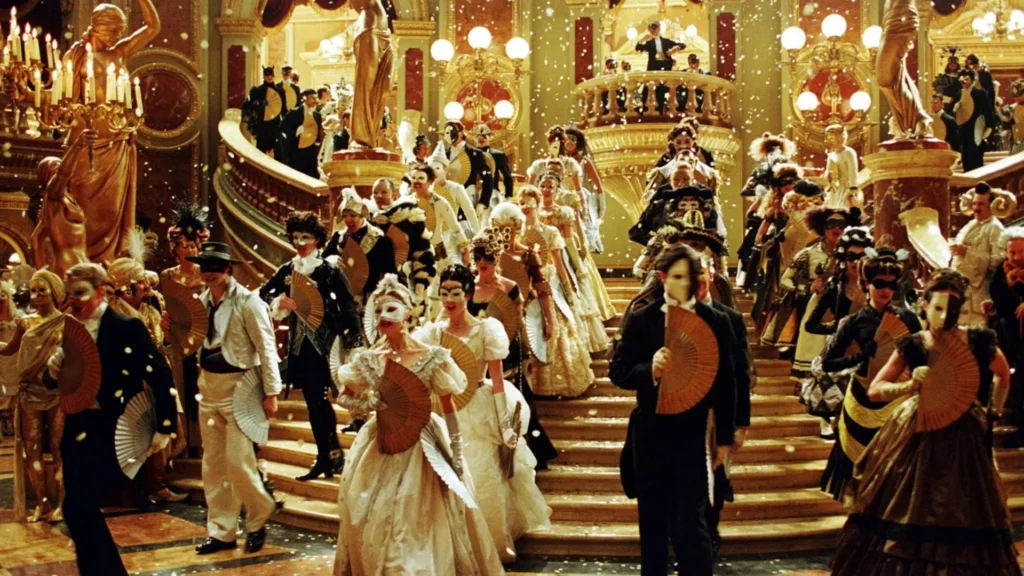
Schumacher gets at least one thing right, and that is the production, which is busy, extravagant, and tacky in a fun way. And unlike Wicked, it’s cleanly lit so you can enjoy it: The film lets you soak in the tremendous sound stage recreations of the Paris opera house. The costumes are good fun, too; a black-and-white masquerade evokes the climax of An American in Paris, and it wasn’t the only garment that reminded me of classic studio Hollywood glitz.
I keep coming back to the grand sweep of the music, though. Webber’s motific musical composition, which shifts genres and moods between characters, only for musical ideas to resurface at a point of emotional connection or shift in mood, is satisfying and more sophisticated than his detractors give him credit for, even if the execution is a messy panorama rather than something cohesive and focused. Phantom of the Opera is far from a great movie, and I am open to the argument that it is not even be a good one. But I watched it and I accepted it for what it was. Not every musical needs to be a piece of art. Sometimes the chandelier just needs to fall.
Is It Good?
Good (5/8)
Related Articles
Dan is the founder and head critic of The Goods. Follow Dan on Letterboxd. Join the Discord for updates and discussion.
2 replies on “Phantom of the Opera (2004)”
If nothing else, this film introduced me to la Belle Rossum (For which I remain grateful).
I’d also argue that the notion of a Phantom who loves and breathes Opera, but simply doesn’t have the voice is a potentially-excellent one (Albeit difficult to integrate into the stage musical version of things), since this would help fuel his obsession with the genuinely-gifted and his vicious hatred of those who ignore his expert advice (As well as other mediocrities) since that expertise is all he has.
It also occurs to me that a cinematic adaptation that leaned more into the Grand Guignol origins of the story might potentially allow a film to carve out it’s own distinct identity (Since in a film one can focus on little details in a way no stage musical can get away with).
The idea that the Phantom is vain and deluded about his own ability is a fascinating one that I could definitely see being the focus of a story.