
Cluedunnit
You don’t need me to tell you that the concept of a movie constructed around a board game is ridiculous. What will they come up with next, a movie based on Barbies? Legos?
But Clue is something of a miracle. Today, it would be IP slop: deeply bland, starring one or more Chrises, heavy on green-screen, designed to launch the Hasbro Cinematic Universe. In 1985, that template didn’t exist, so we got something much more interesting: Clue is a wacky mid-budget black comedy starring a bunch of weird and attractive B-listers, crammed with jokes about socialism and prostitution. One of its signature visual gags simulates necrophilia. It’s a relentless, searing farce with enough mystery structure to prevent devolution into gag conveyor belt, though the laughs do come nonstop. And it has such good connection to the spirit of the source board game that it’s a masterstroke of brand use. Even its much-ballyhooed split finale, all three variations helpfully appended to modern releases, works wonderfully, and feels in line with the whodunit nature of the game.
That Clue exists at all is one of those Hollywood happy endings that could have gone sideways in so many places. Tom Stoppard took John Landis’s screenwriting advance then returned it, unable to crack a story that fit the board game. Stephen Sondheim and Anthony Perkins, Norman Bates himself, were intrigued but priced themselves out. Producer Debra Hill wanted a “Rocky Horror meets murder mystery” with live audience participation, which Paramount scrapped in favor of a different gimmick: three different final acts distributed randomly to theaters, labeled A, B, and C in newspaper ads, a high concept worthy of William Castle that has become the film’s most famous feature. (A fourth ending involving mass poisoning was shot, deemed too Looney Tunes, and scrapped.) Scriptwriting responsibilities ultimately landed in the lap of Jonathan Lynn, and then he signed on to direct, making his feature debut. The film started coming together, but lost its biggest star early in production: Carrie Fisher, originally cast as Miss Scarlet, withdrew to enter treatment.
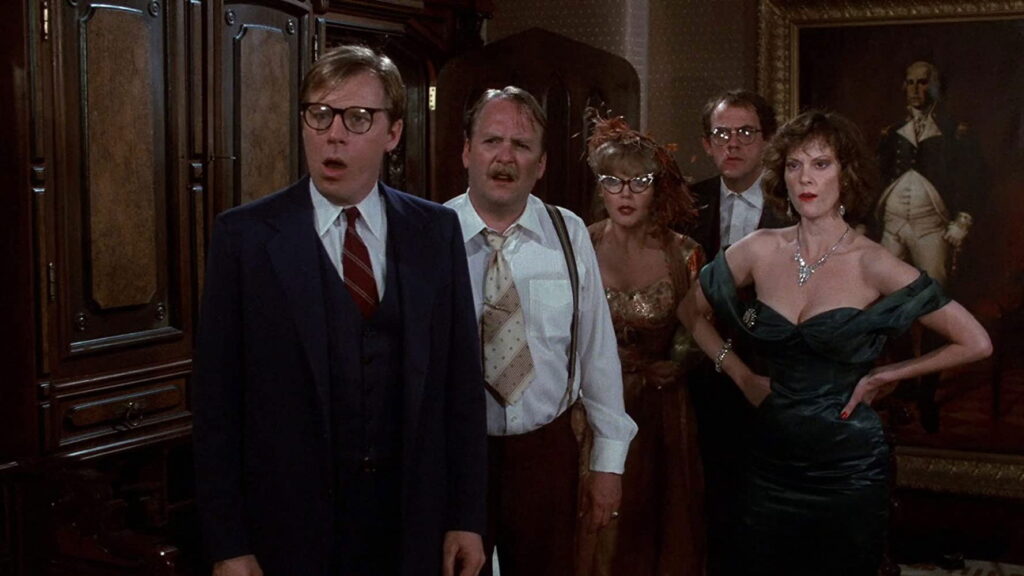
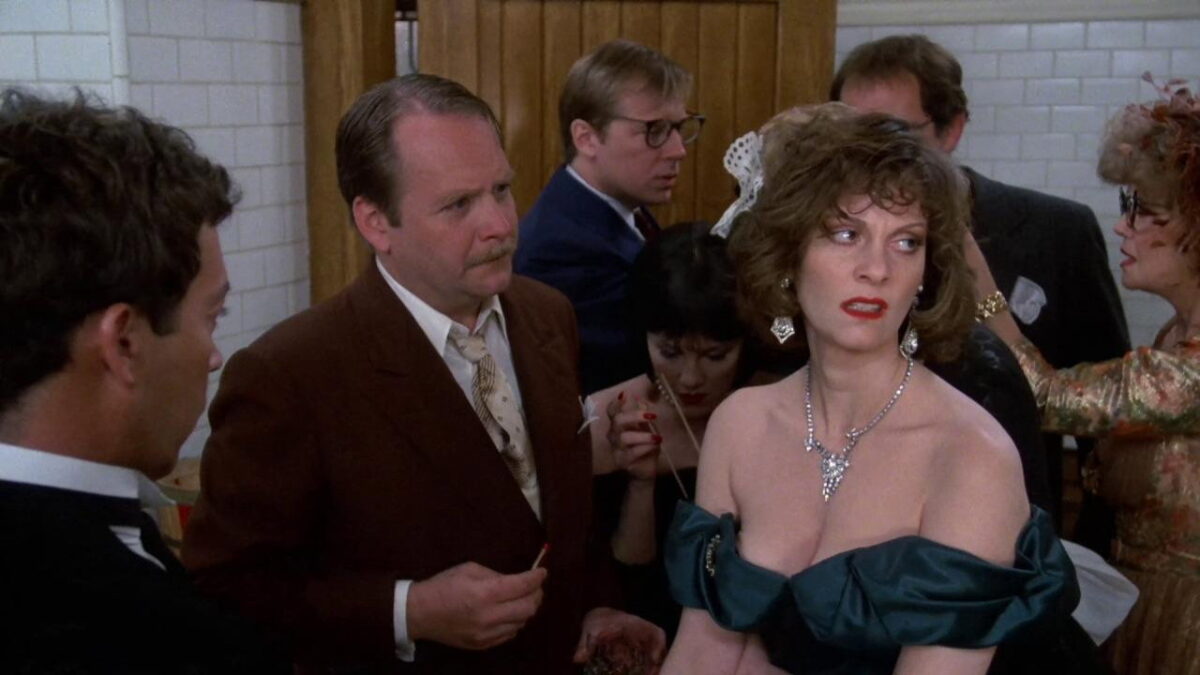
The colorful ensemble Clue ended up with is its big draw. The players include: Wadsworth (Tim Curry), the motor-mouthed butler who may be the only one who knows what’s going on; Miss Scarlet (Lesley Ann Warren), the D.C. brothel operator with an unceasing seductive smirk; Mrs. White (Madeline Kahn), the black-widow ice queen whose grief over her lost husband(s) is a thin membrane over homicidal rage (and/or lesbian lust); Mrs. Peacock (Eileen Brennan), a senator’s wife who speaks mostly in “harumph”s; Professor Plum (Christopher Lloyd), a sleazy psychiatrist; Colonel Mustard (Martin Mull), a war profiteer playing dumb; Mr. Green (Michael McKean), a prim State Department nerd who prefers the company of men; and Yvette (Colleen Camp), the French maid wearing the bustiest garment in cinema history. The cast was reportedly paid identical salaries and receive equal billing.
What’s maybe most surprising is how structurally sound the writing is under the wit and slapstick. Lynn’s screenplay is a real mystery, planting clues in throwaway dialogue while self-consciously breaking the classical rules of the form (multiple bodies spread throughout the runtime rather than just the first act; servants as culprits rather than red herrings; multiple killers). Underneath the unceasing screwball wordplay and double entendres is a legitimately pointed little satire, too: McCarthyism, blackmail rings, government corruption as the rotted underbelly of a quaint period facade of genial upper class. Victor J. Kemper shoots the mansion terrifically, a perfectly realized location for an Agatha Christie pastiche: the sets are decorated with authentic 18th- and 19th-century furnishings, some rented from the Theodore Roosevelt estate. The terrific sense of space (even the secret passages have personality) elevates the frequent physical comedy. John Morris, a regular Mel Brooks collaborator, scores it with a heavy dose of strings and only the slightest jaunty wink.
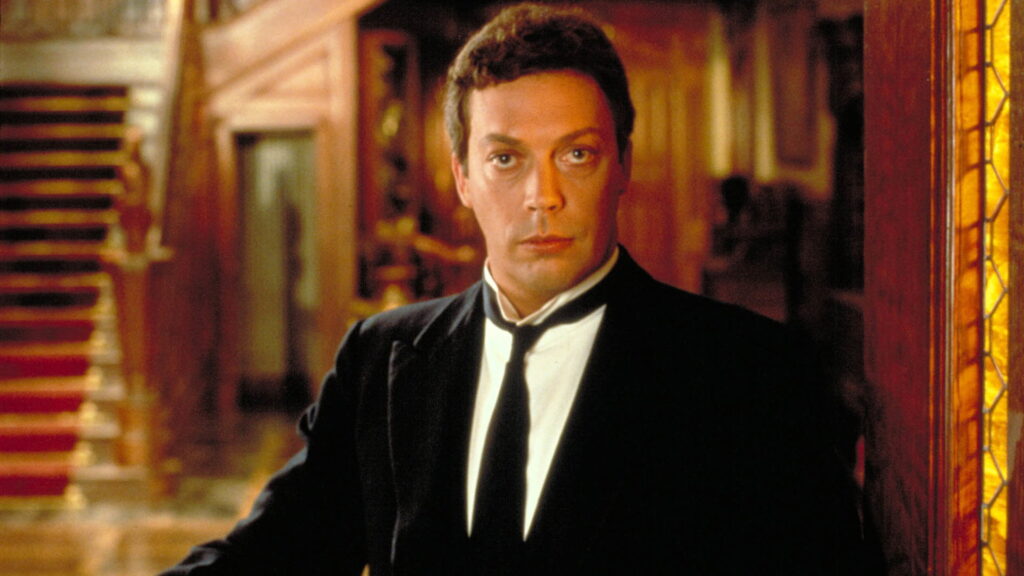
Nobody here is better than Curry. His climactic reenactment sequence, where he hurls himself from room to room explaining the evening’s events at double speed, is one of the great physical-comedy bravura turns of the decade; and, in fairness, it’s also where the movie pushes its luck. After an hour of carefully controlled mayhem, the third act devolves into Wadsworth re-narrating an evening we just watched, and Curry is working hard to keep that water-treading aloft. Then the split endings arrive and it snaps back to life. Kahn’s “flames on the side of my face” monologue is a classic and was reportedly improvised. Warren (looking quite a bit like peak Susan Sarandon here, which I mean as a compliment) leaves a strong impression, too, with some sultry line deliveries and great face acting. And for a freewheeling comedy, Clue has aged surprisingly well: The only stuff that genuinely comes across as dated is some of the unwanted-advances schtick and a handful of “fruity”-era homophobic language that the movie tosses around carelessly, though even all that is light and is something you can attribute as period color.
Clue flopped at the box office (grossing just $15M), allegedly killing a planned wave of board-game adaptations: treatments for Monopoly, Life, and RISK all reportedly died with it, delaying that particular ecosystem by decades. (I guess the “Hasbro Cinematic Universe” idea was not far off the mark.) What Clue built instead was one of the most durable cult afterlives of the 1980s: VHS, cable, repertory screenings, anniversary re-releases, a touring stage adaptation, and Wadsworth cosplayers at conventions. That all sounds a lot like the treatment fellow Curry vehicle Rocky Horror gets, which means Debra Hill’s original pitch came true eventually, to a degree.
It’s very funny, more anarchic and blistering than analogous modern darlings like Knives Out can claim to be, and it spreads the wealth across its wonderful cast. Nobody is making this specific movie today; its budget would be bigger, its target audience younger, its action more cinematic; its ensemble less perfect. We did eventually get Barbie. We got The Lego Movie. We’ll never get another Clue; it’s something of a miracle, forty years on.
Is It Good?
Exceptionally Good (7/8)
Dan is the founder and head critic of The Goods. Follow Dan on Letterboxd. Join the Discord for updates and discussion.
6 replies on “Clue (1985)”
Always been a big fan of this one.
What could a Risk movie possibly be? A Napoleonic Wars movie? You can already make that if you want to! (Or was it six kinds of differently-colored cubes at last learning to finally throw off the shackles of mutual hatred and coexist?)
If it kept the same approximate mission statement as Clue, maybe it’d be a Dr. Strangelove type film? I guess Risk has no characters like Clue so it’d be a lot more open ended, to your point. In my childhood printing of the game, the tokens weren’t cubes but tiny cheap-plastic figurines: soldier, horse, cannon for 1, 5, and 10. Go team blue cube.
I guess they did end up making a Battleship movie, didn’t they?
I’d definitely bet on a satire skewering the notion of war as a game (and probably having fun with the gleeful unreality of the player’s ability to move armies anywhere on Earth without regard to logistics, economics and political realities), especially the sort of mindset that treats war as a game whether it’s fought by mere counters or by flesh & blood.
HAH! Here’s a plot hook for you – what if somebody tried to settle a diplomatic crisis by playing a game of RISK instead of actually going to war? (Imagine the rules-lawyering, pressuring of players and outright cheating likely to be going on).
Bonus points if actual military types stand at the sidelines operating as a peanut gallery “That’s not how war works!?!”
For the record, my personal favourite of the three endings is the one where Mr Curry gets to play the most heroic butler since Alfred Pennyworth.
“How many husbands have you had?”
“Mine, or other women’s too?”
“Yours.”
“Five, just the five. Husbands should be like Kleenex – soft, sturdy, and disposable.”
Glad you enjoyed this one. For my money it’s funnier and more rewatchable than any comedy that’s come out in the last decade. (And it was a dud at the time!) I think the Curry extravaganza in the final 20 minutes does get to be a little much, but ymmv on that. Very few comedies are as rewatchable as this one; if you’ve seen it just the once, you’ll enjoy it again.
I’d seen portions of it before but this was my first time through, and it holds together really well. I’ll definitely be watching again