

You and me, old timer
Paul Thomas Anderson showed up in the mid-’90s as a wunderkind and a walking contradiction, a filmmaker whom you could describe as literary with almost none of the traits you might associate with calling a filmmaker “literary.” He pairs strange story structures, complicated characters, and ambivalent themes with scenarios that sound pulpier or breezier than the final product actually delivers. Every one of his films offers some new structure, theme, tempo, or genre for the director, and still carries an unmistakable authorial fingerprint of someone piecing together incongruities and dark truths of modern life. His films are also adventurous, technical achievements. The visual form and the dense writing of his films work in conjunction to explore odd or unlikely pockets of life inhabited by haunted people (mostly men). He’s a director out of his time, spiritually more in line with the filmmakers who preceded him by a couple of decades, except every one of his movies latches onto some distinctly modern angst. He’s a divisive director, a flawed and uneven artist, but unmistakably a talented visionary, one of the towering voices of cinema of the past quarter century.
Part of Paul Thomas Anderson’s appeal is craft you can feel in your bones: long takes that glide, camera moves that both give visual space a shape and enliven that space. He always draws from his impeccable troupe of actors performances that rattle the screen with gravity and complexity. He’s also a filmmaker obsessed with systems, and how they control us as much as we control them: money, faith, fame, family, sex, power. And for all the bigness people associate with him, he’s often locked onto a single question: What does it look like when someone broken takes a crooked path to becoming whole, when every instinct and institution tells them to do otherwise? The exact nature of, and answer to, that question has changed with the years; Anderson has grown more skeptical, sometimes even cynical, as he’s aged, but his moral preoccupation gives his films a powerful core.
Many of Anderson’s trademarks come into focus in Hard Eight, his debut feature, though much of it is in nascent or stripped-down form. This is as simple a film as Anderson has made, and in some ways that simplicity is a strength; accusations of Anderson’s art-film pretension, of obtuse narrative structures, are not entirely undeserved, but you won’t detect much of that here. This is a casino neo-noir about a surrogate family. It’s anchored by its quartet: a tremendous Philip Baker Hall performance in the lead alongside an early, wonderfully affable John C. Reilly, plus Gwyneth Paltrow and Samuel L. Jackson filling out the ensemble.

It’s tempting to project significance onto all the firsts here: For example, the movie opens with a tracking shot that immediately suggests PTA is a director who puts much effort into camera movement and much thought into what it can achieve. Sydney (Hall) approaches John (Reilly), a broke, grieving loner sitting outside a diner, and offers the simplest invitation: coffee, a cigarette, and company. (The opening lines of the movie are an invitation from Sydney, so it scans as an invitation to the viewer, as well.) Sydney is suspiciously kind; John’s guard is up, and ours is too. In a more conventional film, you’d expect the set-up of a con or scheme by Sydney right from the go. Hard Eight swerves into Sydney’s apparent selflessness and lack of agenda instead, as Anderson drags out introducing tension, conflict, and inevitable criminal violence as long as possible in the story. It’s a different suspense, a creeping unease and a lack of clarity when the actual conflict will even emerge, and this structural gambit makes Hard Eight, like much of Anderson’s filmography, an unpredictable affair.
Sydney offers to help John get back on his feet and into stability; and yet he ushers him into a casino (an irony that keeps us skeptical of Sydney’s grace and wisdom). The casino regular Sydney (suggested, but not explicitly confirmed, to be a degenerate gambling addict) introduces to John the ways of the neon cathedral: little routines and “hacks” that don’t steal money, but make John seem like a high roller. Hard Eight is not a long film, but it has patience building a fluorescent world where time doesn’t exist and everyone is both anonymous and intensely observed. Sydney’s composure is hypnotic: he’s disciplined, measured, and paternal to John, his inner motivations opaque. But the movie subtly hints Sydney has averted his eyes from some dark inner truth we’re just waiting to emerge.
Sydney’s paternal energy deepens when Clementine (Paltrow) enters the orbit. Sydney treats her with a careful, almost protective decency that is rare in an environment where everything is a transaction and a dopamine hit. Waitresses are presumed to double as prostitutes. Paltrow plays Clementine as someone who’s developed toughness because softness is expensive and she’s broke: She has childlike sweetness blended with resigned cynicism. Paltrow sells it; this is one of her better performances. Clementine’s addition to the film expands the movie from the Sydney-John mentor-student two-hander into a complicated, fractured family that feels doomed and unstable even if the danger isn’t yet clear.

And then, right around the halfway mark, the film makes the big tonal and genre pivot we’ve been waiting for. It’s Anderson’s first sharp turn in a career filled with them. John calls Sydney in a panic in the middle of the night and summons him to a motel where John and Clementine have inadvertently found themselves with what they call a “hostage,” and it’s the first time the story’s suppressed violence and depravity break through the surface. This turning point is dark, tense, and (because of Reilly) pathetically funny. Sydney’s role in this mess becomes halfway between scolding dad and mob cleaner: someone who can make problems disappear, we infer, because he’s had to before.
Samuel L. Jackson’s Jimmy functions like a cracked mirror reflection of Sydney. He’s living the same casino-lurker life as Sydney, but without the polish: He openly lusts, blasphemes, and debauches as if that’s the point of being in Vegas. (And maybe it is?) He serves as a thematic counterweight, and thus makes Sydney’s composure the very subject of the film: Is Sydney’s decorum the essence of his character, or simply a mask over a darker truth? Sydney always recoils when Jimmy is around, suggesting that Sydney maybe fears the answer to that question.
We also see for the first time Anderson’s love of single-scene firework casting: Philip Seymour Hoffman pops in and hijacks the movie as a young and reckless craps player in a bravura two minutes. Anderson often lets world-class bit players become quick-passing hurricanes, and Hoffman sets the template that Alfred Molina and Bradley Cooper would have to live up to. And as with the best single-scene appearances in Anderson’s film, the appearance is not just a throwaway but a lens into the director’s game here: The casino is full of people convinced they’ve found the edge, convinced they can force the universe to pay them back: In other words, Sydney. Hoffman’s presence is like the loud version of what our protagonist is doing quietly, almost Sydney’s repressed id.
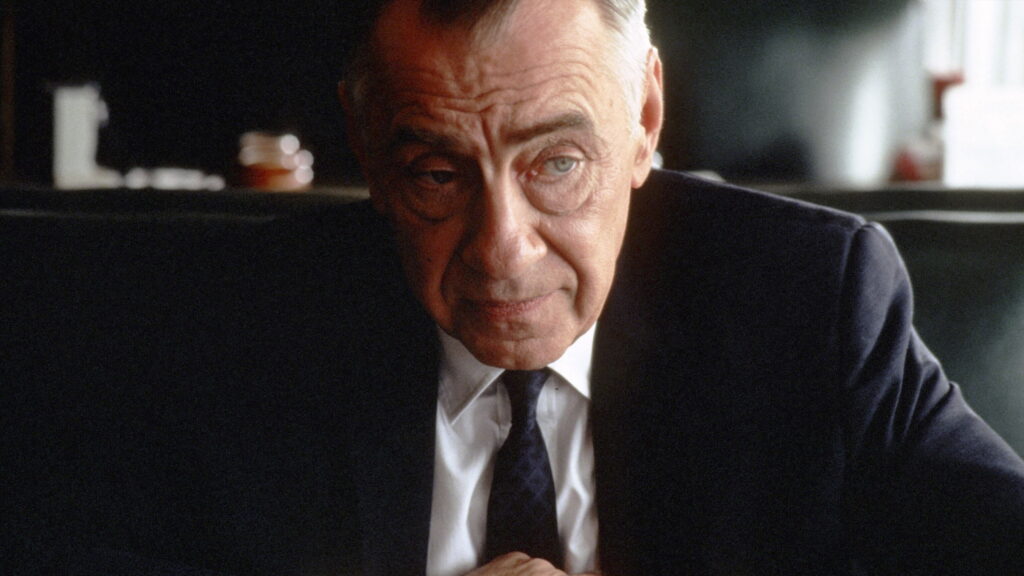
What makes Hard Eight stick isn’t depth or complexity of plot, but the sharpness and thematic roundness of its character sketches, especially Sydney’s. We see in Sydney that empathy and honor in the world of career gamblers is something difficult, unstable, and almost dangerous, like a boulder pushed to the top of a mountain. Sydney’s kindness matters, but it’s always complicated and compromised and at risk of fracturing.
Sydney turns John and Clementine into his proxy children, showing them genuine affection, and yet the pair nearly wiggle out of his grasp into the same sad lives they’d have if they’d never met Sydney. But Sydney’s empathy and love are noble and purifying even when they seem pointless. Sydney’s love towards John and Clementine improve not only their lives but Sydney’s: Hard Eight gradually reveals that saving John and Clementine is also Sydney’s attempt to rewrite his own past, to get a do-over on being the kind of man he wishes he’d been. (Sydney reluctantly admits he has an estranged son and daughter, and this exchange illuminates a lot about his care for John and Clementine.) On the other hand, even the glory of Sydney’s nobility gets upended in the final scene; as in any good noir, morality is complicated, jagged, and one bad roulette spin away from bankruptcy.
The movie is absolutely carried by Hall as Sydney. Anderson almost always gets outstanding performances from his leads, and Hall’s is definitely one of his best, though a bit uncharacteristic in that Hall is more often a character actor and supporting player than a leading man, whereas Anderson usually gravitates to star powerhouse personas to headline his films. Hall has a terrific, understated charisma: his control of a situation magnetic to watch, and yet he doesn’t shy away from exposing the micro-fractures in Sydney’s confidence. He also has a great voice — he’s a delight to listen to reading lines for a hundred minutes.
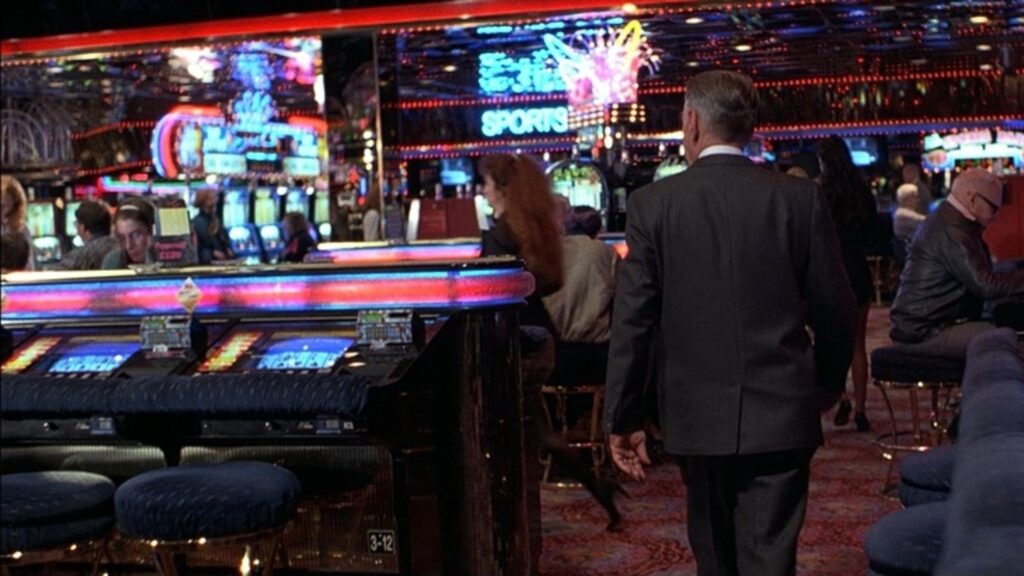
From a formal perspective, Hard Eight is an astonishing achievement for a 26 year old, and frankly any director. Anderson aligns himself with New Hollywood legends like Martin Scorsese and Francis Ford Coppola in the boldness and confidence of his direction: the compositions and roving camera tell a story of Sydney’s inner turmoil by themselves, with clever rhythm that’s comfortable until it’s intentionally jarring. Many shots are notably asymmetric when they don’t have to be (but more symmetric when the childlike John is around), keeping the audience on its toes and suspicious of Sydney’s psychology. Anderson regular Robert Elswit offers strong, boxed in cinematography with just the right amount of disorienting Vegas neon glow.
As a debut, Hard Eight takes its time and exhibits restraint rather than showing off. (Boogies Nights is the opposite, and honestly feels more like a debut than this.) Anderson shows intuition for carefully controlling the audience’s perceptions and the relationships we have with the characters. Once Hard Eight gets cooking, you realize its deliberately paced opening is part of the design: Anderson is teaching you how to watch these people before he asks you to judge them in their hard times. It’s far from his flashiest film, which is fine. It’s almost a relief to revisit after the intensity and/or sprawl of his later works. Anderson would go on to more complicated, thorny, and ambitious material, but Hard Eight offers a rewarding story and a great intro to one of his generation’s most celebrated directors.
Is It Good?
Very Good (6/8)
Related Articles
Dan is the founder and head critic of The Goods. Follow Dan on Letterboxd. Join the Discord for updates and discussion.