
I want to get off Mr. Aster's wild ride
On film social media, much virtual ink has been spilled anointing Eddington a future cult classic: a misunderstood triumph that depicts the COVID era with real gravitas, penetrating into that cursed time in a way no other filmmaker or artist has. Well, if that ends up being true, you can safely count me among the misunderstanders. I just don’t get Eddington. I don’t enjoy it, I don’t find it thrilling or cathartic, I don’t think it competently tells a story, I don’t believe it has much to say, and I don’t want to spend another minute thinking about it after I hit Publish on this review.
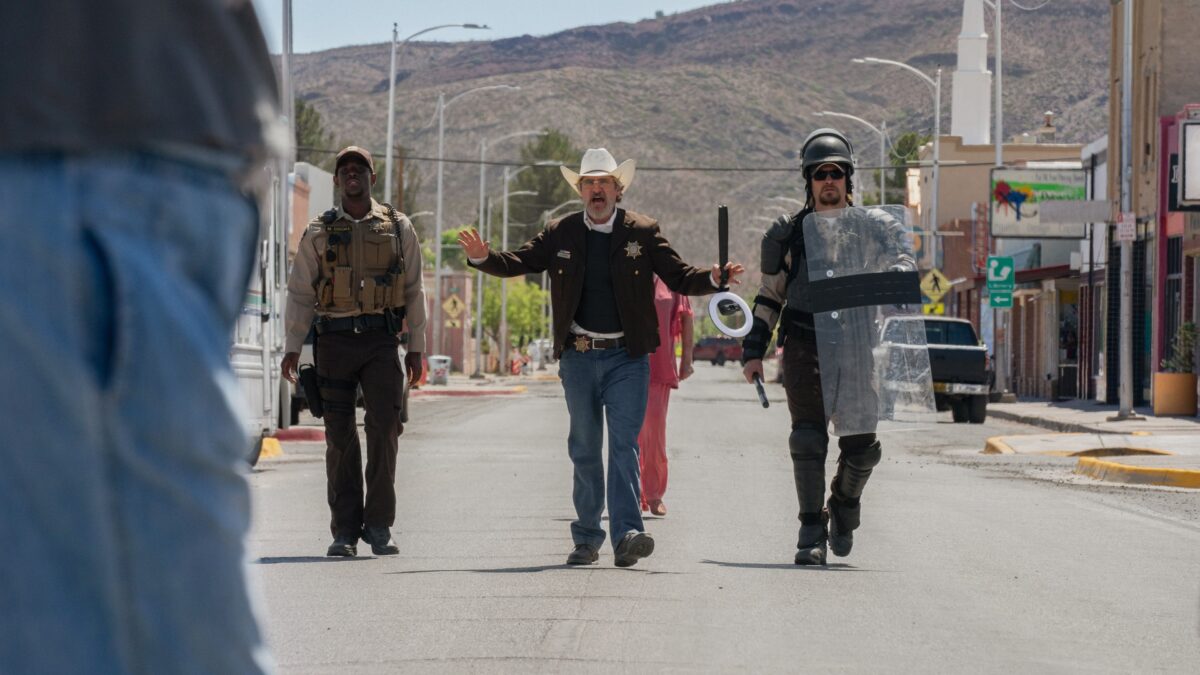
The film is set in the titular New Mexico town as it prepares for a mayoral election in May 2020, COVID lockdown and malaise in full effect. We track one candidate, Joe Cross (Joaquin Phoenix), a mask-skeptic sheriff aghast at the moral deterioration he sees everywhere, somehow missing the rot taking hold in himself. Across from him is incumbent Ted Garcia (Pedro Pascal), who has an unobjectionable personality, a professional operation, and a sane, proactive approach to public health messaging. Tensions mount as Cross’s campaigning becomes more erratic, and one night the brittle calm snaps into a hurricane of ultra-violence that takes us to the credits.
The first problem with a film that aims to literalize the tensions of lockdown into physical carnage is that the violence was already literal. Police brutality, angry protests, nasty counter-protests, and, oh right, a suffocating plague that killed millions. Damn, Ari, you’re saying that was a hard time for us? You don’t say.
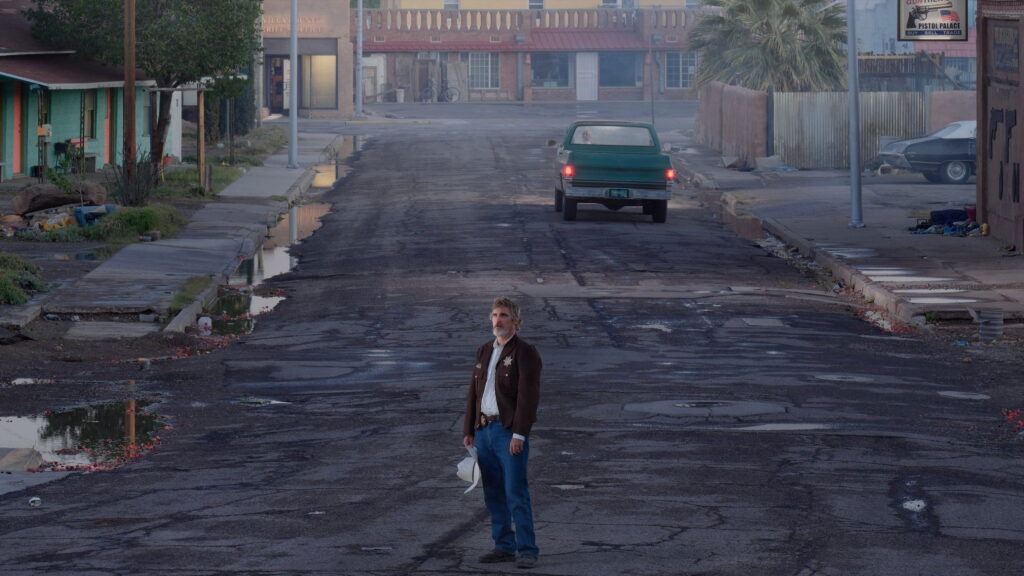
Maybe if any part of the film was organized into actual thoughts, it’d be worth engaging with. Instead it’s shrill and flop-sweaty, spewing bile in every direction. The reason nobody can agree on its politics is because it doesn’t have any beyond a baseline nihilism: brainrot is the true virus, the movie shrugs, and we’re all infected whether or not we wore a mask. Life is pointless; morality does not exist. Eddington doesn’t raise the discourse, it beats it with a baseball bat.
The narrative is flat-out busted. I’m sure Aster broke it on purpose, but intention doesn’t redeem the fracture. The movie lines up a row of semi-interesting subplots — the election campaigning, a thorny romantic history with some suggested trauma, a seductive cult leader in town possibly involved in human trafficking, a funding scheme linking City Hall to Big Tech… and then Aster flips the table so it all smashes together in one big, bloody mess. Nothing pays off, nothing interlocks, there are no provocative reversals of fortune, just self-destruction masquerading as resolution. Uncontrolled chaos isn’t clever; it’s a waste of time.
Meanwhile, a bunch of talented actors are left trying to corral the noise into something interior. Phoenix, back from Beau is Afraid, gives a more human turn but still skews so neurotic that two and a half hours in his head feels like a Herculean trial. Emma Stone shows up for something like four minutes as Cross’s disturbed wife. Austin Butler gets maybe half that. The supporting players do what’s asked and then vanish into the dust cloud, or the bloody miasma, as the case may be.
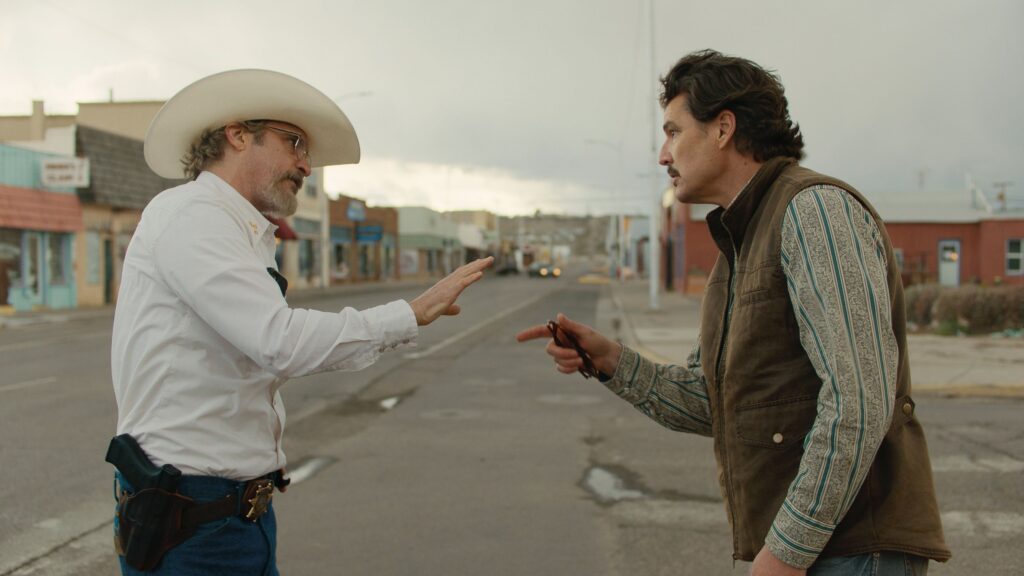
I won’t deny Aster’s fundamental directing chops. As a pseudo-neo-western, Eddington gives him a canvas to stage chases and gunplay with a nasty, credible impact. Darius Khondji, in his first pairing with Aster, frames the desert so we can practically smell the baking asphalt, and the second-half mayhem occasionally finds a brutish rhythm that almost passes for momentum. The western totems are there in twisted modern forms that might pass as clever and thoughtfully rendered if they were used for anything: You have a mystic drifter, clouds of dust, bangs from rifles, town saloons, sunset showdowns, a morally complicated sheriff, and some cowboys-vs.-Indians tension. All of that only makes Aster’s haughtiness and rudderless storytelling more aggravating: the craft keeps promising a movie that the script refuses to deliver.
I’ll even give Aster credit for sprinting headfirst into COVID trauma at a moment when most of us are anxious to move on as fast as possible. The ways that era rewired America and its people — our politics, our troubled capacity for empathy, our fizzling attention span, our appetite for conspiracies — are absolutely worth cinematic excavation. And Aster, the biggest and boldest director to go spelunking there so far, swings a very large hammer. But he doesn’t hit the nail; he wallops your toe and declares the throbbing pain the point.
So if there’s nothing to say and no story to tell, what’s left is the Ari Aster vibe check. You could say the same about Beau is Afraid, which I hated less but also bounced off for parallel reasons: too much angst, total dependence on riding his dour mood, masochistic anxiety-as-expression, and a narrative structure addicted to chaos. Gone is the carefully layered dread of Hereditary or the chilly, inside-out horror of the lugubrious Midsommar. With each of his releases I slide further off his wavelength and grow less convinced there’s a signal under the noise. But he’s going to keep blasting that empty noise at full volume, I can promise you that much.
- Review Series: Ari Aster
Is It Good?
Not Good (2/8)
Awards, Honors, & Rankings
- The B.A.D.S. (2025) - Best Needle Drop ("Firework" by Katy Perry) (Nominee)
Dan is the founder and head critic of The Goods. Follow Dan on Letterboxd. Join the Discord for updates and discussion.
2 replies on “Eddington (2025)”
Not to make you think about this more since you’ve already hit publish, but I think I started basically where you are and got more skeptical of my own conclusion of its inconclusiveness as I thought about it more. Then again, I’m more sympathetic to broad nihilism as an intellectually honest position than the average beat (thank God) even as I reject it as ultimate reality. Can’t say I disagree with too much if any of your well-wrought review.
In a vacuum, I intellectually appreciate your position. And yet everything about Eddington just puts me off it. Maybe if it had a more satisfying story payoff and not just 20 minutes of carnage to wrap the film I’d be more appreciative.
Now that I’ve seen OBAA, I think it manages to be a cynical political broadside culminating in a big violent action sequence, while still finding the core humanity worth saving and celebrating, MUCH better than Eddington does.