
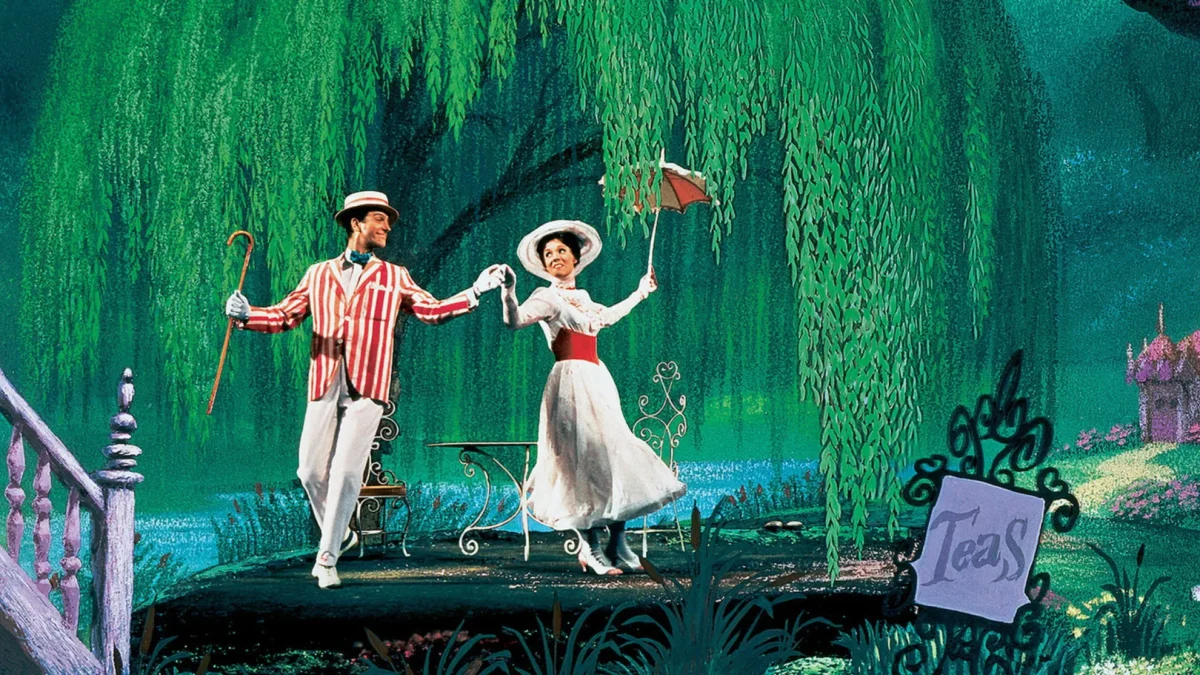
A jolly holiday
There is a version of this review where I try to explain, analytically, why Mary Poppins works. I could praise the tremendous stage-bound but bespoke production that makes London feel infinitely cozy, colorful, and whimsical. I could point to the Sherman Brothers constructing what might be the greatest collection of original songs ever assembled for a single film. I could map out the thematic architecture: the way each vignette is both a magical diversion and a different lens on the same essential argument about some mystical force guiding us tuned-in folk, some joie de vivre, that calls us to actually live our lives rather than just manage them with grown-up precision and productivity. All of that is true, and all of it is worth saying. But none of it quite captures the big picture, which is that Mary Poppins is one of those rare films where the whole is so much greater than its considerable parts that you start to feel like blow-by-blow criticism is the wrong tool for the job.
This was Walt Disney’s last great personal obsession. He spent twenty years prying the rights loose from P.L. Travers, the notoriously resistant British author who created the character, and when he finally made the movie in 1964, that hunger to tell this specific story showed. It has the feeling of a film that someone desperately needed to make; not greenlit in the usual sense, but needed. In hindsight, it reads as what cinephiles call “late style” for Mr. Disney: a heightened, unrestrained, sui generis swing full of retrospection on what the whole Disney project has been for: The spoonful of ineffable sugar that helps the medicine of life go down.
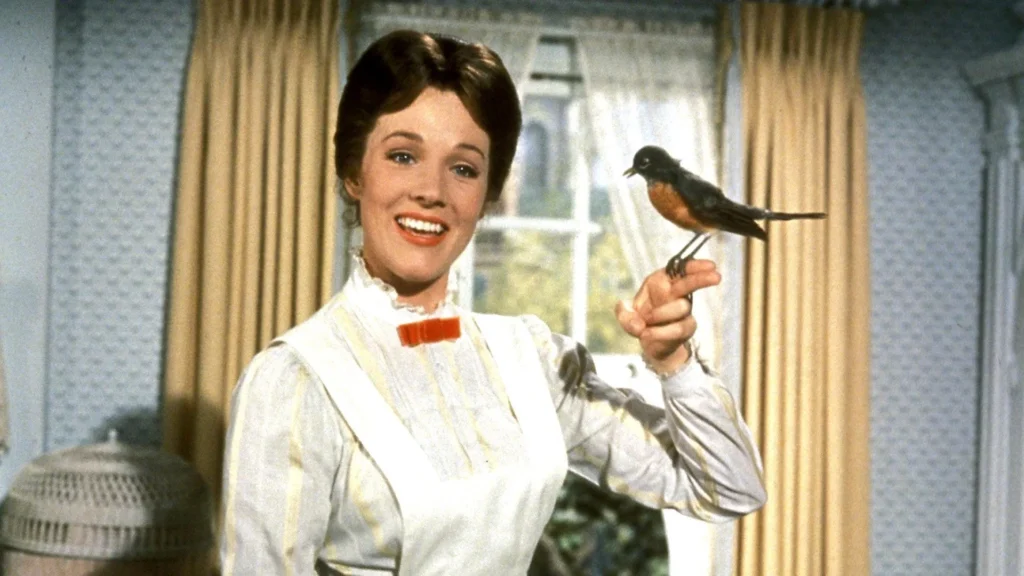
Julie Andrews, in her first film role, is miraculously good here as the titular nanny, and “miraculously” feels like the right word because the role requires something almost paradoxical. Nearly everything Mary Poppins says is stern, clipped, unsentimental — and yet Andrews makes you feel the warmth radiating out from underneath every tight-lipped correction. She’s Broadway-trained perfection whenever she opens her mouth to sing, but the real trick is what she does in between the songs. She plays the character as someone who knows, on a cellular level, what is happening in the world and that she is right in her approach, and there is something almost intoxicating in her certainty. It reads to me, like much of the film, as the exaggerated perspective of a child: a nanny so inspiring she borders on the divine and supernatural.
Dick Van Dyke takes the screen as a one-man-band / street artist / chimney sweep depending on the scene, his cartoonish Cockney accent positioned alongside actual British actors in a way that is broad and delightful. (I’m an accent truther — it’s not the atrocity that some retrospective reviewers claim.) He’s frankly as good and charismatic as Andrews, floppy-limbed and electric, and his warmth with Andrews is genuine. (The writing team of Bill Walsh and Don DaGradi, at the guidance of Disney and Travers, avoid making the pair a romantic couple except through some suggestion and throwaways.)
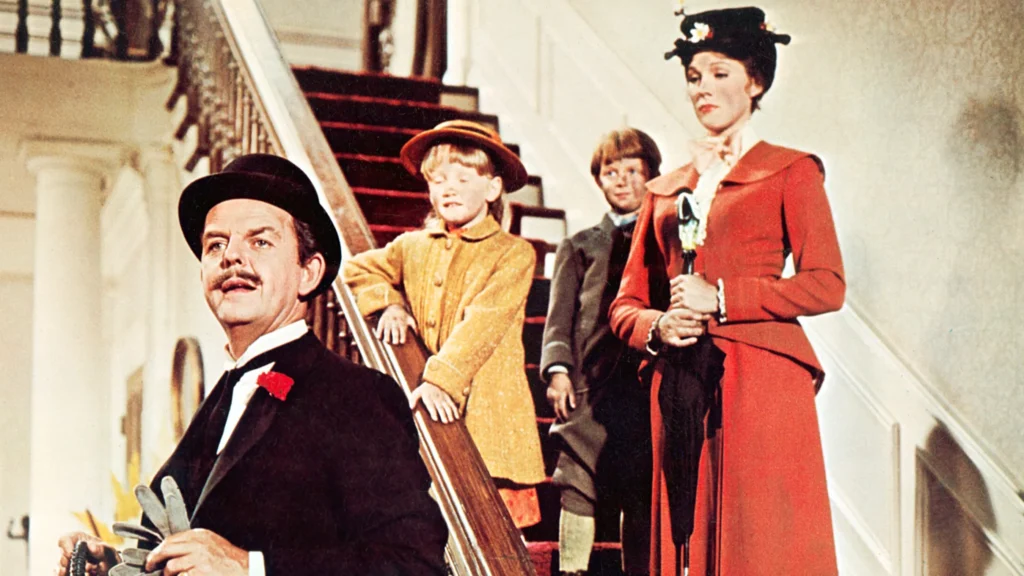
The structural strangeness and extended runtime of Mary Poppins are definitely peculiar. This is indeed a 140 minute film that starts to feel like it’s wrapping up around minute 110. But the movie hasn’t even decided who its protagonist is at that point: The film’s opening hour-and-a-half plays more like a series of connected philosophical essays than a conventional three-act narrative. Mary Poppins herself has no arc to speak of. She is perfect from go. The kids, who might have been the focus in another telling of this story, are sweet but largely along for the ride. The answer, clarified only in the film’s final act, is that their father, Mr. Banks (David Tomlinson), a buttoned-up Edwardian banker who has organized his life around productivity and prestige, is the one who needs to grow. He’s the one missing everything that Mary and Bert and the kids have in spades. The film’s episodic first half is not mere wheel-spinning whimsy, but loading the gun, thematically. When Mr. Banks finally melts down in newfound insight on living in the moment in front of the bank board, the movie earns it completely, because we’ve spent ninety minutes learning the many ways such a worldview helps you through each little adventure and tune.
The extended dive into Bert’s chalk-painting fantasy world, where live actors interact with hand-drawn animation through a process called “sodium vapor” animation, remains jaw-dropping. Nearly six decades later, it looks better than most modern effects work because it was built with artistic vision, technical innovation, and loving patience. It features two of the film’s best songs, “Jolly Holiday” and “Supercalifragilisticexpialidocious.” To some extent, the film peaks in sheer joyful energy during this stretch.
But as great as the animated interlude is, it’s “Feed the Birds,” the minor key ballad, the one Walt Disney reportedly asked the Sherman Brothers to play for him repeatedly in his final years, that brings the film to its apotheosis. It’s a song not just about finding meaning in small, overlooked gestures but centering your life on them: a few pennies for the pigeons, a moment of human connection with someone the city has passed by, a spoonful of sugar. “Feed the Birds,” one of cinema’s great tunes, sounds like a hymn because it is one.
The ending — kite strings in a blue London sky, a family stitched back together, a man who finally learned what actually mattered — is a body blow of a happy ending, yet so graceful you barely feel it. In many ways it’s the same rediscovered life finale as It’s a Wonderful Life, reframed in Technicolor and sunshine rather than capitalist angst and mortality. Where that story asks what the world would look like without you, this one asks what your life would like if you lived, really lived, every moment. The answer, here, is this: children laughing, a kite soaring, and a song carrying over rooftops. Some movies just have the answers.
Mary Poppins is one of them.
Is It Good?
Masterpiece: Tour De Good (8/8)
Related Articles
Dan is the founder and head critic of The Goods. Follow Dan on Letterboxd. Join the Discord for updates and discussion.
3 replies on “Mary Poppins (1964)”
My mother is somebody who has more or less treated THE SOUND OF MUSIC as her very own personal birthday present for many a year, so one can only hope she will never, ever find out that I prefer MARY POPPINS (No, really, my mother loves the film so much she went to a SOUND OF MUSIC party as The Baroness), which is quite possibly my very favourite Dame Julie Andrew’s film.
On the other hand, I’m not sure I don’t prefer BEDKNOBS AND BROOMSTICKS, even so: all the fun of MARY POPPINS and they fight Nazis!
Yeah, man, Mary Poppins rules. Though my favorite bit is “Step In Time.” Pretty incredible dance number.
Per Wikipedia: “”Step in Time” appears in the 2004 Mary Poppins stage musical, with a similar purpose. The main difference, however, is that Bert walks upside down on the proscenium arch.” What.
“Step in Time” absolutely rules. You loving that is definitely in line with your “musicals are really dance movies” viewpoint, as that one is a real ensemble dancing visual treat.
How is that possible though, haha.