
Yo, Adrian!
The American dream and boxing: easy to mix up. In one, you get beaten to a pulp and hope to find yourself conscious in the end. In the other, you wear boxing gloves.
Both also run on the same promise: Anyone, no matter how low they start, can get a shot at the title if they’re willing to bleed for it. By 1976, that promise was wobbling on its feet. America threw itself a two-hundredth birthday party a year after the last helicopters lifted off from Saigon and two years after Nixon resigned. Then, at the tail end of that Bicentennial year, came a scrappy little movie about a Philly palooka handed a title shot nobody thinks he deserves. Rocky sees the country’s bruises as clearly as any of its gloomy New Hollywood peers. It just refuses to stay down. It caught a nation mid-pivot, turning from post-Watergate cynicism towards the possibility of a brighter future, one shared with the people we love.
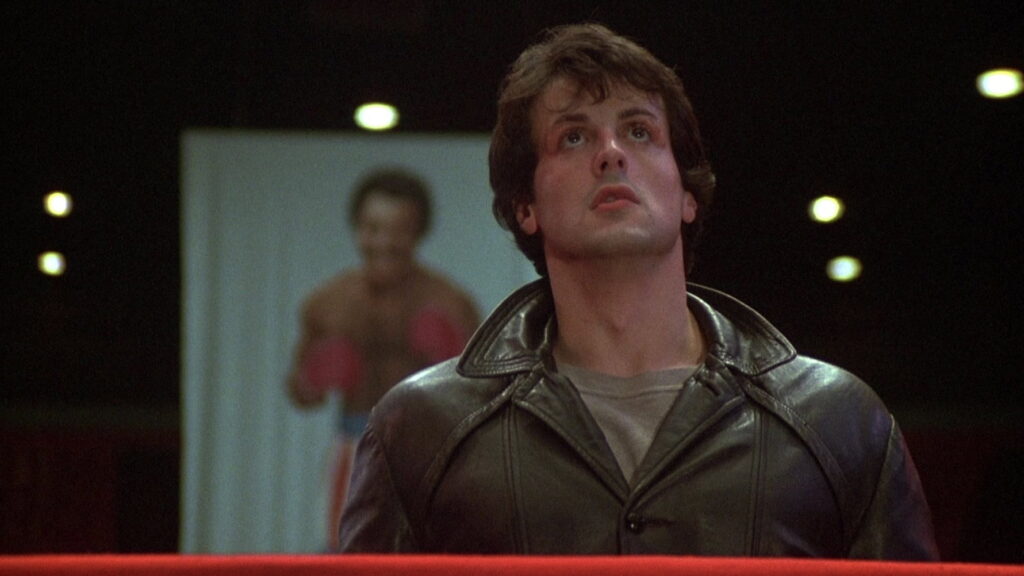
Pop culture has turned Rocky Balboa (Sylvester Stallone) into an icon of cool. He is not cool. That’s the key to the movie’s charm. Stallone plays him big, dopey, and inarticulate, a softy with a heart of gold and a faraway detachment, neither suave nor clever. He’s a journeyman club fighter who pays the rent as a loan shark’s collector, and he’s lousy at it for the best possible reason: His “save the cat” moment is declining to break a deadbeat’s thumb, since then the guy would get laid off. How would he pay?
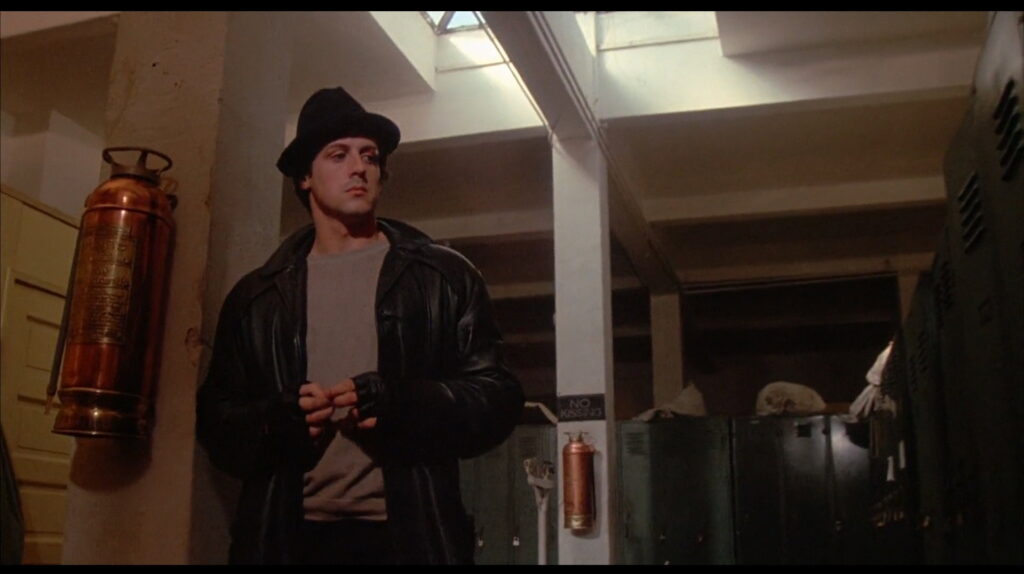
Nobody around him is cool, either: not Adrian Pennino (Talia Shire), the painfully shy pet shop clerk he’s sweet on, nor her brother, Paulie Pennino (Burt Young), a boozy meatpacker. Then heavyweight champ Apollo Creed (Carl Weathers) loses the challenger for his Bicentennial title bout and goes shopping for a local nobody, picking Rocky because he likes the sound of “the Italian Stallion.” (“Who discovered America? An Italian, right?”)
For all its inspirational power, Rocky is a gamey ’70s movie to its bones, grimy and lived-in: a gym where every surface looks stained, Philadelphia’s streets shot on location in all their wintry decrepitude. The dialogue feels half-improvised, characters ambling down sidewalks talking like actual people. Nobody’s Cary Grant lobbing perfectly formed quips; you’re living in there with them. It’s a fine companion to Elaine May’s Mikey and Nicky, another gritty portrait of Philadelphia losers released just weeks later. Neither needs a high concept. They simply shine a light on the rot, living and dying by the sketchwork of the characters.
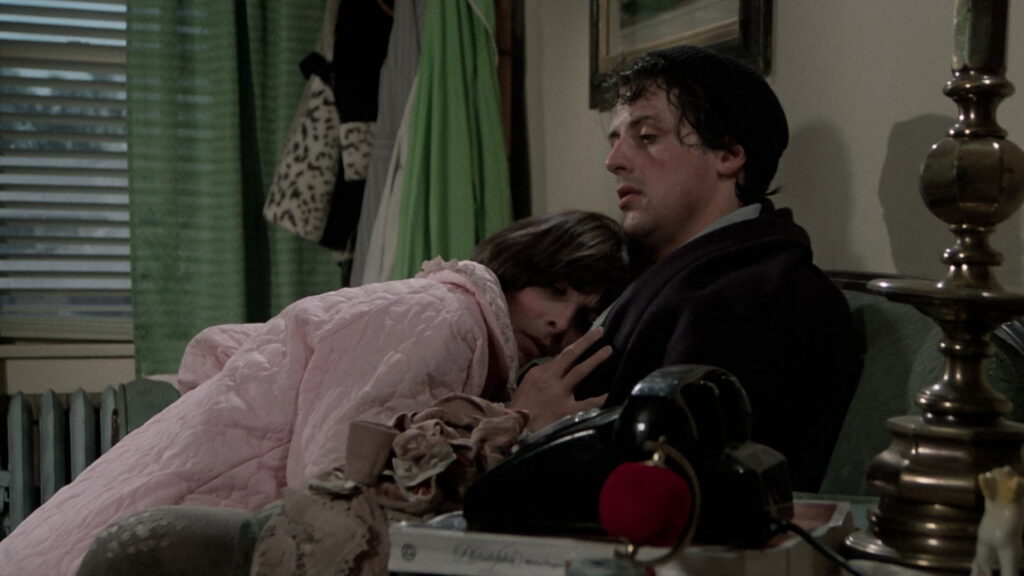
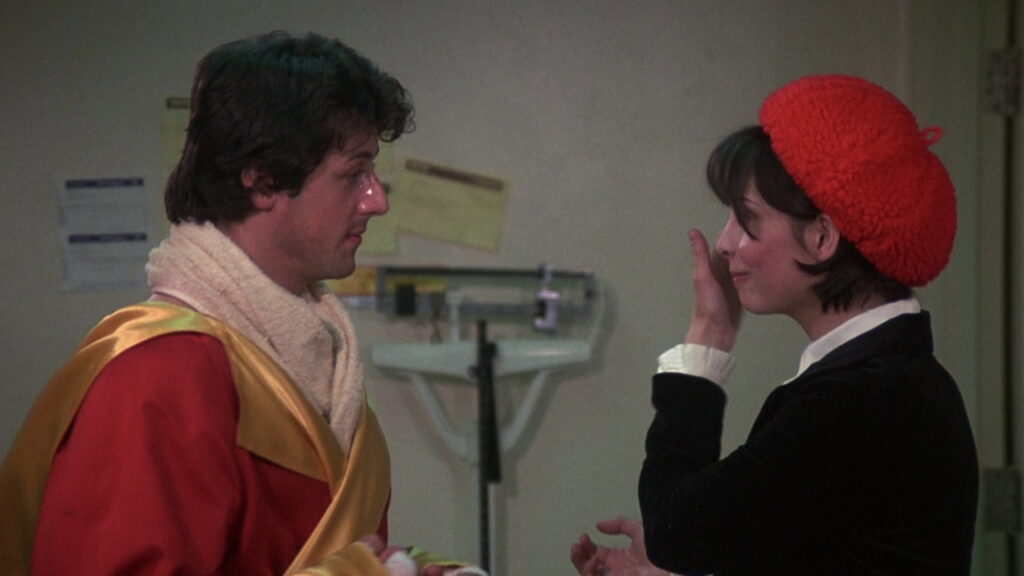
Paulie is the sourest note, a bitter drunk who calls his own sister “a friggin’ loser,” but he’s awful for a reason. This is a movie about people stuck in a low place, and how some find dignity there while others never will. Adrian finds hers. She can barely make eye contact, wary of the world and especially of men. Rocky is persistent, and the film treads a careful line, making it plausible he’d crack her shell without letting him become a pushy creep. He sees the beauty in her before she does, and Shire plays Adrian as a slowly unfurling enigma.
Their first date is a small marvel: Thanksgiving night at a closed ice rink, where Rocky slips the attendant ten bucks for ten minutes on the ice. The script originally sent them to a diner, which director John G. Avildsen found “really boring.” He pushed for a skating rink, and with no budget to fill it with extras, the rink ended up deserted. “It’s so much sweeter and unique that way,” Avildsen said later, and he’s right: two lonely people with an entire rink to themselves. I didn’t expect a boxing movie this romantic.
If anyone here is cool, it’s Apollo. Weathers plays him as a fascinating blend of collected savvy and performative provocation. Every room he’s in is crowded with his entourage and management, cultivating his image and controlling his brand. He’s a showman who arrives dressed as George Washington, a race-swapped founding father four decades before Hamilton, then sheds the wig to reveal an Uncle Sam getup. The film remixes the up-from-nothing minority story: The institution at the top is Black, the nobody clawing up from the bottom is white. Apollo is an obvious riff on Muhammad Ali, and many critics have read the film as a salve for white working-class resentment following the civil rights era. Ali himself later said America needed “a white image on the screen, to counteract my image in the ring.” This interpretation has more than a kernel of truth to it, but to dwell too much on the movie’s depiction of race would be an ungenerous reading of a film that never makes Apollo a villain. Rocky’s defining traits are his outsider loserdom and working-class roots, both agnostic to skin color.
Rounding out the core crew is Mickey Goldmill (Burgess Meredith), the crusty gym owner who’d written Rocky off but now comes around, hat in hand, to whip him into shape. Meredith gives a scene-stealing, blustery performance. He set a new standard in the crotchety-trainer archetype, the Phil to Rocky’s Hercules.
Cue the montage. When I considered the concept of “montage” in my review of Sergei Eisenstein’s Strike, the first example I reached for was Rocky prepping for Apollo as Bill Conti’s “Gonna Fly Now” blares. The sequence runs on the principle Soviet montage was built on: The cut between two images creates a meaning neither holds alone. One-armed push-ups. Bare knuckles on frozen beef. A rail yard at dawn, the Italian Market, the riverfront. Separately, they’re a guy working out; cut together, they’re a working-class city carrying one of its own towards the top. Shoutout to editors Richard Halsey and Scott Conrad, who justifiably won an Oscar for work like this.
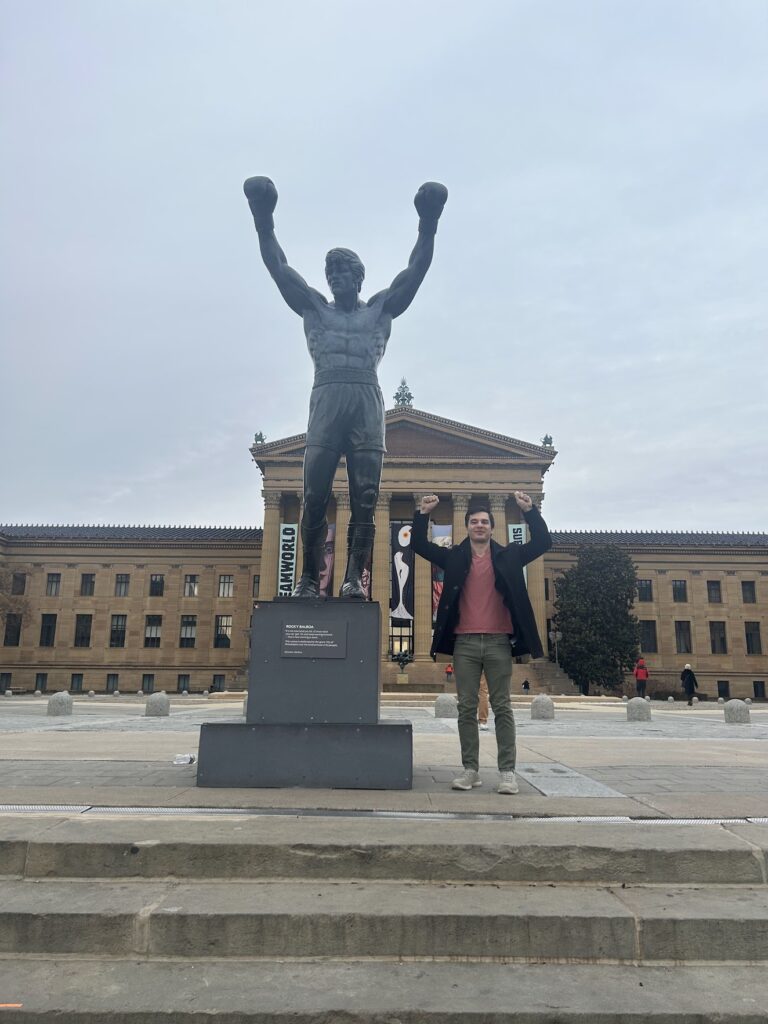
The training climaxes a long, gliding shot that keeps pace as Rocky builds from a jog to a flat-out sprint, and Garrett Brown’s newfangled Steadicam follows him up the Philadelphia Museum of Art steps to the arms-raised pose every tourist has imitated since. (Guilty.) The movie didn’t invent the training montage, but it crystallized the form. Every sports movie since has operated in its wake, either borrowing the technique or pointedly steering clear of the now-cliched trope.
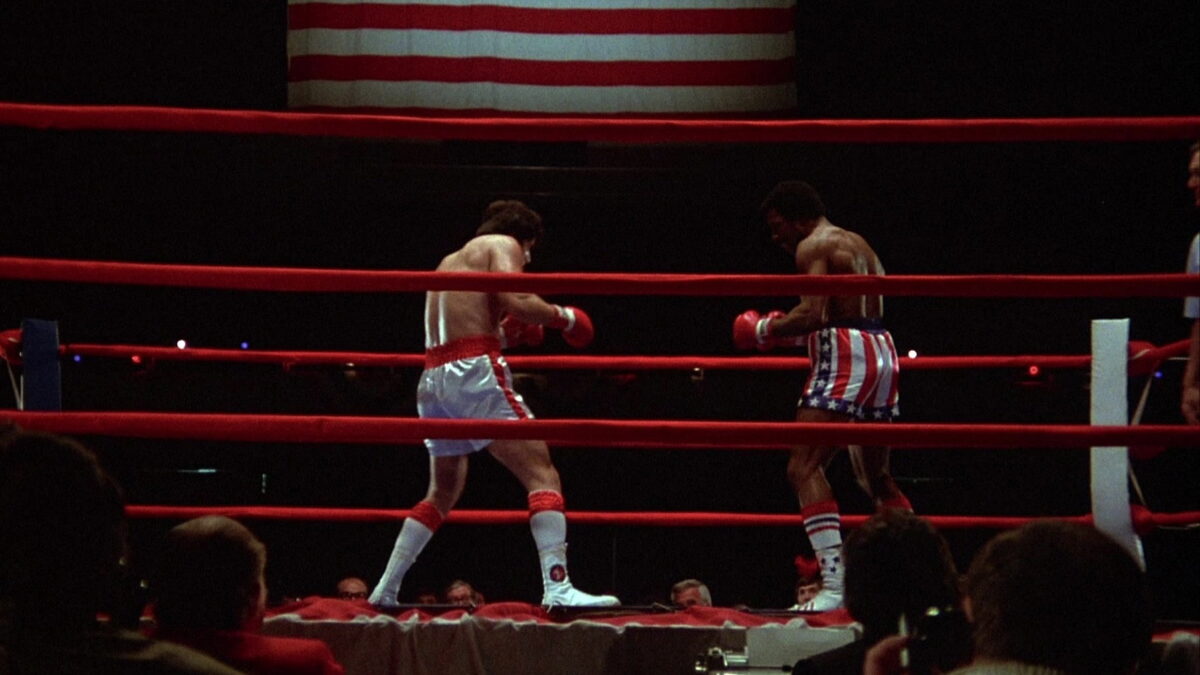
The title fight is brutal. I’ve never been sure whether boxing is ballet or just one slab of meat pounding another until he stops getting up; this is no ballet. Where it really gets you is between rounds, when the makeup department convinces you both men have had their faces bludgeoned to putty. When Rocky’s eye swells shut and he demands “Cut me, Mick!” I did a full-body, horror-movie shudder. Read into it what you will, but right there is the American dream, beaten to a pulp: We put ourselves through the meat grinder (almost literally, here) to achieve something in this accursed, wonderful nation.
And then the movie makes the perfect choice that turns Rocky into a classic. Nine times out of ten, a sports movie lets the hometown hero win. But Rocky loses. The night before, he tells Adrian he just wants to go the distance, because if he’s still standing at the final bell, “I’m gonna know for the first time in my life, see, that I weren’t just another bum from the neighborhood.” He goes the distance. “Ain’t gonna be no rematch,” Apollo tells him. “Don’t want one,” Rocky says, and as the split decision goes to the champ, he’s too busy screaming for Adrian to care. The boxing was never really the story; the story is who he’s going to spend his life with. It’s a terrific ending: bittersweet and romantic, with its chin up as the credits roll.
Stallone is why all of this works, twice over. As an actor, he’s no Brando, but his mumbly, puppyish style is exactly right. He is Rocky. But it was his other credit that impressed me more. As a writer, he’s the real deal: He banged out the first draft in about three and a half days after watching Chuck Wepner, a journeyman called the Bayonne Bleeder, knock Ali down and come within nineteen seconds of going the distance. (Stallone has disputed this origin story, but it fits perfectly.) It’s an excellent screenplay, its characters so sharply drawn you know them within a scene yet always part of a living, human world. The double duty earned him nominations for Best Actor and Best Original Screenplay, making him only the third person ever to land both for the same film, after Charlie Chaplin and Orson Welles. Not bad company for a bum from the neighborhood. Stallone refused to sell the script unless he could star in it, and it’s poetic that it landed at United Artists, the studio Chaplin co-founded so artists could control their own work.
Avildsen’s Best Director win is the shakiest of the film’s three Oscars. The montage and Steadicam work set standards, but scene to scene his direction is sturdy rather than virtuosic. If nothing else, Avildsen gets out of the actors’ way.
This brings us to the elephant in the ring. Rocky won Best Picture over All the President’s Men, Network, and Taxi Driver, a legendary gauntlet, and I’m not convinced it’s the best of the bunch. So why this one? Because its rivals capture a country on the ropes, and Rocky is the one that answers the bell, affirming the dignity of trying and of leaning on the people around you.
So, yes, Rocky is good, but is it great? If there were only one Rocky and I stumbled onto it on TCM, I’m not sure I’d use the word; part of the movie’s charm is that it’s too low-key for a word like “great.” But context matters. Rocky laid the template for fifty years of sports movies. It’s a metaphor for itself, a low-budget underdog that became the year’s top grosser and a Best Picture winner. And the saga it spawned (I binged all nine films in a week) enriches it in retrospect. Rocky didn’t just go the distance. Half a century later, it’s still standing.
Is It Good?
Exceptionally Good (7/8)
Related Articles
Dan is the founder and head critic of The Goods. Follow Dan on Letterboxd. Join the Discord for updates and discussion.
One reply on “Rocky (1976)”
A physical ailment alters how a person perceives such striving. Crisp Stream