
Black tie affair
Alfred Hitchcock is messing with us from the opening frames of Frenzy. It begins with a long and magisterial helicopter shot of London, gliding over the Thames and Tower Bridge before zooming in on some good old-fashioned hustle and bustle on the riverbank. Ron Goodwin’s score is swelling and almost jolly. A politician is mid-speech, assuring the crowd that “pollution will soon be banished from the waters of this river.” And then the naked corpse of a woman, bare and blue ass front and center, floats into frame, strangled with a necktie. Welcome home, Hitch.
This sets us up for the central, very uncomfortable tension in Frenzy. For one, Hitchcock is returning to his British filmmaking roots and sensibility; it’s his first film shot entirely in Britain since Stage Fright. We’ve seen in that film, among others, that Hitchcock tends to let his whimsical sense of humor and distinctly British peculiarities emerge whenever he sets and shoots a film in England. It is not a matter of simply moving a filmmaking unit from one city to another, but a total sublimation of cultural values, language, and especially sense of humor. Indeed, Frenzy is one of Hitchcock’s more blatantly comic films, with a few moments of downright broad gags. An extended conversation at dinner in which Chief Inspector Oxford (Alec McCowen) tries to avoid eating the disgusting gourmet experiments of Mrs. Oxford (Vivien Merchant) — slimy fish soup, a tiny overcooked quail — feels like it could be in a sitcom. And several portions of the plot have a comedy-of-errors cadence, one thing going wrong after another. The central image — a naked corpse wearing a fancy necktie — tells an ironic story on its own.
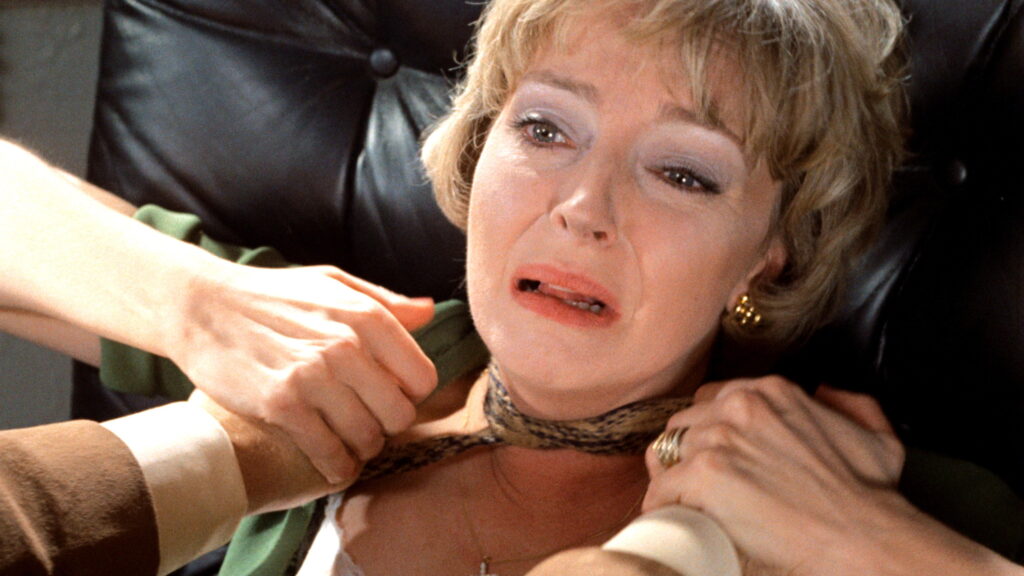
But I don’t want to be accused of burying the lede, because I don’t think most people remember Frenzy first and foremost for its comedy. No, what most stands out is how seedy and explicit it is. In his time, Hitchcock was known as a purveyor of cheap thrills and violence, and some of his movies, including Psycho, broke new ground in how dark a mainstream, prestigious film could get. But compared to Frenzy, Psycho looks like an episode of Paw Patrol. Frenzy features multiple instances of nudity, including in the context of sexual violence and sadism. One of its signature set pieces involves a serial killer snapping the bones of his recent victim. Hitchcock had been so good at using suggestion, innuendo, and careful concealment throughout his career, allowing us to imagine evil deeds more often than we see them, that Frenzy’s cruelest moments had me flabbergasted that I was seeing what I was seeing. It’s not the smuttiest or most violent film of its era — indeed, if you’re well-versed in any true pieces of exploitation, you might wonder what the fuss is — but in the context of this filmmaker and his continuing mastery of suspense and control of our attention, it has more impact than many films that surpass it in graphic content.
And so those are the two modes in collision in Frenzy: Hitchcock at his most British, comic, and idiosyncratic, and Hitchcock at his most searingly brutal. It is not a matter of alternating between them and wondering which mode will win out, but of both existing in abrasive, compelling tension at the same time. (Case in point: Oxford describes over dinner how the killer “had to break the fingers” of a corpse while Mrs. Oxford noisily crunches a breadstick.) As such, I think Frenzy works best as a Hitchcock deep cut, one that plays with some of his greatest hits of narrative and thematic preoccupation, but in new and provocative tones, with some visual ideas and, frankly, boundaries pushed that make it stand out as a curiosity in his filmography.
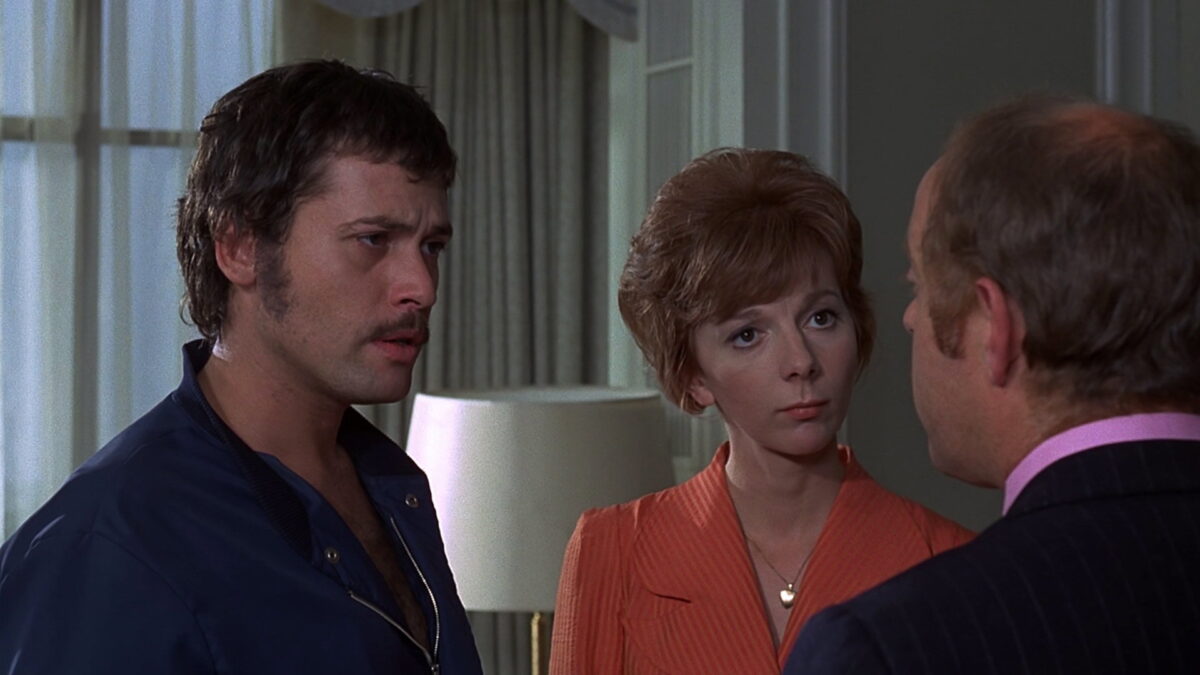
London is in the grip of the “Necktie Murderer,” a “sex killer” who strangles women with his tie. Richard Blaney (Jon Finch), a hot-tempered former RAF squadron leader, gets sacked from his bartending job near Covent Garden. When his ex-wife Brenda (Barbara Leigh-Hunt) is found strangled in her match-making agency a day after the two were overheard rowing, Blaney becomes the prime suspect and goes on the run with his girlfriend, barmaid Babs Milligan (Anna Massey). Also in his corner: chummy pal Bob Rusk (Barry Foster), a Covent Garden fruit merchant. Hitchcock tips his hand early, though: the cheerful Rusk is the Necktie Murderer, making Frenzy less a whodunit than a wrong-man thriller marinating in poisonous dramatic irony.
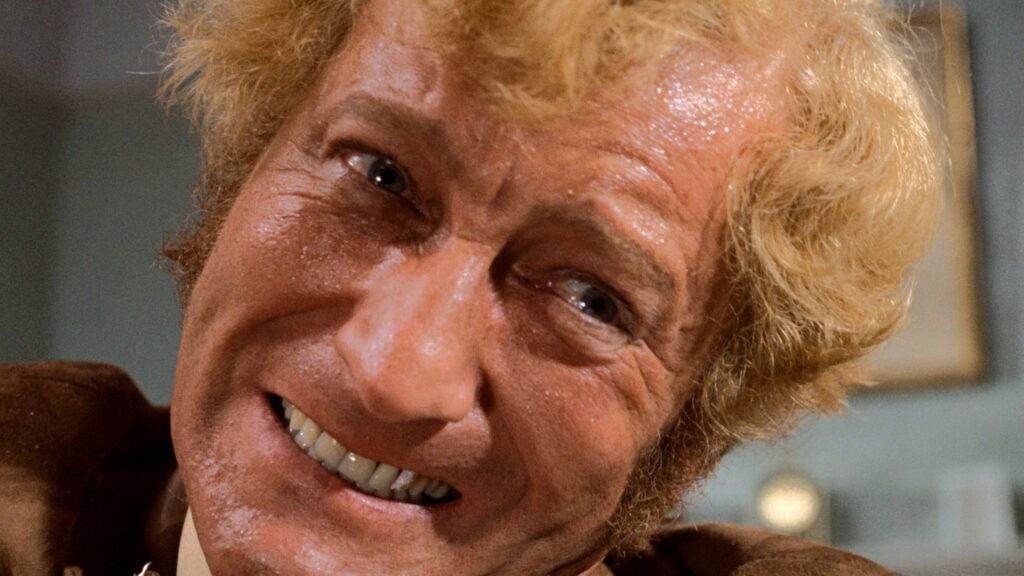
What really stands out about the film and makes it distinctly Hitchcockian is the attention and cinematic savviness he pays to each of its key moments, using visual language as well as writing and acting choices to convey both story detail and observations about human nature. The rape-murder scene that reveals Rusk as the killer plays not as a kinetic bit of violent thrashing but as a degenerating, dissociating experience: Rusk repeats “lovely, lovely” like a man hypnotizing himself, while Brenda retreats into the 91st Psalm. The grotesque images at the scene’s climax — Brenda’s tongue lolling from her lifeless face, Rusk taking another bite of her half-eaten apple and picking his teeth with his tie pin — are all the more chilling because this isn’t just mere havoc. It’s almost transactional and routine, sexual violence and imbalance unpunished.
A bit later comes the famous and remarkable shot where Hitchcock shows us nothing at all. Rusk leads Babs up to his flat and trots out the line he used on Brenda: “You’re my type of woman.” The door closes, and the camera backs away in one long, unbroken retreat: down the stairwell, out the front door, and into the bustle of Covent Garden, where passersby go about their business, oblivious. It’s a stunner. Having made us watch everything once, Hitchcock doesn’t need to show a second murder: we know exactly what’s happening behind that door, and our imaginations do the dirty work. The master of concealment reasserts himself in his least concealing film, the camera slinking away like a bystander who’d rather not get involved.
The potato truck sequence that follows fuses the film’s two modes into one gnarly set piece. Back home, Rusk realizes his tie pin, a signature item of his wardrobe, is missing: Babs tore it from his lapel in their struggle, and now it’s clenched in her dead hand inside a sack of potatoes on a lorry bound for Lincolnshire. Cue a slapstick nightmare: Rusk burrowing through sacks in the back of the moving truck, getting smacked in the face by the corpse’s leg, coated in potato dust, and finally snapping her rigor-stiffened digits to pry the pin loose. It’s horrifying, and it’s also, God help me, grotesquely funny. As with Norman Bates’ cleanup in Psycho, Hitchcock has us anxious on the killer’s behalf.
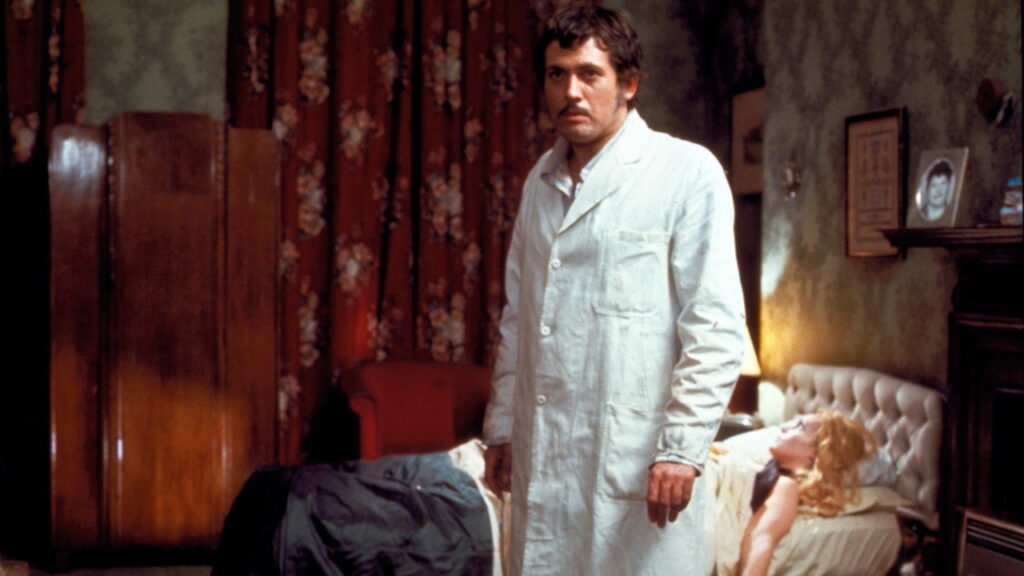
Where the movie fails to elevate is its ending, which relies on a major bout of coincidental timing and an undercooked prison escape. Blaney, convicted and imprisoned, throws himself down a flight of iron stairs to land in the prison hospital, where fellow patients help him slip sleeping pills into a guard’s tea, and in no time he’s hot-wiring a car. Then the key players converge on the same room within moments, the climax arriving by convenience rather than the slow-tightening knot Hitchcock ties so carefully elsewhere. The last line is a perfectly dry punchline (not too far off, in spirit, from “The Aristocrats!”), I’ll grant, but getting there feels like Hitchcock checking his watch after he got past the bits he was most interested in.
Frenzy has a look all its own. The production design and fashion are a blend of mod and grimy street life. Everything about the style screams British, including the look of the cast and the thick accents and slang they toss around. Finch’s Blaney is an especially rough-edged hero, a bit of a jerk and a loser even when he’s sympathetic and has good instincts. When old RAF mate Johnny Porter (Clive Swift) lets him crash to hide from the cops, Blaney goes off on him the next morning because Johnny, cowed by his wife Hetty (Billie Whitelaw), won’t put his own neck on the line to provide an alibi.
While Hitchcock’s work has always had a complex relationship with women, often subjecting them to terrors but giving them a fair share of dignities and complexities, Frenzy is the first film of his that really feels mean-spirited towards the fairer sex. Though the film offers its women several substantive roles, almost all of them end up either unpleasant nags — like Hetty, who hounds Blaney for things he didn’t do — or raped and murdered — like Brenda, defiled and killed in slow motion. Even Mrs. Oxford, who correctly doubts Blaney’s guilt well before her husband does, is mostly a punchline about inedible cooking. Babs is plucky, loyal, and courageous, until she’s disposed of as a convenient plot device, too. I usually give Hitchcock the benefit of the doubt on his gender politics because his women are so often brave and developed with nuance and depth, even when they’re put through the wringer, but this one is just nasty: when a barmaid asks whether the killer rapes his victims first, a customer quips that “every cloud has a silver lining,” and Hitchcock plays it for a laugh.
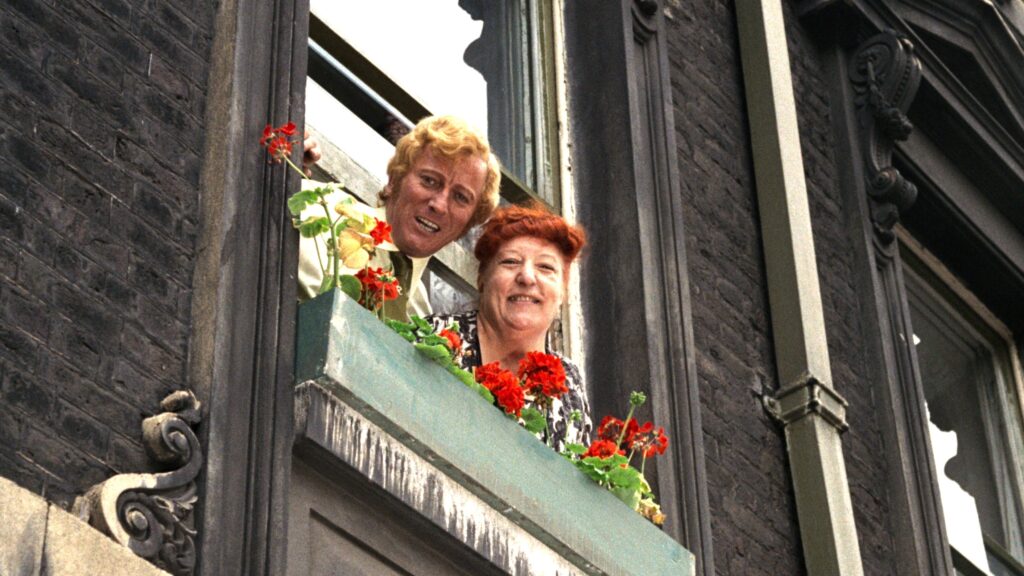
Frenzy isn’t top-shelf Hitchcock, and it isn’t always pleasant company. I’ve written before that Hitchcock has three filmmaking gears: coasting, locked-in, and getting weird. Frenzy grinds through all three, but its heart is in the third: brutal and broad, mean and mordantly funny, often in the same breath. It’s not the Hitchcock I’d hand to a newcomer, but for those of us Hitch-heads deep in the filmography, it’s a thorny, fascinating deep cut, proof the old master still had a few nasty surprises to float up out of the Thames.
Is It Good?
Good (5/8)
Dan is the founder and head critic of The Goods. Follow Dan on Letterboxd. Join the Discord for updates and discussion.