
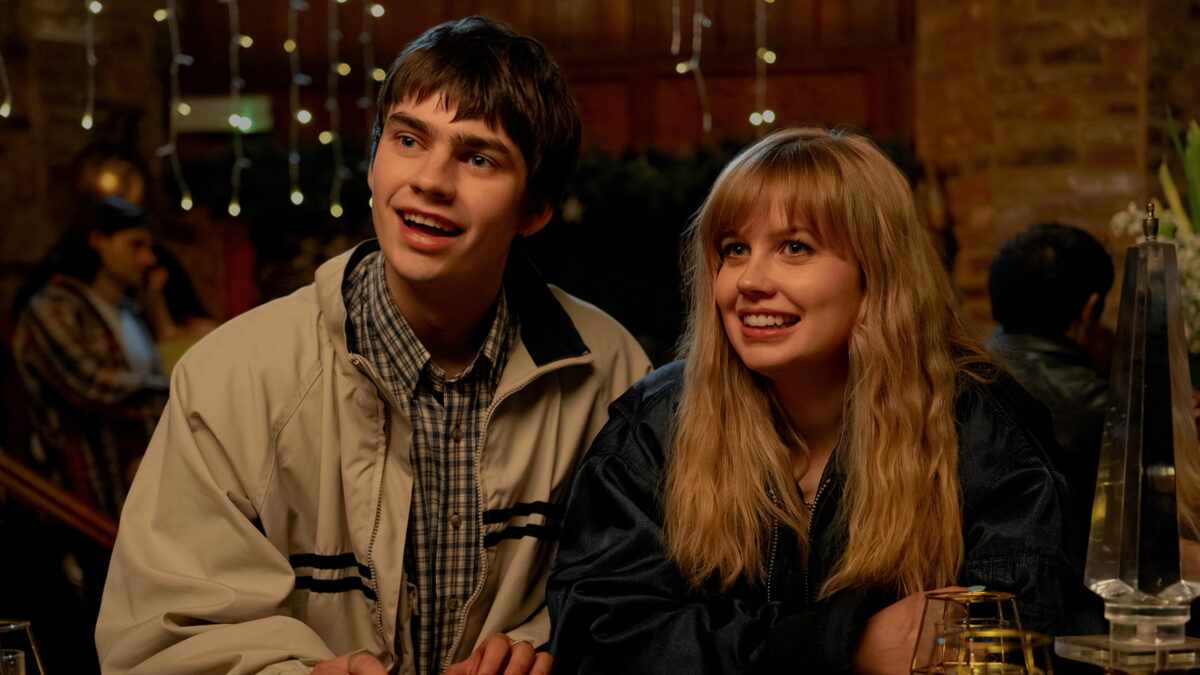
Hey, I just met you, and this is crazy
Finding Emily has a thesis about love, both literally and narratively: One of the two leads is writing a research paper on romance. Her argument: Romance causes us to do stupid, delirious, and self-sabotaging things. The movie built around her agrees, but then argues that love is still probably worth it anyways. It’s a damn lovely film for most of its runtime.
The setup is a fun high concept. Owen (Spike Fearn) runs sound at the student union bar of the fictional Manchester City University and has a great night out with a girl who gives him her first name, Emily (Sadie Soverall), and a phone number with a typo in it. So begins a Cinderella quest: scour every Emily on campus until one fits the slipper. The first false Emily he bumps into is Emily Raine (Angourie Rice), the psychology student writing that thesis, and she offers to help him find his true Emily, never mentioning he’s now her research subject. You can probably guess 90% of the story from that alone.
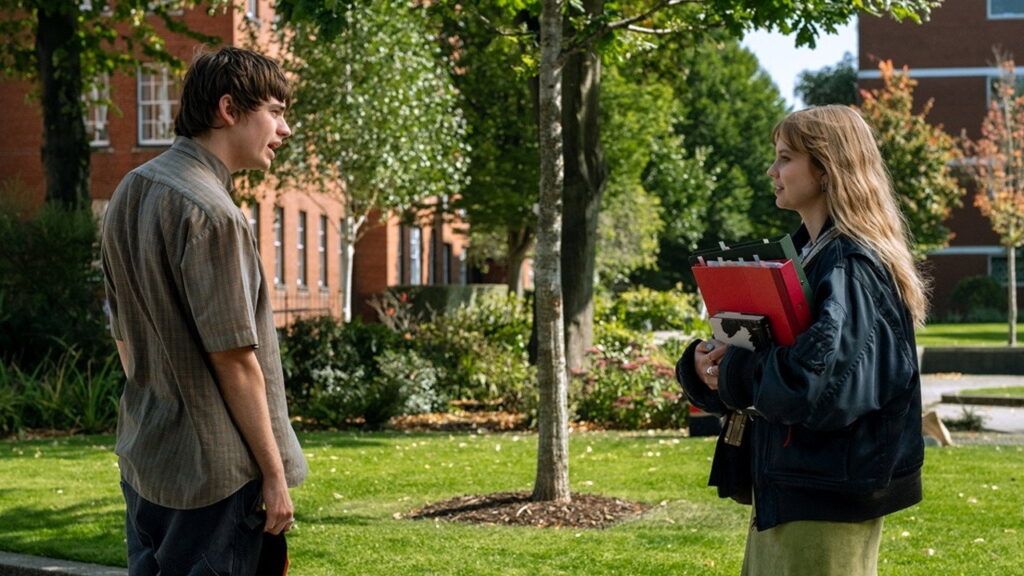
The film quickly finds a groove doing what a romcom ought to do: exploring the chemistry between its characters, the ways they’re similar, and, more importantly, the ways they’re different and can grow from each other: Owen tempering his romanticism with reality, and Emily vice versa. All of it flows naturally from the premise and from what Fearn and Rice offer, two delightful performers in easy sync.
Then the second half arrives, and the film ramps its high concept higher and higher until it’s juggling satire of social media, cancel culture, and toxic masculinity, pushing its story beats to farce levels of misunderstanding and contrivance. It’s not a total trainwreck, but it’s a mismatch of expectation set in the first half. None of the extra story material surrounding his Emily hunt works as well as the core romantic comedy material. The film thankfully never abandons the fundamentals: the romance and the comedy between Owen and Emily. But I can’t help but wonder if we were robbed of an upper-tier romcom if first-time feature director Alicia MacDonald and writer Rachel Hirons had trimmed the plotting escalations and given their couple some space to breathe and grow.
My favorite aspect of the film is the flavor and texture of its Englishness. Fearn’s Manchester accent is so thick that it’s sometimes hard to make out what he’s saying, like he’s a lost Gallagher brother, and yet it registers as endearing and scruffy rather than alienating. I was grateful, too, that Rice plays unabashedly American without the whole affair devolving into a fish-out-of-water story. (Sometimes when movies are too British it can feel like I’m visiting an alternate dimension where they speak my language but don’t really speak my language; see: Rye Lane.) It’s a really nice flavor.
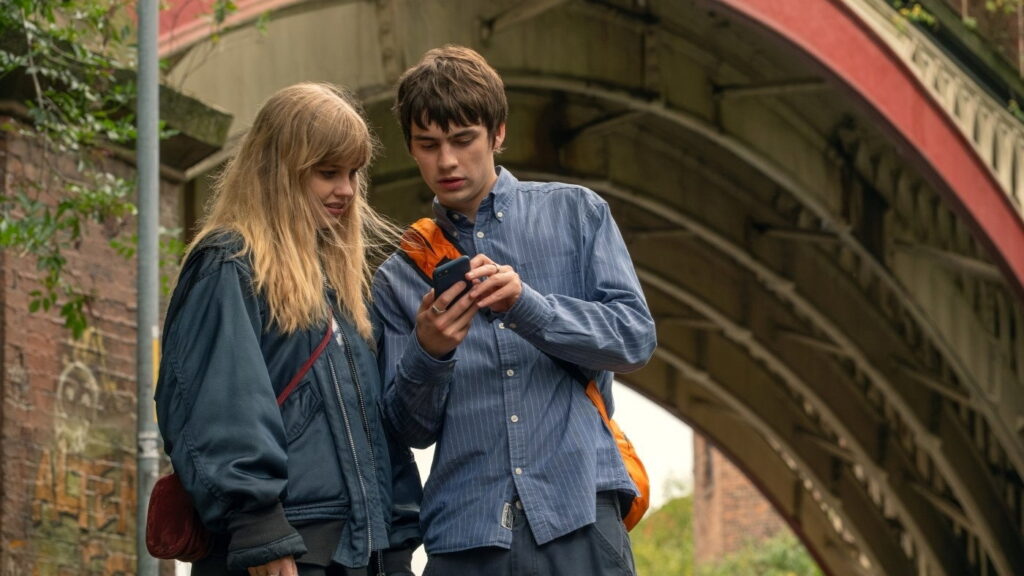
Many of the film’s instincts are excellent. It uses music very well: “Blue Monday,” “Bad Guy,” “Call Me Maybe,” and more all enhance key scenes and turning points without abusing needle drops as a shortcut for emotional engagement the way some films do (see: Voicemails for Isabelle). There’s something comforting about a Manchester movie leaning on New Order. The pace never lulls too badly even with a runtime creeping toward two hours, and the tone is seductively congenial, which is why I find the second-half plotting and satire swings so baffling.
The casting is strong all around. Rice is gradually becoming a destination-programming actress for me whenever she’s a lead; when I saw Honor Society I hoped it portended her rising stardom, and here we are. (I guess I really do need to finally watch the Mean Girls musical.) She has a natural, disarming warmth and keeps choosing flawed, prickly characters that push against her natural demeanor; the net effect reads as witty and complex rather than bland.
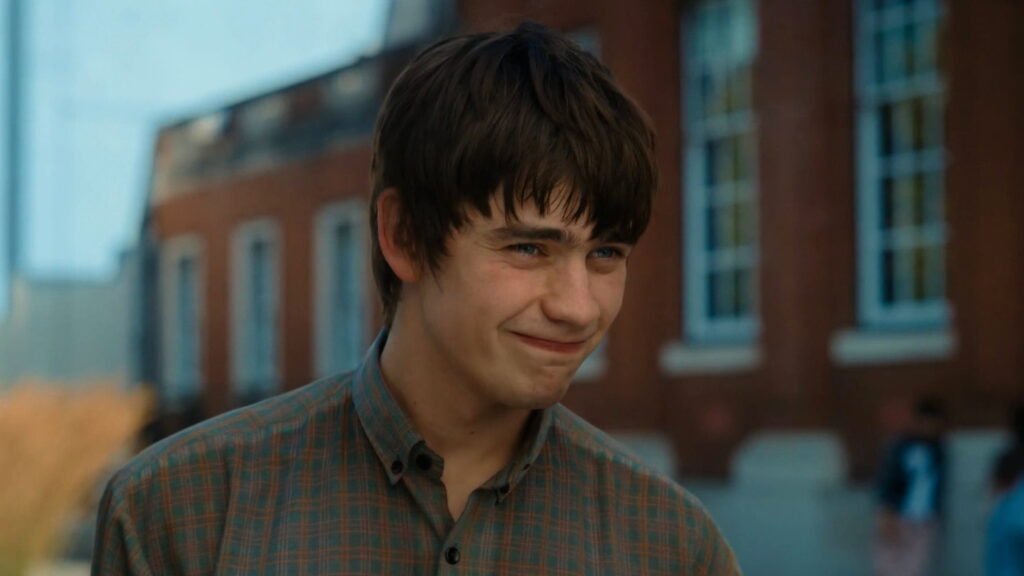
The real breakout, though, is Fearn, who previously had a small role in Aftersun. He does a little bit of everything here, and all of it well: mope romantically, deliver a punchline, execute some physical comedy, deliver a sincere monologue, bat goo goo eyes. He sings once or twice and has rapport with everyone else in the cast. He’s one to watch; it’s basically impossible not to smile when he’s on screen.
If the story is overstuffed, so is the cast. Both Owen and Emily drag around an orbit of uninteresting friends and companions, several of whom get their own subplots, and it’s a little too much commotion for too little payoff. My favorite of the bunch is Professor Westlake (Prasanna Puwanarajah), Emily’s dead-eyed and depressed thesis supervisor, doing an impression of John Oliver’s professor from Community. Minnie Driver has a small turn as a college dean, and I’m not objecting to that, either.
As the film escalated through the satirical beats of its too-long back half, I felt my goodwill start to wane, but it never fully drained. Finding Emily is a real charmer, a pleasing and rewarding romantic comedy built on two wonderful leads, and that’s no small achievement: It’s enough to place it among the year’s more purely enjoyable films. Her thesis was right all along: romance is a delusion we talk ourselves into. I talked myself into this one, and gladly.
Is It Good?
Good (5/8)
Dan is the founder and head critic of The Goods. Follow Dan on Letterboxd. Join the Discord for updates and discussion.
One reply on “Finding Emily (2026)”
I keep hoping that if there’s ever a NICE GUYS 2 the plot is basically a complete inversion of the classic “My daughter has fallen in with a bad crowd” Action Movie plotline (With the eponymous ‘Nice Guys’ getting in so very, very over their head it requires a Young Lady Detective spend a whole movie working out how to get all three of them out, though I’m not sure if it’s more entertaining to have this happen onscreen or offscreen – perhaps Our Heroes get so hip deep into trouble in the first place e because they’re being baited in with the suggestion that Something Has Happened to Holly).