
Goodie Bag is a new, possibly recurring format of collected capsule reviews on a theme. Goodie Bag selections are all candidates for future full-length reviews. If you have any feedback on this format or preferences for what kinds of reviews I publish, please let me know in a comment or by emailing me at danstalcup@gmail.com.
My podcast co-host Brian and I recently appeared on the Alternate Ending podcast for its witch episode, The Podcast: Witches, a great full-circle moment for me: Alternate Ending’s podcast was a big inspiration for The Goods: A Film Podcast, and the writing of Tim Brayton, the critic who publishes on Alternate Ending’s web site, is a major inspiration for my own film reviews. We spent much of the episode trying (and failing) to define what a witch even is as we discussed many of cinema’s depictions of witchcraft.
In preparation for that episode, I caught up with several witch-associated movies, and watching them back to back, a pattern jumped out at me: Given that witches are almost always women, the films about them are very often about gender and sexuality; and about the men (and churches, and neighbors) who would very much like to keep women in line. That thread runs from Day of Wrath’s quiet feminism straight through to The Love Witch, which drags the subtext outward. Here are some mini-reviews of what I watched:
Day of Wrath (1943)
Is It Good? Exceptionally Good (7/8)
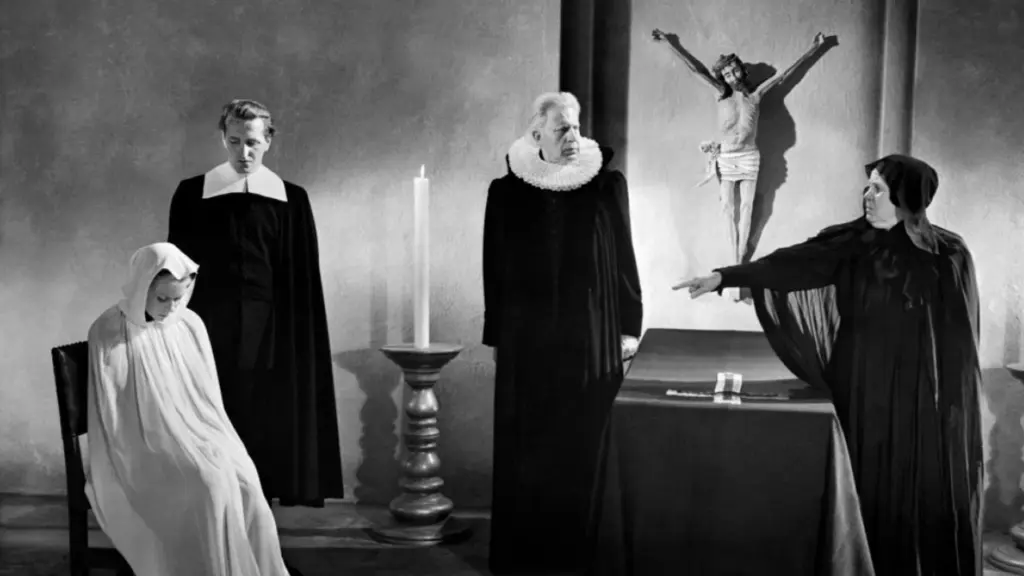
Day of Wrath is a strong candidate for the best movie about witchcraft, or, at least, alleged witchcraft. This period piece about a witch craze in a Danish village in the 1600s was filmed during the Nazi occupation of Denmark. As such, an unrelenting sense of oppression and injustice accompanies the film. (It makes a good companion piece to Häxan, the witchcraft essay film that fellow Dane Benjamin Christensen made two decades earlier.)
Directed by cinematic titan Carl Theodor Dreyer, the film is textbook European art cinema: It is so precise, patient, and still in its observation that it occasionally feels stiff. But it is truly marvelous as drama, with rich and surprising characterization, and a steady, doomed arc for its characters. It’s also a feminist and anti-fascist commentary without ever beating its themes’ drums.
The film follows a priest organizing the local witch-burnings, Rev. Absalon (Thorkild Roose); his young wife Anne (Lisbeth Movin), whose mother was accused of witchcraft but spared in exchange for Anne’s hand; and his son Martin (Preben Lerdorff Rye), who falls in love with Anne. Anne and Martin’s connection grows stronger as the flames of the witch craze climb higher and higher.
Day of Wrath is an immaculate achievement. For a slow, talky film, it is always engaging. It’s gorgeously produced in enclosed spaces (the only outdoor shots occur when characters are feeling romantic and unburdened, or else frenzied during a witch burning), with world-class lighting, cinematography, and shot blocking. Dreyer employs gentle but powerful camera movements. The acting, especially Movin’s, is outstanding. Terrific film.
Rosemary’s Baby (1968)
Is It Good? Exceptionally Good (7/8)
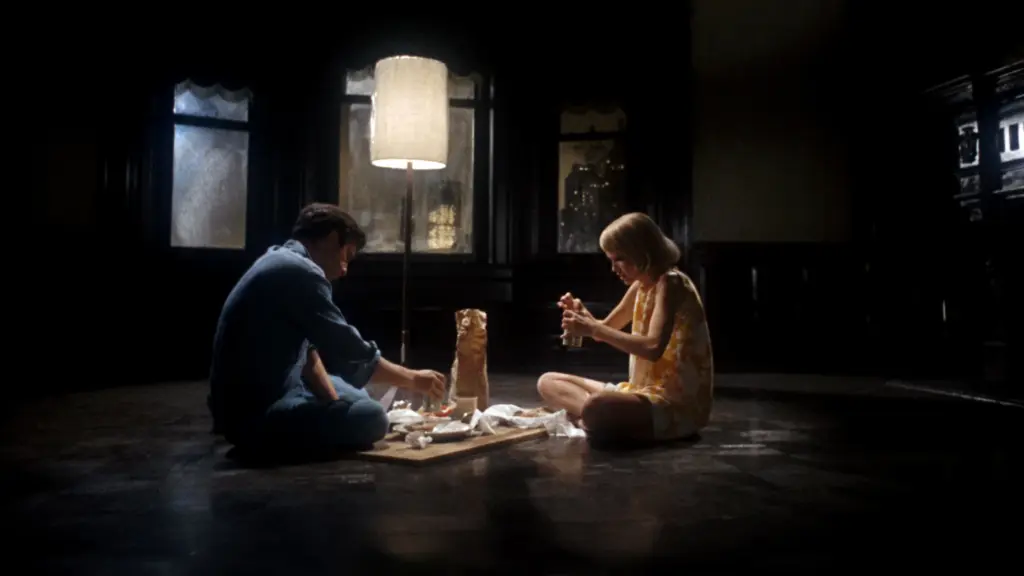
Roman Polanski is an awful, woman-terrorizing human being; so, I guess it sorta fits that he’s made one of the most gripping and unnerving depictions of a woman being terrorized by something awful. In this case the awful thing is a baby, as you might guess from the title, but a baby she suspects comes from the devil rather than her aloof husband.
What makes this movie so powerful is the contrast between Rosemary’s dreary domestic life and her growing fear that she is bearing spawn of Satan. She is belittled in so many ways – demeaned by neighbors, dismissed by her husband, betrayed by a doctor she confides in. Any of these actions in isolation might be a normal thing that happens to a pregnant woman living in a stately old Manhattan apartment building and married to an actor; yet in accumulation they create a deeply unsettling depiction of evil.
Mia Farrow is phenomenal as Rosemary and she’s buoyed by a great supporting cast including John Cassavetes as her husband and Ruth Gordon as her domineering neighbor. (Gordon won an Oscar for her performance, the movie’s only golden statuette.)
It’s a miraculous achievement of a horror film, perfectly paced and so canny in building dread with only sparing use of supernatural imagery (really just a dream sequence of uncertain literal reality). I’m especially infatuated with the production, turning Rosemary’s apartment into a Gothic prison full of suffocating rooms and haunted corridors.
The Devils (1971)
Is It Good? Good (5/8)
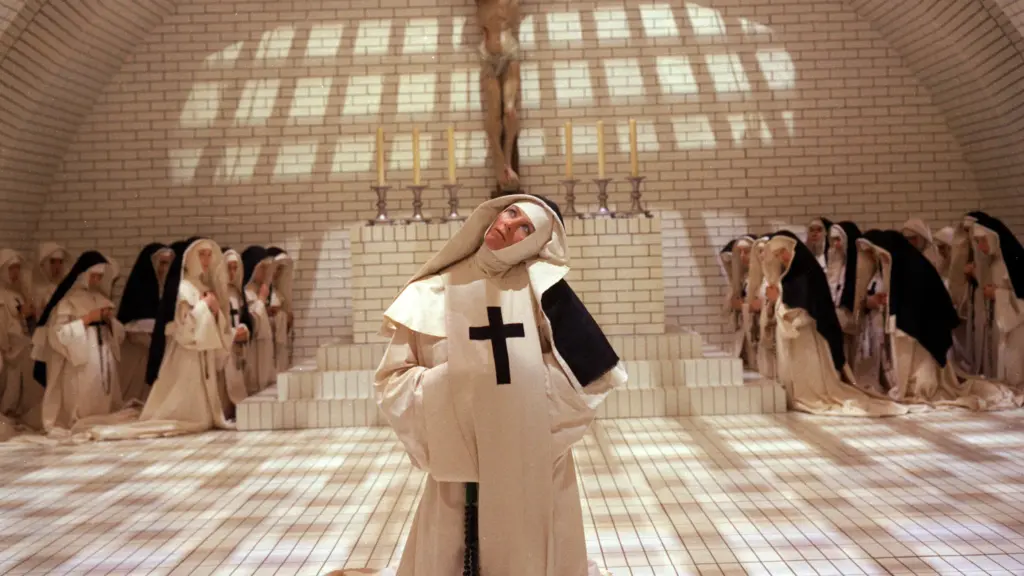
The Devils is one of those films that forces you to ask why it is you watch movies, and I frankly don’t know what to do with it. Ken Russell constructs this like a man possessed, his filmmaking on fire such that every howling image lands with provocation and gusto. Some of these compositions are so inventive and charged that I could barely breathe as I watched; it is not an exaggeration to call it one of the grand masterpieces of film production in cinema history. Derek Jarman’s production design, his first work in cinema, turns the walled town of Loudun into a gleaming, white-tiled asylum. Jarman and Russell are visionaries in the way they carefully build a visual language of black and white only to tear it asunder with red blood and pink flesh.
Contained within that technical mastery are some powerful stories: A womanizing priest named Grandier (Oliver Reed), who rules Loudun, creates a sexual furor bordering on bewitchment among the residing nuns, most especially Sister Jeanne (Vanessa Redgrave). Meanwhile, a group of civic and religious bureaucrats connive to wrest control of Loudun from Grandier. The film’s characterization is searing and occasionally nuanced; Grandier is both a true cad and a true believer; Jeanne is a bundle of contradictions.
And yet I found the film tough to get through. I wouldn’t go quite so far as Roger Ebert, whose sarcastic 0-star review mocks it as a self-important parade of torture and orgies dressed up as brave truth-telling, but I do find it to be an edgelord, try-hard piece of art, displaying contempt for everything it encounters. A little bit of punk-rock fury aimed at all pillars of the establishment is okay, especially when you’re a magician of a filmmaker, but The Devils left me with the same gross aftertaste as Texas Chain Saw and Trainspotting: It pushes its buttons of dour cynicism so hard it circles back to uninteresting for me. It features some filmmaking for the ages, but is just a bit too frothing for me to give it anything more than an academic thumbs-up.
(N.B.: Although The Devils is inspired by a documented historical “witch craze” incident, it is essentially not a witch film, but I included it here because I watched it in prep for the podcast about witch movies. Also: after decades of censorship, a 4K restoration of Russell’s uncut version opened in North American theaters for a currently-active one-week run.)
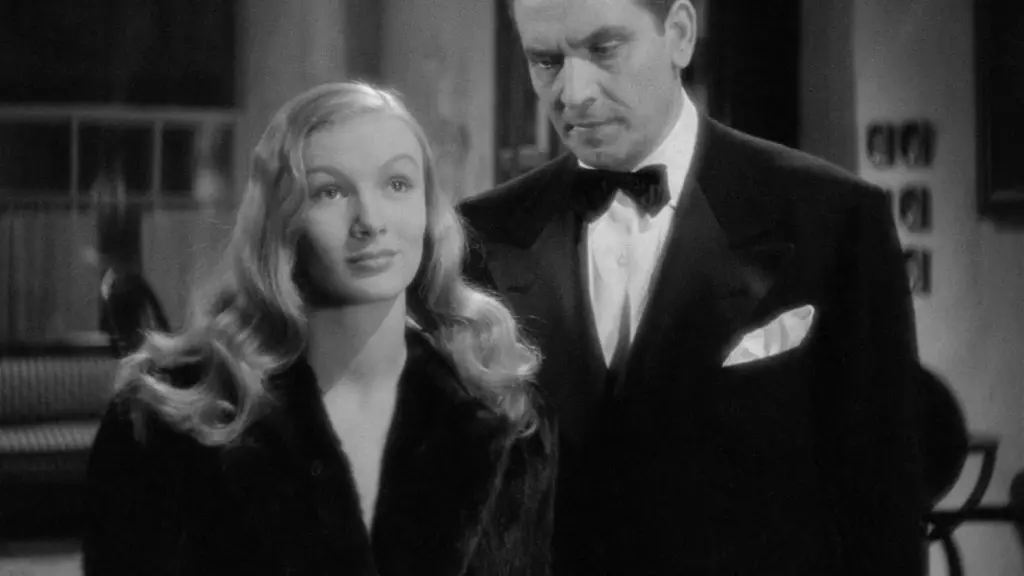
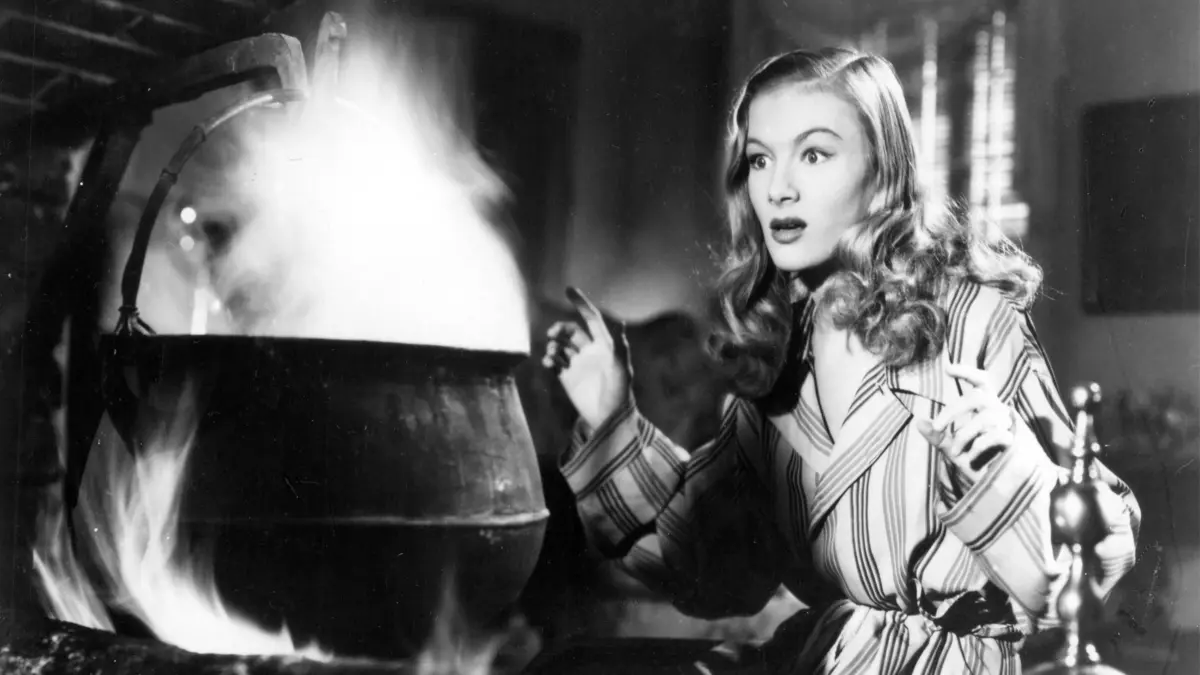
I Married a Witch (1942)
Is It Good? Very Good (6/8)
It’s tough to imagine a movie aging better than the screwball comedy I Married a Witch: We get one of the too-precious-few starring roles for a prime Veronica Lake, an all-time Hollywood firecracker. She’s in feisty sexy gremlin mode here. Her utter disregard for man’s society feels liberated and the exact opposite of fusty, a total delight to watch 84 years later. Director René Clair’s depiction of mischievous magic is cauldrons of fun, and the central storytelling gimmick of Lake’s witch Jennifer accidentally using a love potion on herself, flipping the film’s original dynamic on its head, is inspired. Romantic co-lead Wallace Wooley (Fredric March) is just fine but mostly gets out of Lake’s way.
Where the film stumbles is in the final act when a new conflict emerges after Jennifer and Wallace get together that turns Jennifer’s father Daniel (Cecil Kellaway) into an antagonist. It’s significantly less fun than everything that leads up to it, but not enough to blunt the overall delight of I Married a Witch.
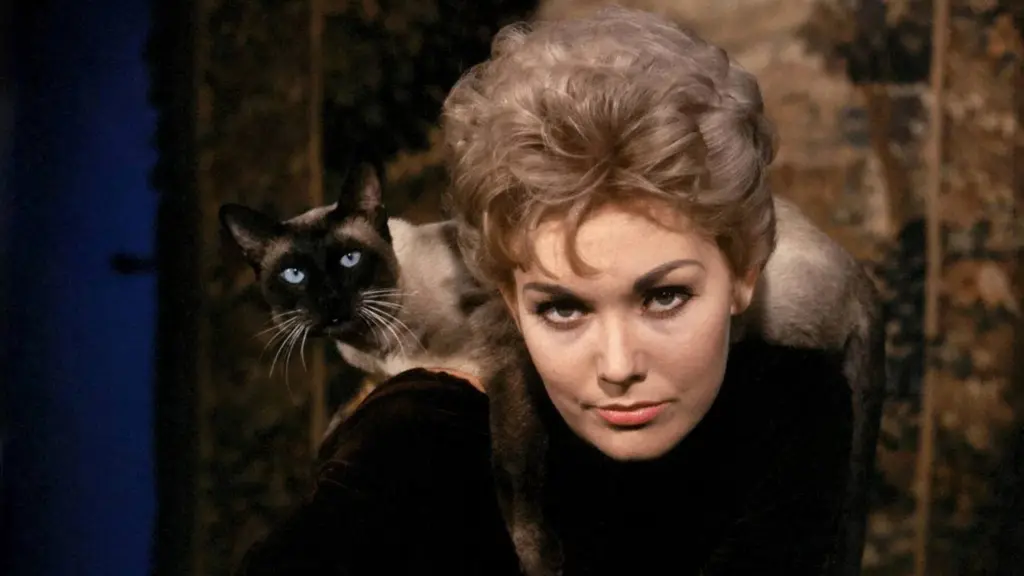
Bell, Book and Candle (1958)
Is It Good? Good (5/8)
Tell me if you’ve heard this one: Jimmy Stewart and Kim Novak star as romantic leads in a 1958 Technicolor film. This, of course, describes Alfred Hitchcock’s Vertigo, an all-time masterpiece, but it also applies to a fluffy little delight of a witch-themed romcom that has some beatnik flavor to it, Bell, Book and Candle. Stewart landed this role as the other half of the trade that sent Novak to Paramount for Vertigo. (Essentially all documentation I can find on the film eschews the Oxford comma in the title. The film’s own opening title card goes even further and skips the commas entirely.)
The mood on this one is great, shot in Greenwich Village with great scenes set in clubs and on the streets. Legendary cinematographer James Wong Howe gives it groovy, green-heavy lighting; he said he had a blast experimenting with tinted lights and filters on this one. It also benefits from an extremely charming supporting cast: Jack Lemmon playing a gay-coded warlock, Ernie Kovacs as a paranormal-obsessed writer, and, most importantly, a remarkable cat named Pyewacket. Novak’s Gillian is about as bewitching as any woman has ever been on film (this and I Married a Witch make a great double feature of contrasting but magnificent examples of eye-popping beauty and screen command with Lake and Novak). Funny that it’s ever-great Stewart who is the closest thing to a wet blanket among the bunch; he’s a bit too old and stodgy for the part, and it’s no surprise this is generally considered his final turn as a romantic lead.
It’s a lightweight affair, and its ending feels a bit like a selling out of the spirit of witchy, feminist freedom that Gillian displays throughout the film, but it’s a good time nonetheless.
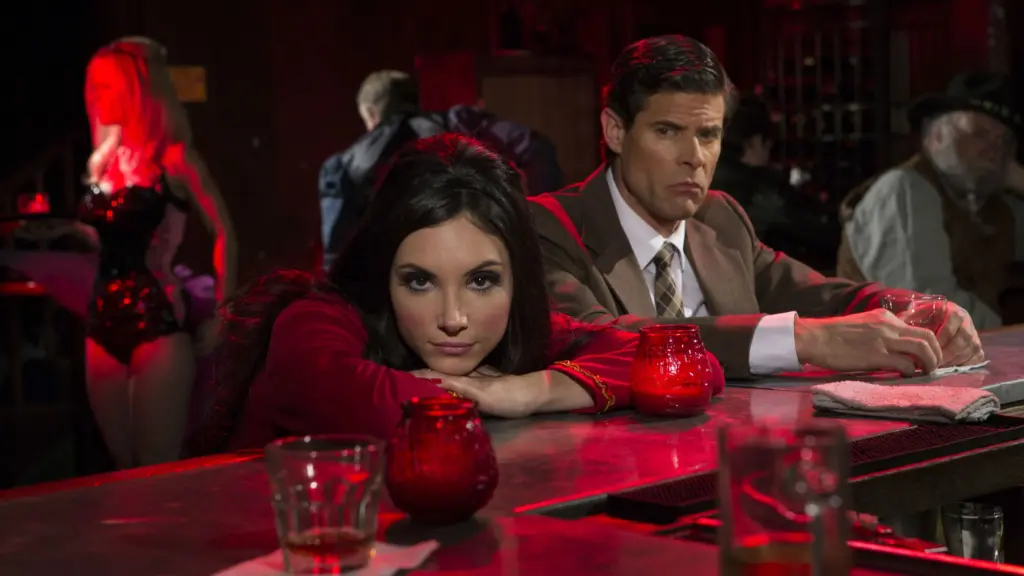
The Love Witch (2016)
Is It Good? Nearly Good (4/8)
The Love Witch is a film of both glimmering achievement and exhausting frustration: Its singular vision by auteur (director, writer, production designer, etc.) Anna Biller simply hums. It’s even more vibrant than the Technicolor movies it pays tribute to, e.g. Bell, Book and Candle. And its idea to take the barely-subtext feminist themes of witch cinema and make them explicitly investigated text is a fascinating choice, one that places it in a half-ironic zone that isn’t all that far off from my beloved Z-O-M-B-I-E-S movies… at least, if they had lots of nudity.
But the film is completely backbroken by its slim, repetitive story that drags on for a grating two hours. Witch antiheroine Elaine Parks (Samantha Robinson) ensnares and kills men one at a time like she’s a slasher villain crossed with a black widow, but the cadence and payoff of those scenes never escalate in a rich enough manner to justify making this as more than a short film, or maybe one of those 75-minute turbo-features.
That said, I’m tempted to give the film a passing grade just on how brilliant the production is and how well-cast Robinson is in the lead. The film has gorgeous colors, lovely costumes and makeup, terrific sets, and an overall intoxicating visual vibe. It’s too bad I just couldn’t get on its narrative wavelength.
Other witch movies reviewed on The Goods
Still in a witchy mood? Here are a few more I’ve reviewed:
- Häxan (1922)
- Suspiria (1977) and its remake, Suspiria (2018)
- The Witches of Eastwick (1987)
- The Blair Witch Project (1999)
- The Witch (2015)
- Wicked (2024) and Wicked: For Good (2025)
Dan is the founder and head critic of The Goods. Follow Dan on Letterboxd. Join the Discord for updates and discussion.