
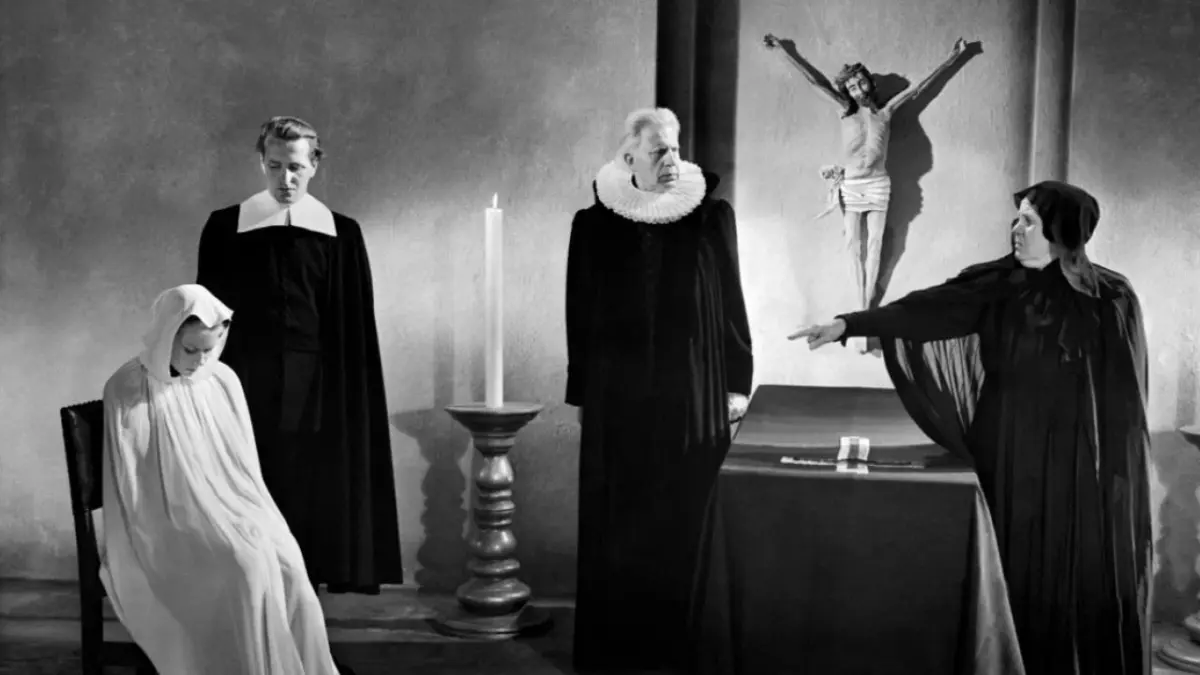
Day of Wrath is a strong candidate for the best movie about witchcraft, or, at least, alleged witchcraft. This period piece about a witch craze in a Danish village in the 1600s was filmed during the Nazi occupation of Denmark. As such, an unrelenting sense of oppression and injustice accompanies the film. (It makes a good companion piece to Häxan, the witchcraft essay film that fellow Dane Benjamin Christensen made two decades earlier.)
Directed by cinematic titan Carl Theodor Dreyer, the film is textbook European art cinema: It is so precise, patient, and still in its observation that it occasionally feels stiff. But it is truly marvelous as drama, with rich and surprising characterization, and a steady, doomed arc for its characters. It’s also a feminist and anti-fascist commentary without ever beating its themes’ drums.
The film follows a priest organizing the local witch-burnings, Rev. Absalon (Thorkild Roose); his young wife Anne (Lisbeth Movin), whose mother was accused of witchcraft but spared in exchange for Anne’s hand; and his son Martin (Preben Lerdorff Rye), who falls in love with Anne. Anne and Martin’s connection grows stronger as the flames of the witch craze climb higher and higher.
Day of Wrath is an immaculate achievement. For a slow, talky film, it is always engaging. It’s gorgeously produced in enclosed spaces (the only outdoor shots occur when characters are feeling romantic and unburdened, or else frenzied during a witch burning), with world-class lighting, cinematography, and shot blocking. Dreyer employs gentle but powerful camera movements. The acting, especially Movin’s, is outstanding. Terrific film.
This review appeared in Goodie Bag: Witch Movies
Is It Good?
Exceptionally Good (7/8)
Dan is the founder and head critic of The Goods. Follow Dan on Letterboxd. Join the Discord for updates and discussion.