
Hell is other rooms
“Beware the buzzy horror release” has become such a mantra around here that I assume you’re sick of reading it. But Backrooms arrives with an extra-large helping of buzz, most of it generated by forces well outside the actual text of the film. You cannot have a conversation about this movie without three talking points taking center stage. Did you know it was directed by a twenty-year-old YouTuber named Kane Parsons? Did you know it’s adapted from his own web series, which grew out of a single unsettling photo posted to 4chan back in 2019 and then metastasized across Reddit and the rest of the internet? Did you know it’s now A24’s highest-grossing film ever, posting receipts on the scale of the year’s Star Wars and superhero movies, powered by a Gen Z audience that turned out in droves? If you’re tapped into the movie discourse even a little, you certainly have. I’ll spare you my thoughts on each for now, except to say that, as with most headline-grabbing narratives about the future of movies, there’s some genuine truth here and some wildly inflated hype.
Which brings us to Backrooms itself, and my first reaction is that this movie is barely even a story. It’s more of a scenario, and not even an especially developed one. What it actually is, is a monumental achievement of production design, leveraged for a remarkable quantity of eerie uncanniness that eventually darkens into outright horror. That makes it a genuinely tough movie to pin a verdict on, because parts of it are tremendously functional, bordering on inspired, and other parts are discarded gristle, and I suspect everyone will respond to that split differently. I don’t mean that in the noble “great art speaks to each of us uniquely” sense. I mean it in the far more mundane sense of: what, exactly, do you want out of a screen for a hundred and ten minutes? Story? Experience? Spectacle? Vibe? Your answer decides this one for you. My own rating apparatus, quasi-ironic reduction of art that it is, wants to plant a flag somewhere in the impossible middle (i.e. a Kinemalogue 5.01), but I’ll ultimately tilt ever-so-slightly positive.
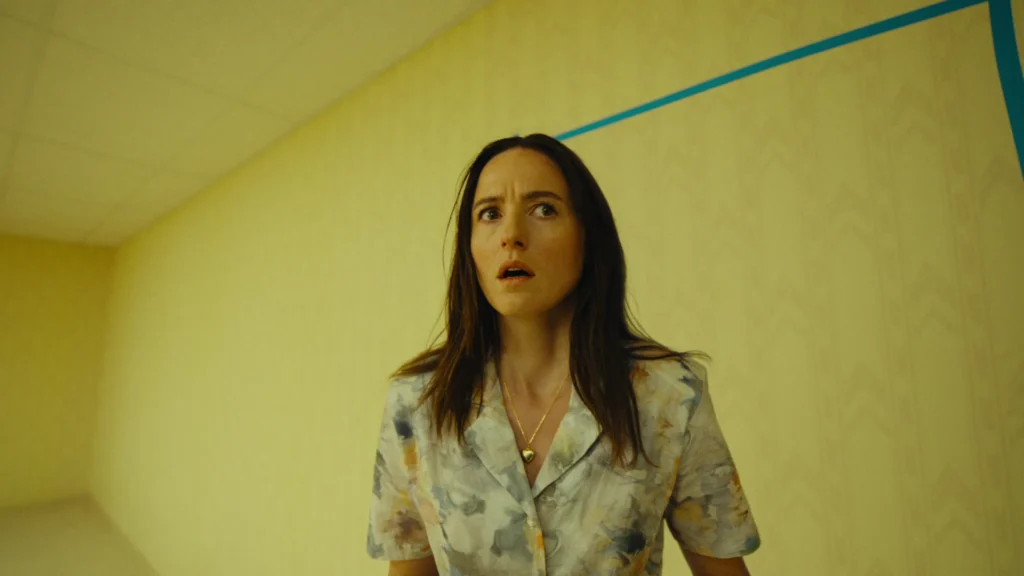
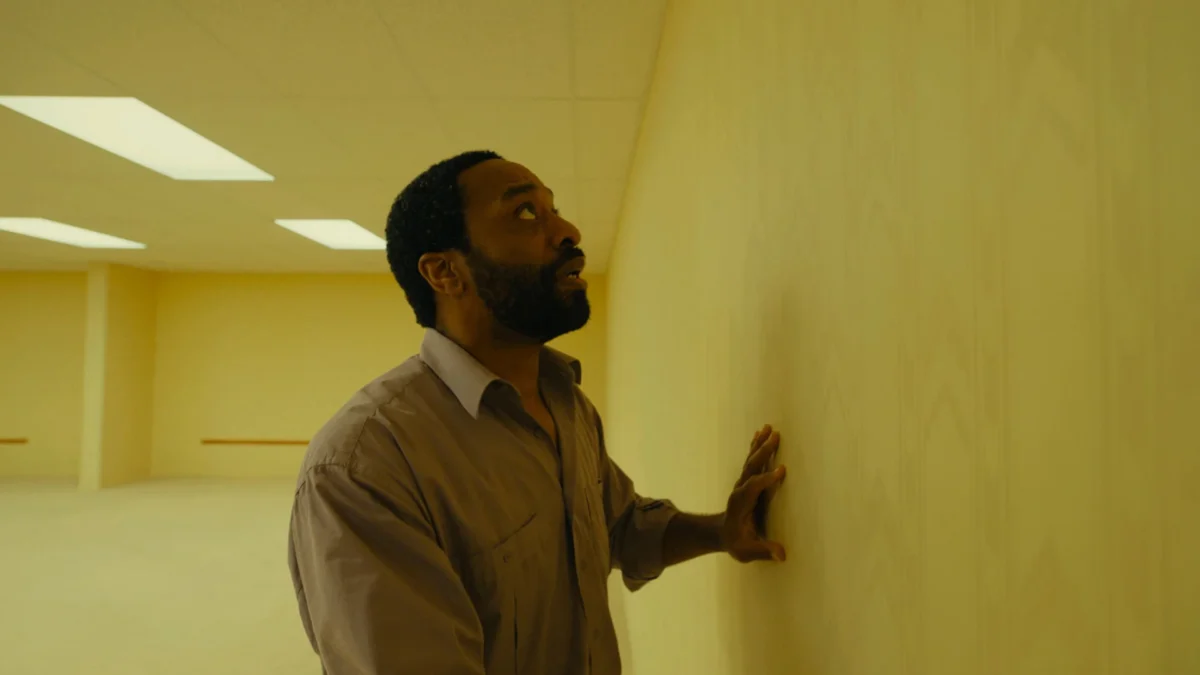
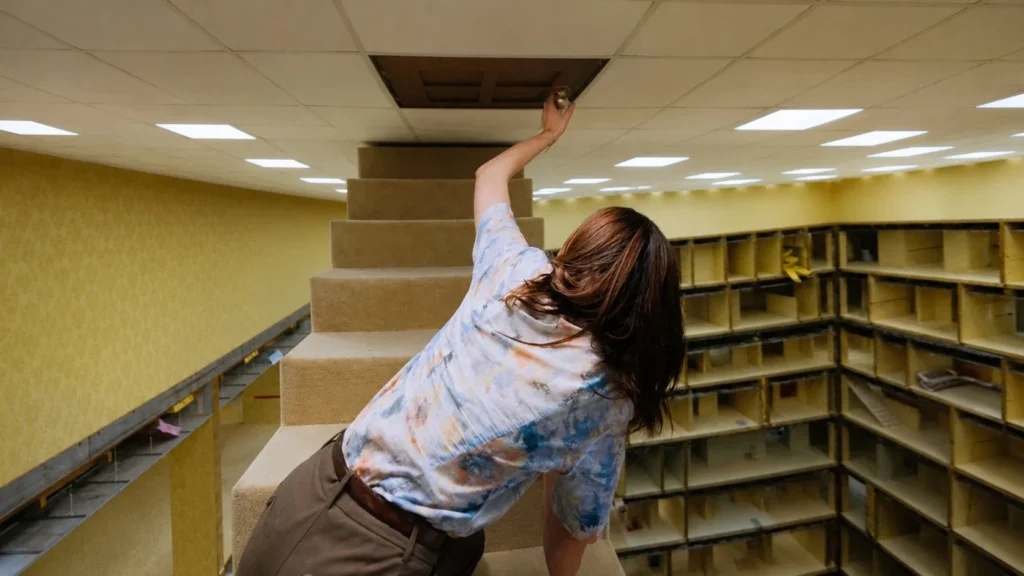
Let’s start with the production design, because the Backrooms themselves really are the film’s raison d’être. Much of the film unfolds in an alternate dimension composed entirely of interior spaces: an unholy mosaic of yellowing suburban architecture from the 1990s and early 2000s. Office hallways, strip-mall storefronts, boxy living rooms. But something is off about these spaces. Many things, actually. They’re abandoned and drained of life, save for little hints that someone was recently here, or might still be rustling in a corner, like spotting mouse droppings on a basement floor. The rooms are largely bare, except for the occasional pile of broken or half-assembled furniture heaped up like an unmarked mass grave if the battlefield were an IKEA or an Office Depot. (Severance has recently tapped into a very similar visual vibe.)
The wrongness only deepens the longer you stare. The dimensions are never quite right: some cubbyholes are claustrophobically tiny, some spaces as vast and lifeless as an airport terminal in the early months of COVID. It breeds optical illusions where you can’t trust proportion or perspective, which only tightens the sense of the walls closing in, a feeling made worse by the total absence of windows to the outside. And the most striking thing about these spaces is that they’re endless and eternally winding, an asbestos labyrinth of liminal modernity. (The minotaur at the center is capitalism, presumably.) You open a door and a larger, stranger hallway blooms behind it. Vertical space expands and contracts, too; one of the film’s more memorable scenes is in a fluorescent-lit corridor sloping sharply down into a shadowy void. The production is buoyed by outstanding sound and lighting work: noises muffled yet somehow filling every room, the piss-yellow hues lending the whole place a poisoned glow.
It’s a great cinematic idea, and I applaud the movie for centering it. Frankly, I’d rather watch it chase this concept to its outer limit than do almost anything else. That said, a few large caveats. The first: I simply do not find any of this scary. Strange, sure; maybe even unsettling. But outside of those squeezing, claustrophobic corridors, nothing here made me squirm or shiver. (I guess “uncanny” horror is in right now; see Longlegs and I Saw the TV Glow, too.) The second caveat: a hundred and ten minutes is too long, and the film takes an excruciating half hour just to reach the Backrooms in the first place. The time in the Backrooms is split between handheld-camcorder footage and traditional anamorphic photography, and I found the latter far more watchable and interesting than the shaky-cam.
Parsons worked with an experienced crew of writers and craftsmen to bring this vision to life, and it shows; Backrooms is less amateurish or sloppy than plenty of debuts. Slight though the screenplay is, it falls cleanly into three structured acts: a setup intro; a promise-of-the-premise middle spent exploring the maze; and a more intense horror climax. The middle is the best of the three, though the climax has a few incredible moments of its own.
You’ll notice I haven’t described the plot or the characters or the lore yet, which tells you roughly how much I invested in them. What saves the actual narrative material from completely torpedoing Backrooms is that it’s anchored by two world-class actors, Chiwetel Ejiofor and Renate Reinsve. Clark (Ejiofor) is an alcoholic failed architect running a furniture store (the wonderfully named Cap’n Clark’s Ottoman Empire). He is in the midst of a full meltdown, his business circling the drain and his wife having tossed him out to live among his store’s futons. He’s seeing a therapist, Mary (Reinsve), who is wrestling demons of her own, chief among them the lingering trauma of growing up with an agoraphobic, now-institutionalized single mother who stole her childhood with paranoia.
One evening, Clark discovers a “noclip,” reality-bending portal to the Backrooms in the wall of his store. He ropes in his employee Kat (Lukita Maxwell) and her boyfriend Bobby (Finn Bennett) to explore it, and eventually Mary follows them in. The film keeps gesturing at the notion that the Backrooms mirror each character’s private trauma — failed architecture for Clark, cramped and paranoid rooms starved of sunlight for Mary — but this psychological deconstruction never becomes interesting (or, thankfully, too strained). The narrative never compels; and then it just stops being a narrative once everyone is in the Backrooms. The performances do compel, though: Ejiofor plays his role with a darkly comic intensity that refuses to undercut the tone’s gravity, while Reinsve counters with a somber, haunted stillness lifted straight out of Bergmanesque arthouse dramas like Sentimental Value.
So I’m right back where I started: recoiling from an overhyped, buzzy horror release and still, against my own resistance, finding merit in it, with plenty of qualifications. In that sense, it’s not so different from Obsession, the year’s other breakout horror sensation by a YouTuber, which I found more emotionally involving than anything here. But Backrooms is fresh enough, and clear-eyed enough about its genuinely original strengths, that I’d call it a success in spite of its watery narrative, its limp screenplay, and its runtime bloat. Beware the buzzy horror release, by all means. But sometimes those Backrooms beckon.
Is It Good?
Good (5/8)
Dan is the founder and head critic of The Goods. Follow Dan on Letterboxd. Join the Discord for updates and discussion.
7 replies on “Backrooms (2026)”
I admit my only engagement with this film is noticing an advertisement on the side of the bus that made it look vaguely like some sort of old-school cinema erotica/soft porn.
Clearly assumption has made an assumption of me, hee haw.
ASSUMPTION HAS MADE AN ASS OF ME and so has my carelessness when posting.☺️
I’ve seen that poster and oh my God, yes. It legitimately–this is funny, but I’m not joking–looks like a cropped still of Reinsve getting railed from behind, and so much like that it’s hard to believe it wasn’t on purpose.
The poster had me wondering if the Backrooms themselves (I capitalized it throughout this review, but now that I’m thinking about it, the space, rather than the movie, should probably not be… but I will continue to for consistency’s sake) had a strong sexual or Freudian aspect to them, but not really. If they do at all, it’s very, very subdued.
Doubtless if this movie were called THE BEDROOMS it would be slightly more gross, but a good deal less ‘Crushing existential terror’.
I landed about where you did Dan, though I was higher on the found-footage section in the middle and lower on the third act. (God, that was a dumb monster to hang the climax on.)
I’m not entirely sure why the handheld/found footage scenes didn’t work for me. I’ve liked found footage movies before.
(Moderate spoilers…) Yeah, I didn’t talk much about the third act. I thought it had some dumb moments, and I was baffled that a long stretch of it compressed in a single room. The monster itself was quite dumb, though its weird quasi-humanity did start to freak me out a little bit in its relentlessness. But I liked the semi-slow chase throughout the bizarre spaces once it got going — actual good payoff on the production design. And I was fine with the final coda with Mark Duplass; it playfully punctures the idea that it’s more of a symbolic place. I frankly did not want to know any more than we got.