
Close encounters of the heard kind
What have we here? The Vast of Night announces a fresh and original filmmaking voice, one unusually skilled at conjuring a milieu. Its opening minutes so wonderfully suck you into its distinct world and wavelength that I immediately knew director Andrew Patterson will be making idiosyncratic, flavorful films for as long as he chooses to keep pursuing the art form.
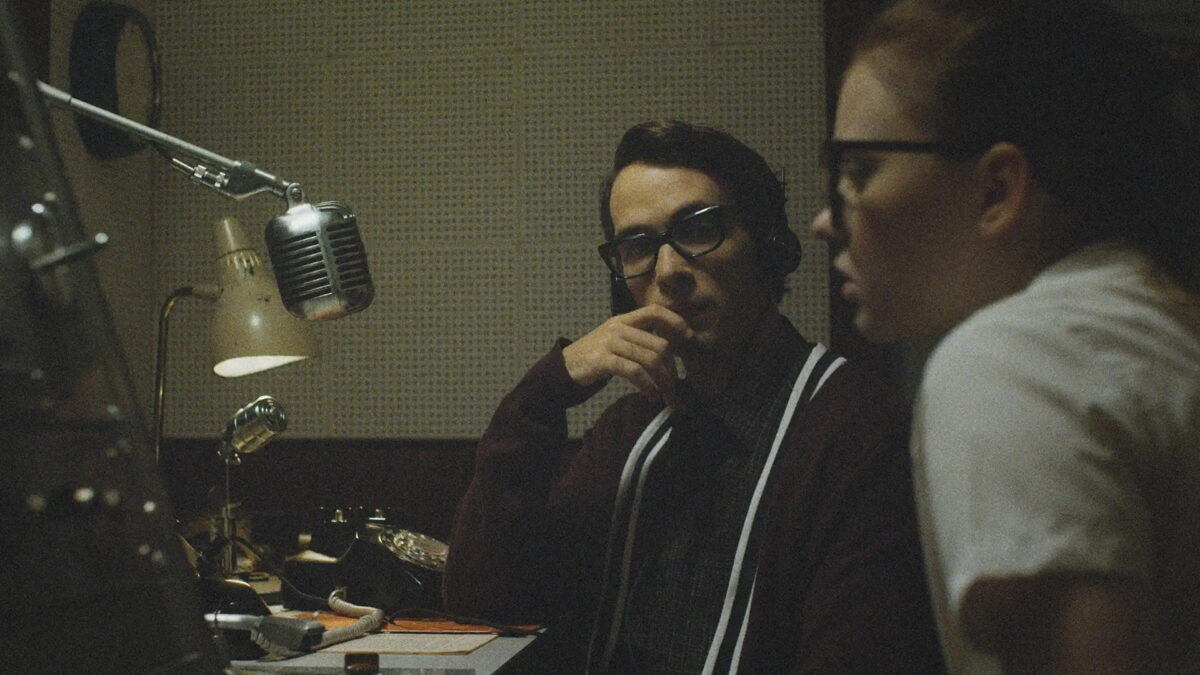
The film unfolds over a single night in late-’50s Cayuga, New Mexico (population 492), as the whole town packs the gym for a high school basketball game. Weaving through the crowd are our heroes: Fay Crocker (Sierra McCormick), a teenage switchboard operator with a brand-new tape recorder, and Everett Sloan (Jake Horowitz), the cocksure young DJ at the local radio station. Patterson follows the pair in a long, unbroken walk-and-talk out of the gym and through the empty streets toward their night shifts, as Fay excitedly relays a magazine’s predictions about the future, like miniature televisions you can keep in your pocket.
This opening stretch is so specifically observed, so stuffed with distinctive rat-a-tat dialogue and small details, that I was instantly rapt. The script crackles with period lingo, like an Eisenhower-era cousin of Brick‘s hardboiled high school patter. Though it spends most of the film with just a couple characters, it evokes the one-night, whole-town ramble of American Graffiti and its heir, Dazed and Confused. Many of the cornerstones of ’50s nostalgia are present. It’s got the sock-hop cheeriness, the milkshake innocence. And yet it feels authentic rather than hackneyed. Crucially, this setup places us in the headspace of a culture ready to be rattled by something from beyond.

And rattled it gets, slowly and quietly. Most of the movie is spent just listening. Tuning into Everett’s show as she works switchboard, Fay hears a strange, rhythmic signal. Everett puts out a call to his listeners: Does anyone know what this sound is? Then the phone rings. Billy (Bruce Davis), an ex-military man, calls in with an extended confession about classified work at a desert facility, hinting at a darker truth beyond what the eye can see.
The Vast of Night is clearly trying to mimic the legendary Orson Welles War of the Worlds broadcast (Everett’s radio station is even called WOTW): We witness a small group of characters become convinced, one eerie testimony at a time, that something extraterrestrial and non-human is afoot. That’s always a reliable chestnut of a story, and it feels more multimedia and experiential in The Vast of Night than cinema often does. Like found footage, the film essentially places us in the eyes and ears of its characters. During Billy’s call, Patterson slowly zooms on a still, darkened shot of just a speaker — in essence, a black screen — effectively turning the film into a radio drama and inviting us to lean in and listen.
The problem, of course, is that we are watching a movie, and this conceit is not especially cinematic, nor does it entail much actually happening. The back half mostly consists of people telling overlapping stories: Billy over the phone, then Mabel Blanche (Gail Cronauer), an elderly woman Fay and Everett visit in the third act. The momentum sags. I understand why some find the film flat-out boring: There’s not much plot, and not much to look at along the way.

And yet I found myself enamored with The Vast of Night. For one, it feels like a synthesis of well-worn ideas made fresh in the execution. We’re in the approximate mood of a ghost story told around a campfire, but rendered as a radio sci-fi story, accompanied by two characters who feel like the Adam and Eve of the Sputnik era, ready to chomp on the apple of atomic knowledge. I find it all tremendously evocative.
Part of the film’s mood comes from the symbolic weight of the setting, America on the cusp of a new age. It plays like the last gasp of an age of innocence and the dawn of a new Cold War anxiety, when the sky itself became a source of dread and the very wires and airwaves holding a small town together became transmitters of fear. Billy’s story carries an extra sting: He suspects he and his fellow workers, all Black or Mexican, were chosen precisely because nobody would believe them. As with the flying saucer jitters of Them!, the people who glimpse the truth are the easiest to wave off. That milkshake innocence was never evenly distributed.
Perhaps Patterson’s biggest misstep is the very first thing we see: He has framed the entire story as a lost episode of The Twilight Zone, or rather a copyright-friendly facsimile called Paradox Theater, complete with a Rod Serling soundalike. This choice certainly emphasizes that the story comes from a lost age of American storytelling, back when simple flying saucer stories held paranoid power. But it’s a distracting touch that undercuts the immersion and dismisses some of the film’s heft by reducing it to homage. (Nor does Patterson’s gliding camera resemble the stagebound TV it’s imitating.) It just doesn’t fit.

Whatever its limitations, this is a remarkably assured directorial debut. Patterson, an Oklahoma commercial director, self-financed the film for less than a million dollars and co-wrote it with Craig W. Sanger. Alongside cinematographer M.I. Littin-Menz, he stages a handful of really clever constructions whenever the story is actually moving. That opening walk-and-talk is the highlight, a whole tour of a community in just a few shots. Another memorable sequence is a single take that runs in the vicinity of ten minutes of Fay juggling calls at the switchboard. The most impressive piece of camerawork comes in the middle of the film with a tracking shot that races back down the main drag of town, through the gym and its basketball game, and out a window toward the radio station. It goes a long way in making the community feel more connected to the danger at hand, and it’s and eye-popping piece of composition, too. (I’m much less sold on the overall look of the cinematography, as the film is dim and underlit.)
McCormick and Horowitz are charismatic leads with good chemistry, tossing off rapid-fire banter while hitting every mark of Patterson’s elaborate choreography within the long takes; McCormick carries that switchboard sequence beautifully to the point you almost forget it’s happening in real time. But Davis and Cronauer are also key to the film not collapsing in on itself, successfully maintaining interest with their long, haunting monologues (Davis with his voice alone), their slow, deliberate delivery a perfect counterweight to the leads’ escalating panic. The sound design is immaculate as a bland of various midcentury buzzes and doodads, with a lovely little score from Jared Bulmer and Erick Alexander that treads the same line between nostalgic and tense that the movie does.

The Vast of Night took a winding road to its audience. Eighteen festivals rejected it before micro-budget haven Slamdance gave it a home and its audience award in 2019. Amazon scooped it up later that year. Amazon released it in May 2020, a couple of months into the COVID lockdowns, first at drive-ins (the most 1950s release strategy imaginable) and then on Prime Video. Homebound audiences starved for something new found it, and it made a bigger splash than it likely would have in a normal theatrical year.
It’s ultimately little more than a puff of a film: an eerie incident; a snapshot in time of a specific place; a tribute to lost ages of analog communication tech and oral storytelling. But in spite of its smallness, The Vast of Night stole my heart and declared Patterson an original worth watching as he applies that creativity and specificity to other times, places, and genres. His second feature, this year’s The Rivals of Amziah King — a present-day Oklahoma story starring Matthew McConaughey as a singing beekeeper — promises just such a journey.
Is It Good?
Good (5/8)
Dan is the founder and head critic of The Goods. Follow Dan on Letterboxd. Join the Discord for updates and discussion.
3 replies on “The Vast of Night (2019)”
Yeah, I liked this a fair amount back in 2020, though I was, like, real turned off by that centerpiece giant tracking shot, just found it a useless gesture, and not all that impressive in that–if I remember correctly, I may stand to be corrected–it has essentially no narrative content, which means it’s a lot easier to choreograph. On the other hand, for the most part I recall liking the underlit cinematography at the time, finding it cozy or intimate or doing something likeable to the mostly-limited spaces of the film while we listened to people talk, though of course “at the time” was “before, or at least before I’d realized, that underlighting had also become something of a pandemic.”
Never thought of the film as boring, though it’s not the best sign that I have to admit I straight-up forget how it even ends. Been kind of meaning to rewatch it, currently rewatching the X-Files, so it would seem to dovetail.
1000% cosigned on the stupid framing device. It’s not even like a Twilight Zone episode. At all.
I liked the long tracking shot but I guess I’m just a sucker for long shot gimmicks. And I like your case for the cinematography; I guess I’m expecting this era to have more hues to it, but I’m sympathetic to your take. I was thinking of showing this one to my wife so we’ll see how I feel if I watch it again.
I avoided talking about the ending, but it ended up a bit more literal than I was expecting throughout much of the runtime.
“We’re in the approximate mood of a ghost story told around a campfire, but rendered as a radio sci-fi story, accompanied by two characters who feel like the Adam and Eve of the Sputnik era, ready to chomp on the apple of atomic knowledge.”
Excellent.
The comparison to radio drama is apt. Love this movie.