
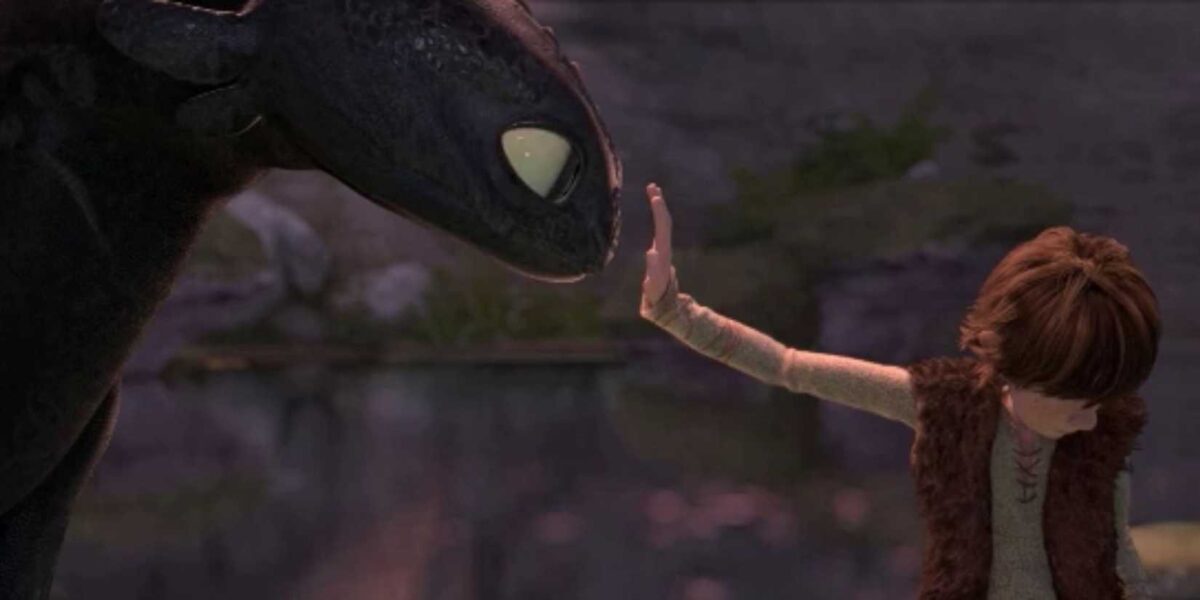
Defying gravity
There’s no experience quite like falling in love while you’re young, and in the late 2000s and early 2010s, it was cinema that stole my heart. This surely leads me to overrate the movies I saw during this time, as they were the ones that sold me on the medium for life. But art is subjective, and so I must be honest about how I feel. And I feel that How to Train Your Dragon is a masterpiece and the best movie DreamWorks Animation has ever released. It is not flawless, but it is a film with which I have a post-critical relationship. That is, I can see its flaws just fine. I just wouldn’t change a single one of them. I love it for exactly what it is.
Part of my love for cinema came from the dual blessings of being a child during the Disney Renaissance and a teenager for much of Pixar’s imperial reign. It turned me on to animation in a big way, to the point where I was happy to look for the best in any film that was animated and hold them up as art. I’ll never forget the chills I felt listening to Anton Ego’s monologue near the end of Ratatouille, to say nothing of watching my childhood end before my very eyes in Toy Story 3. Alan Menken’s tunes for Aladdin, The Little Mermaid, and Beauty and the Beast scored my childhood, as I’m sure they did many people reading this. These movies are part of my movie-watching DNA, and How to Train Your Dragon is as well.
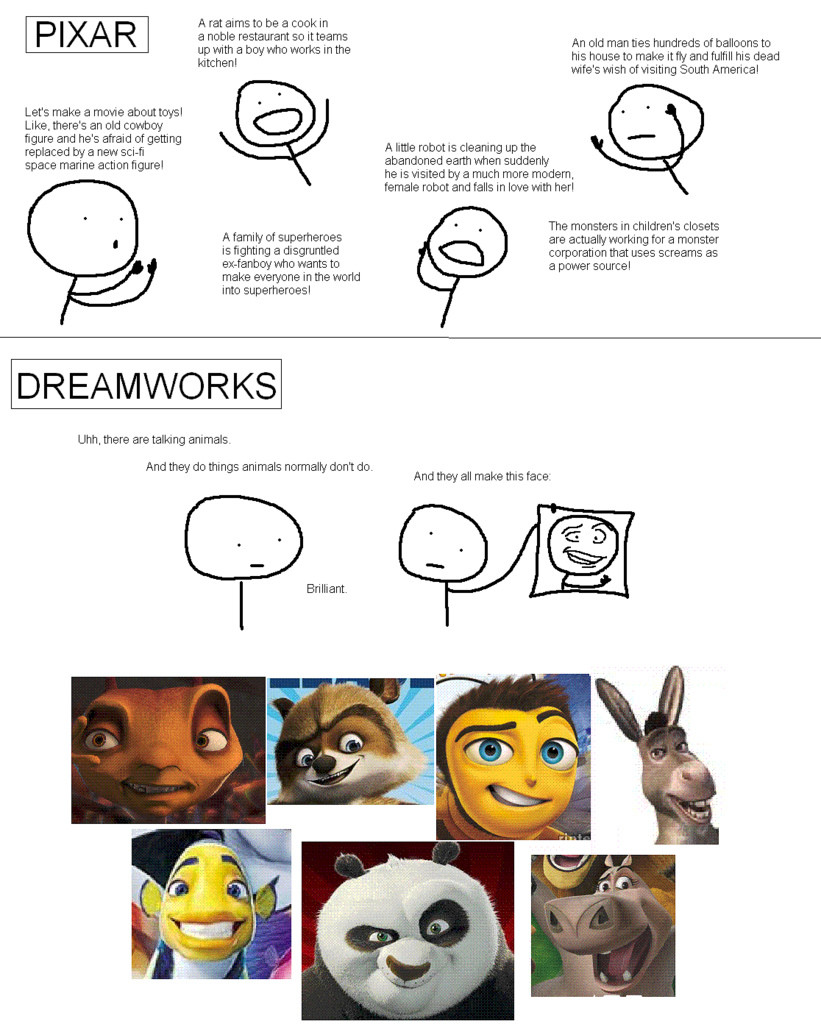
By the late 2000s, DreamWorks Animation had become the punchline among animation studios: the company that put out various Shrek clones whose protagonists all made the same smirk, content to animate their films like sitcoms. But the winds started to change in 2008 with the miraculous Kung Fu Panda, a film that offered mythic sweep, high adventure, stylized and kinetic animation, and a surprising amount of heart. The panda still made that damn face, but otherwise it suggested a new era for the studio, one that How to Train Your Dragon would fulfill two years later.
How to Train Your Dragon is loosely based on the book series of the same name by Cressida Cowell, and it pulls some names and ideas from the books, but it is essentially an original story. It very nearly wasn’t this story at all: The project’s first incarnation hewed close to the books and skewed young, and the studio found it too sweet and whimsical for its growing ambitions. So DreamWorks brought in Chris Sanders, who recruited his Lilo & Stitch co-director Dean DeBlois, and the pair workshopped it into something far bigger and bolder. A key moment in the film’s development came when legendary cinematographer Roger Deakins joined as a visual consultant, advising on lighting and the overall look: how to make the film feel richer, more like live action, and more visual in its storytelling.
The story that Sanders and DeBlois landed upon is one of the most sophisticated and humane that DreamWorks has ever told, even as it treads on well-worn themes. The narrative framework itself is familiar, essentially Avatar and Pocahontas: A misfit from the established society has an encounter with someone from the native population his society is at war with, falls in love, and realizes that his people had it all wrong about the natives. In this case, the natives are dragons, and the love is a pet-caretaker symbiosis that borders on fraternal love.
Here, the misfit is Hiccup (Jay Baruchel), the scrawny, sarcastic son of Stoick the Vast (Gerard Butler), chieftain of the Viking village of Berk. Berk is constantly besieged by relentless dragons, which raid the island for its livestock and set fire to whatever they don’t carry off. Hiccup is the apprentice to the blacksmith Gobber (Craig Ferguson), and would give anything to kill a dragon and earn the respect of his father and his peers. But he has neither the muscle nor, it turns out, the killer instinct, and spends his time tinkering in the blacksmith shop. During one raid, one of his contraptions actually works. He fires a bola that brings down a Night Fury, the elusive terror with a sonic fire blast that never shows itself and never misses. Of course nobody believes him. But he tracks the downed dragon into the woods. It’s his big break: he hasn’t just caught a dragon; he’s caught the most fearsome of all.
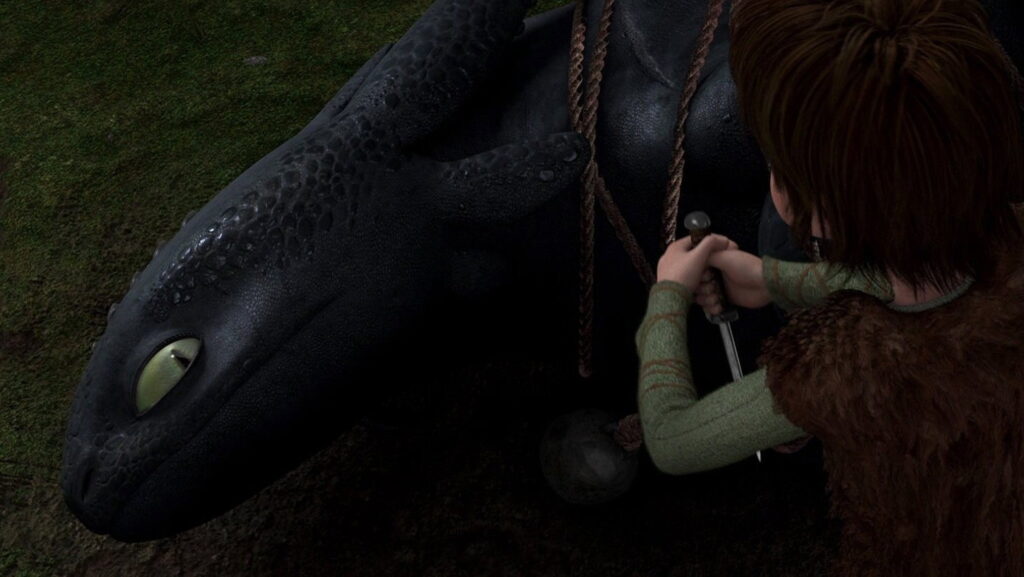
And yet, knife in hand, he can’t bring himself to kill the creature. He uses his blade to cut it loose instead, and it spares him in turn. This kicks off the film’s best stretch: near-wordless sequences of Hiccup and the Night Fury getting to know each other — observing, learning, and bonding. He names the dragon, which resembles both a cat and a dog at different moments, Toothless (a fully ironic moniker). Toothless is a marvelous visual creation, animated with tremendous life. Crucially, he moves and acts like an actual animal, as compared to the “animals” of movies like Madagascar and even Kung Fu Panda, which are in fact humans shaped like animals. Much of his life comes through in the eyes: big, vividly colored, and endlessly expressive. Those eyes are one of my favorite visual touches in the film (one that The Sea Beast would later lift, along with most of this movie’s plot). We learn that Toothless lost half his tail fin when Hiccup shot him down. So Hiccup builds him a new one: a prosthetic. And as he attaches it, something magical happens: Toothless takes off. Hiccup becomes the first Viking ever to ride a dragon. Hiccup and Toothless learn the prosthetic tail only works with a rider to operate it, creating a bond: Neither can fly without the other.
Meanwhile, Stoick is off searching for the dragons’ nest to try and put a permanent end to the dragon problem, and Hiccup is enrolled in dragon training alongside Berk’s other teens, including Astrid (America Ferrera), the fierce overachiever he’s hopelessly sweet on. In the arena, he flails. In secret, he keeps sneaking off to study Toothless.
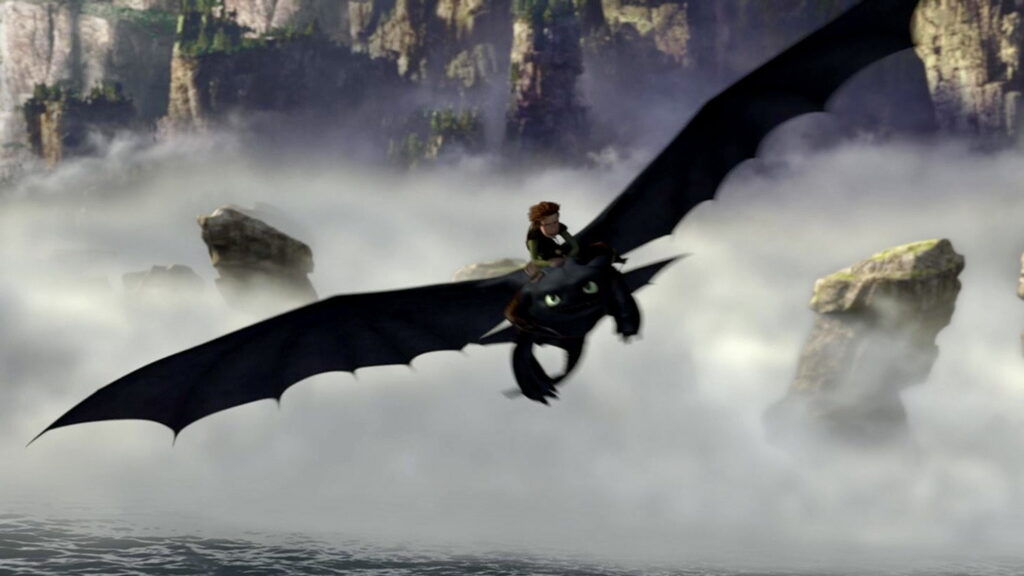
Some aspects of the animation have aged like unrefrigerated soft cheese. I have admitted I was a little nervous about revisiting Dragon, since two Spider-Verse movies had set a new bar for animated flight. I needn’t have worried. The Deakins-informed emphasis on space and perspective still pays off: I have yet to find a movie that captures the sensation of flying through the air — of soaring through the heavens, of defying gravity — as gracefully as this one. Additionally, few films do as much to capture two such different scales at once: the sweep of an entire world, and the three-dimensional space you have to move through to cross it. (I imagine the filmmakers watched a lot of Finding Nemo for inspiration.)
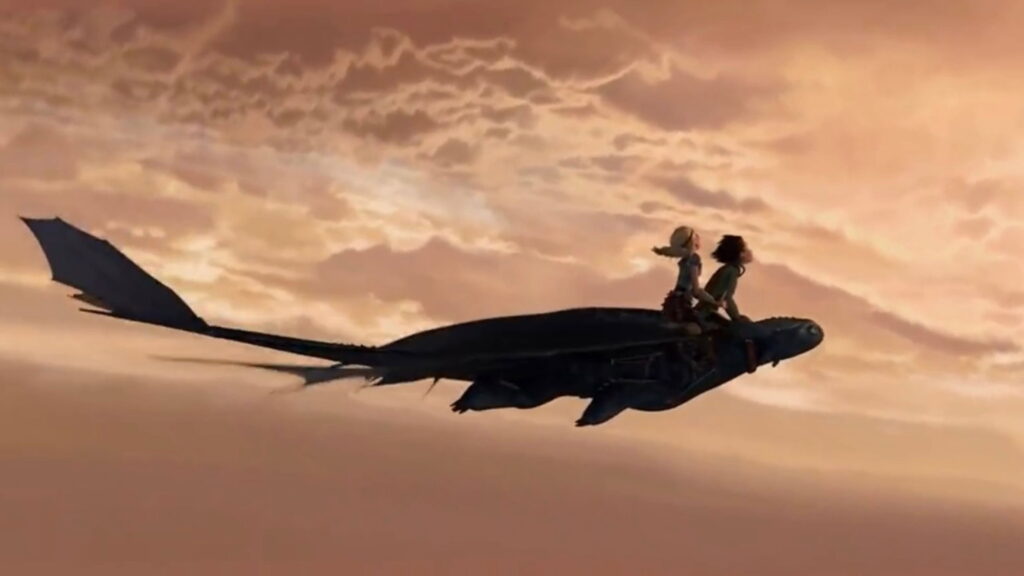
Deakins’ fingerprints are all over the lighting, too. He pushed the film darker than animation usually goes, which reportedly ruffled some of the DreamWorks artists who couldn’t understand why a shadow would be more interesting or expressive than a flatly lit expression or motion. That unorthodox, more realistic lighting gives Berk real atmosphere, especially in the fire-lit night raids. The color design is just as smart, and certainly more sophisticated than most other animated films: Hiccup is in green, Astrid is in light blue, every character readable at a glance. Additionally, every human has a dragon whose color, design, and motion mirrors it, setting up the payoff of the third act when the dragons and humans unite. (DeBlois predictably muted that palette in his blow-by-blow 2025 remake, a casualty of live-action brownification.)
Sixteen years on, the screenplay’s structure holds up as a well-oiled and deeply satisfying machine. Line by line, the script has some wonky dialogue, but its architecture builds out the story’s themes with total seriousness and intricately interlocked concepts, all supported by story details. Every setup gets a payoff, even the setup you didn’t initially identify as such. Dragons’ hatred of eels becomes one of Hiccup’s tricks in the ring; Astrid’s punch-then-kiss “That’s for…” routine comes back in multiple contexts; the pests of Hiccup’s opening narration become the pets of his closing one; and the fact that dragons are highly flammable on the inside (also a pretty good metaphor for adolescence) turns out to be the key to the finale. Most striking of all (spoiler warning for a movie old enough to drive): the tail fin Hiccup accidentally takes from Toothless is mirrored by the leg Hiccup loses in that finale, leaving boy and dragon with matching prosthetics. The entire story builds towards a theme of pacifism and symbiotic coexistence more powerfully than any of the many other kids movies that have tackled such themes. (Sorry, Zombies 4.)
A major piece of what makes the film so effective is the way it builds real stakes, starting with the danger of the world itself. This is not a cartoon war: Berk is a village where every building is new because the old ones burned, where the town blacksmith is missing two limbs, and where the chief keeps sailing off in desperate hope of saving his people. Stoick’s hard line on dragons isn’t prejudice for its own sake; it’s generations of scar tissue.
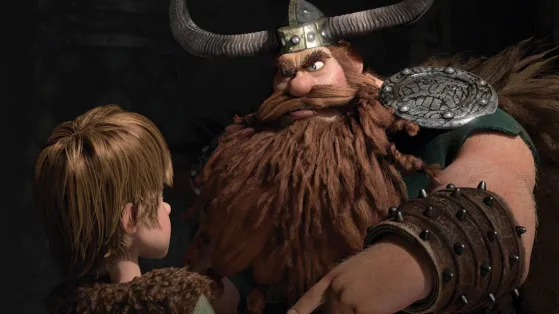
The film presents another kind of danger, too, a social one: The danger of shaking up the status quo. Every lesson Hiccup learns from Toothless makes him a star in the ring, and every triumph in the ring makes his secret more perilous, because the better he gets at befriending dragons, the closer the village comes to handing him one to kill. The film lets that contradiction tighten like a vise around father and son alike until something snaps in a tremendously effective third act, one that depicts the cost of change in a way that I’ve rarely seen in family animation.
The voice cast has two real standouts: Baruchel as Hiccup and Butler as Stoick. Butler sells a man carrying an entire tribe’s survival on his shoulders (the concept itself a bit of a metaphor for general fatherhood, like Mr. Incredible’s superpowers). And yet it’s Baruchel who offers one of my favorite voice acting performances in all of animated cinema. So often the voice actors for animated protagonists are blank ciphers, and so what I love about Baruchel’s performance is how much flavor he gives Hiccup, with a clear and original brand of stammering neurosis. His Hiccup is someone entirely his own yet still recognizable as a pretty normal human teen longing for the things we all want: romance, fulfillment, acceptance, a place to fit in. It’s a funny performance (he nails the deadpans) but one that really sells the highs and lows, too.
The rest of the voice acting is not quite so perfect, though I’ve made my peace with all of the performances. The biggest casting miss, for me, has always been Ferrera. Astrid is written as tomboyish and collected, a character who needs a cool, slightly mysterious allure; Ferrera instead offers a reading that’s too energetic and too surface-level — not quite shrill, but always a little on edge. Still, she nails a couple of the important moments, like when Astrid confronts Hiccup after Stoick has sailed off with Toothless in search of the nest.
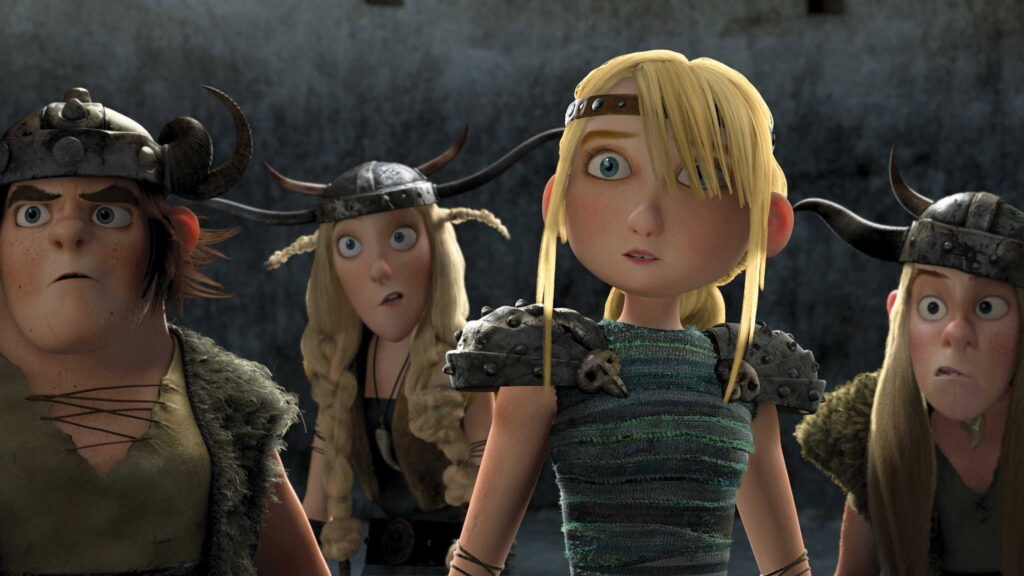
The other teens — Snotlout (Jonah Hill), Fishlegs (Christopher Mintz-Plasse), and twins Ruffnut (Kristen Wiig) and Tuffnut (T.J. Miller) — mostly deliver hammy, Madagascar-esque shtick, making dumb, flirty quips at each other every other scene. But hey, DreamWorks gonna DreamWorks. Besides, they’re as much a part of the bigger picture as they are a tonal nuisance. This is a coming-of-age story, and the teens are exactly what Berk’s way of life produces: kids who can rattle off a dragon’s stats but can’t imagine doing anything with one except killing it. They’re not quite ready to take on the mantle of defending Berk, but what generation of teens is ever ready for adulthood?
Above and beyond everything else in this movie, though, is John Powell’s score. Don’t get me started. (Too late.) It is one of the greatest adventure scores of all time, probably the best in the genre since The Lord of the Rings, and certainly one of the soundtracks I’ve listened to most in my life, good enough to just sit and pay attention to rather than play in the background. It’s filled with multiple interlocking themes from a variety of influences, all brilliantly orchestrated, and every lovely leitmotif deepens the emotions and impact of the story. Powell layers bagpipes, fiddles, and pennywhistles over a full orchestra and, when it counts, a choir, and he weaves his themes together so tightly that the music tracks the bond between boy and dragon as closely as the animation does: The flying theme introduced in the overture surfaces as a tentative variation in the cove, then returns in full, glorious voice once the two finally take to the sky. It’s the score that cemented Powell as one of my favorite modern composers. (It also landed him an Oscar nomination, which he lost to Trent Reznor and Atticus Ross for The Social Network; the same night, the film lost Best Animated Feature to Toy Story 3. Two nominations, two losses, both to masterpieces. I’ll allow it, though I would have given the Original Score trophy to Powell.
Every track is a highlight, but if I have to choose: the table-setting “This Is Berk,” which previews a bunch of the themes in a terrific overture; the springy “See You Tomorrow,” a reel straight out of the Scottish Highlands; the exquisite “Romantic Flight”; and, best of all, the heart-soaring “Test Drive,” which carries Hiccup and Toothless through their first real flight together.
The music is, I think, what takes How to Train Your Dragon from an excellent but quirky adventure story, full of heart, to a higher plane of greatness. I’ve watched it over and over, and I know its flaws as well as I know its best scenes. That’s what post-critical means to me: I wouldn’t change a single one of them. Every time Toothless banks out over the open water and Powell’s orchestra lifts off with him, I fall in love with the movies all over again.
Is It Good?
Masterpiece: Tour De Good (8/8)
Dan is the founder and head critic of The Goods. Follow Dan on Letterboxd. Join the Discord for updates and discussion.
One reply on “How to Train Your Dragon (2010)”
I like the movie, but must admit to having seen it for the first time on television and not in cinemas: grand wee movie it is too.
Also, it always amuses me to remember that the remake felt it could do without almost every single actor – except Gerry Butler, who presumably swaggered majestically into auditions (to a spontaneous chorus of ‘Returns a King’ from 300 from the potentials, naturally) and got his job back on the spot.
SHHH! Don’t spoil the beauty of an image with mere accuracy!