
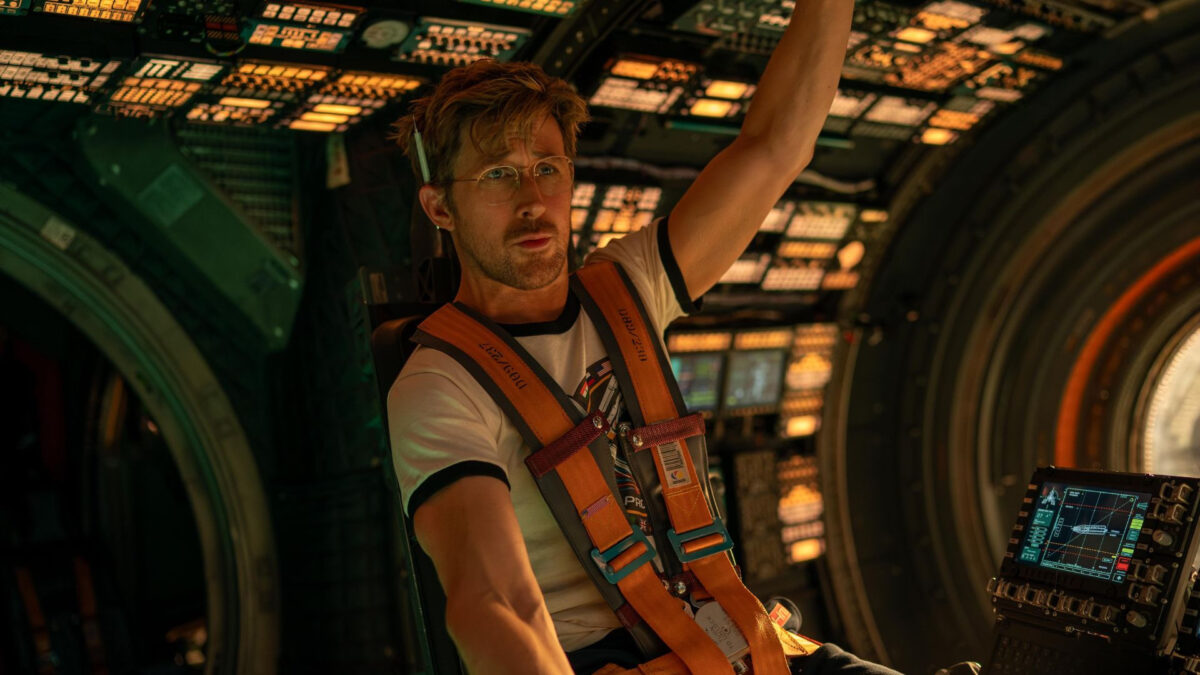
City of stars, are you shining just for me?
Growing up, I understood “hard sci-fi” as a genre with a double meaning: “hard” as in rigorously plausible constraint-based problem solving as the main dramatic focus, but also “hard” as in bleak. The struggle for solutions was inseparable from the struggle for survival, which was inseparable from grimness. But the last fifteen years have seen a boom in what you might call “nice-core” hard sci-fi, stories where the conflicts are still rooted in physics and engineering but the tone stays cheerful without sacrificing stakes. Becky Chambers blazed the trail with her charming, Hugo-winning Wayfarers series, coining a niche sometimes called “hopepunk.” The biggest breakout of nice-core hard sci-fi, though, has been Andy Weir, whose 2011 web serial The Martian became a bestseller on the entirely reasonable premise that dorky engineers with tech degrees need beach reads, too. Ridley Scott turned it into an Oscar-nominated blockbuster. Weir’s third published novel, Project Hail Mary, became a COVID-era smash in 2021 and immediately entered the Hollywood pipeline.
Phil Lord and Chris Miller might not be the obvious directors for a space survival adventure. Their only live-action features to date are 21 Jump Street and 22 Jump Street, buddy cop comedies grafted onto high school comedies. But it makes more sense than it might appear: the two Spider-Verse movies, which they envisioned and produced, have a relentless and well-calibrated control of space, plus a sense of humor that’s kin to Weir’s breezy science-geek tone. The animated work they’ve directed or produced (e.g. Cloudy with a Chance of Meatballs) has always carried a sense of colorful majesty and expansiveness that maps neatly onto the grandeur (and gravity manipulations) of space travel. Their films also exhaustively detail-oriented, fast-paced, and, simply and consistently, a pleasure to watch.
And so it is not a huge surprise to me, but still a great delight, that Project Hail Mary works very well. Lord and Miller have a terrific grasp of how to make the story engaging, and the choice to lean into the offbeat buddy comedy over nuts-and-bolts survival (a tonal choice that has been one of the film’s few divisive points among critics) is almost entirely a good one as far as I’m concerned. The result has less tactile survival tension than Scott’s The Martian, to the point where you might downgrade it to “hard-ish” sci-fi. (Firm sci-fi? Pliable sci-fi? Squishy sci-fi?) But it has more color and personality than The Martian, and definitely more laughs, to compensate.
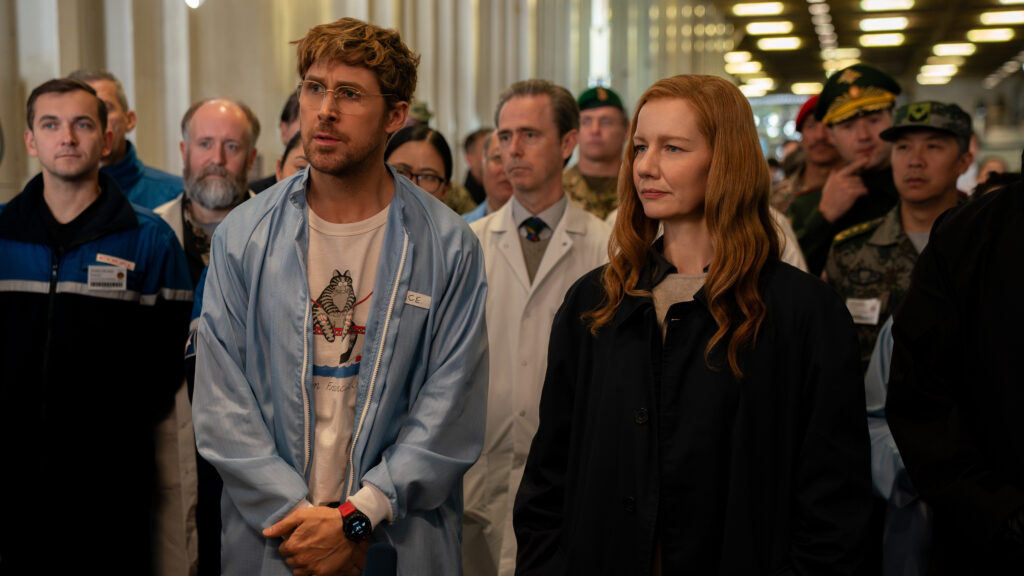
Part of the fun of the film is gradually discovering the film’s premise as it unfolds at the same time as its amnesia-ridden protagonist, middle school science teacher Ryland Grace (Ryan Gosling). We meet Grace when he wakes up stranded on a spaceship very far from Earth, his memory foggy, and the only surviving crew member. Before long we get the rough sketch of a mission to discover a cure for sun-eating microbes called “astrophage,” and not long after that, Grace encounters another spaceship, one not from Earth.
Gosling is the film’s anchor, and he is the exact right actor for this. His charm, physical comedy, and vulnerability carry enormous stretches of what amounts to a solo performance, and his screen presence keeps the movie afloat even when the script over-explains or the pacing sags. The obvious comparison is Matt Damon in The Martian, or Tom Hanks in Cast Away, but it’s a quirkier performance than either of those because Gosling’s charisma has a slight neurotic edge to it. Gosling is, at heart, a little, sad goofball. He cut his chops in movies like Lars and the Real Girl, and he brings a real streak of that weirdo energy to this material. It’s both an original performance and one that locks in his status as a genuine star, if it was even remotely unlocked.
The rest of the cast is good, too. Sandra Hüller is wonderful in a supporting role as a no-nonsense government agent in the flashbacks; her character could easily have been a downer or a cliche. She grounds the Earth-set material in the apocalyptic seriousness of the scenario, keeping the film from getting too light when it needs stakes to pack its full emotional punch. Despite a totally different demeanor, she has great chemistry Gosling, even when their interactions hit some dark points late in the film. She even gets an emotional payoff in karaoke rendition of Harry Styles’ “Sign of the Times” for a group of characters on the verge of a life-or-death mission. (The performance was reportedly not in the original script and semi-improvised.) It’s frankly as touching a scene as any of the more heavy-hitting emotional beats later in the film.
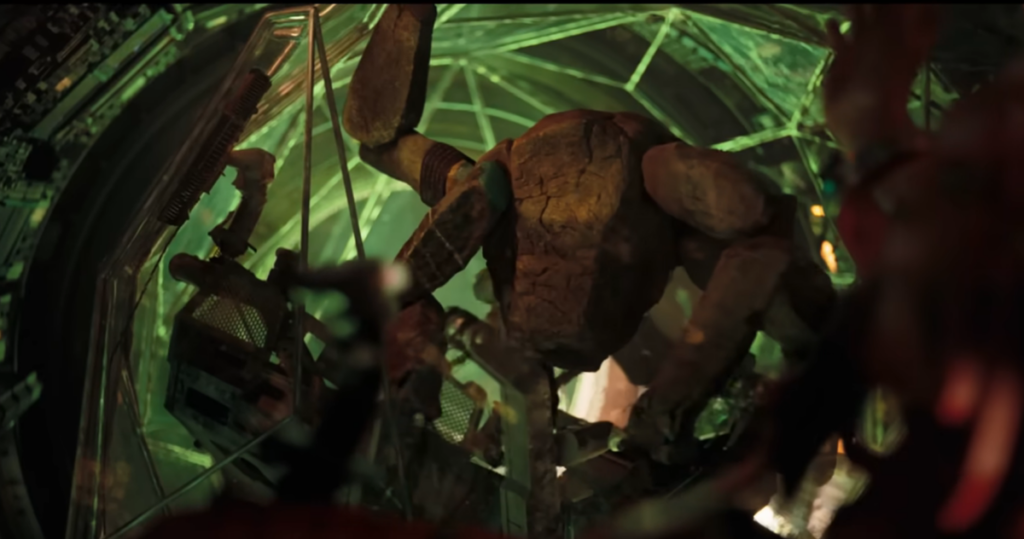
But the real breakout performance, if you count it as such, is Rocky. James Ortiz provides both the puppetry and the voice for a faceless, five-legged rock alien who nonetheless generates real expressiveness, comic timing, and emotional investment. Lord and Miller’s decision to keep Ortiz’s voice rather than dubbing him with a celebrity was extremely sharp; it gives the character an authenticity and strangeness that a famous voice would have smoothed away.
The craft here is top-shelf for a blockbuster when one’s eyes are tempered for superhero browns and grays. Greig Fraser’s cinematography is outstanding, working with Lord and Miller’s direction to create a memorable spaceship setting and build some innovative set pieces. The biggest swing comes in nearly-abstract swirling greens and oranges of a climactic planet harvesting sequence. Fraser applies sensational IMAX-native photography that makes clever use of rotated anamorphic lenses to show shifting gravity. (I was lucky to see this on the biggest IMAX screen in Virginia, just a few hundred yards away from Space Shuttle Discovery.) The film has a lot of innovative shooting and production, with none of the typical use of green or blue screen keying and compositing: All backgrounds were practical or shot against solid-color backdrops with VFX layered in afterward, and the tactile weight of the sets shows.
Daniel Pemberton’s score, meanwhile, is inventive and striking, built from organic and unusual sources: steel drums, wood blocks, hand-claps, choral vocals, and, according to the composer, a sampled squeaky faucet. It has a bit more edge and personality than the typical sweeping big-budget epic score, with a “sciencey” sort of feel, and it’s a perfect match for the film’s atmosphere.
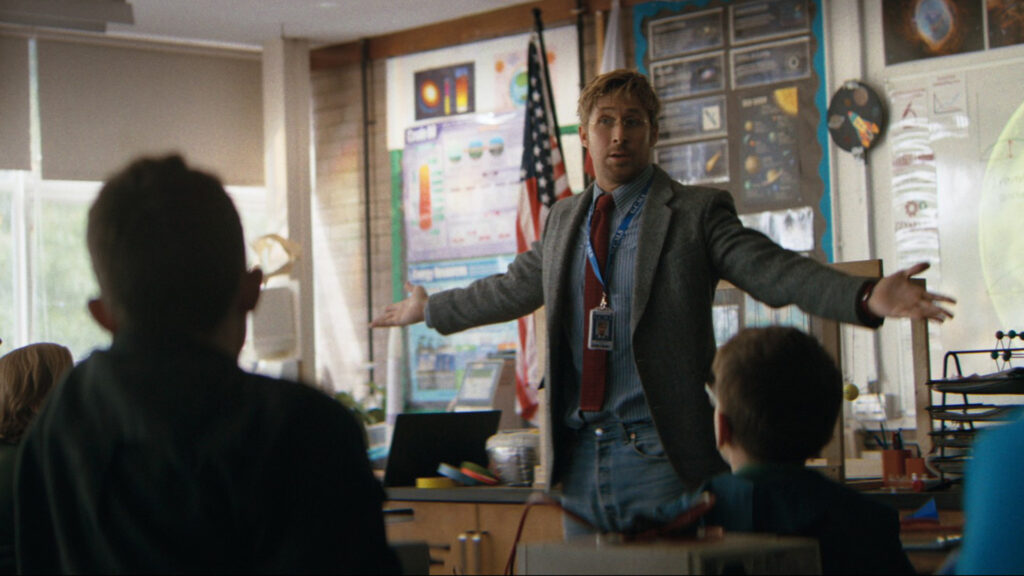
The screenplay by Drew Goddard hits the mark in terms of making the dense science accessible without dumbing it down, and he effectively translates the novel’s memory recovery-as-flashback structure. We learn the backdrop and stakes of his mission at the same pace Grace recovers his memory, and the cadence of reveals is pretty satisfying.
Where the film stumbles, and it does stumble, is mainly in its third act, which is bloated to the point that I found my cynicism starting to curdle as the credits approached… or, at least, as I thought they approached. Project Hail Mary blows past three obvious ending points and still keeps going, like this is Return of the King, and while I’ve gathered that the issues are endemic to the source material, Lord and Miller show little ambition to streamline or trust in the audience to accept ambiguity or suggestion: they apparently even expanded the ending a bit. The runtime of 156 minutes is taxing, almost backbreaking, and soured me to the point that I am tempted to bump the score you see below down a notch. Much of the expository dialogue and repetitive beats could have been trimmed in addition to a smoother sign-off. Tonally the film has a few moments that don’t land, and I don’t mean the comedy: Lord and Miller indulge in a little bit too much emotional manipulation: we get so many “goodbye” and/or near-death scenes for Rocky that they start losing impact by the end, and the writing tilts a bit towards over-explained. (Although, to be fair, this aligns with Weir’s procedural, step-by-step prose style.)
But even in the strained sections, Project Hail Mary is a damn treat, funny and flavorful. I try not to hold against it the instinct of erring on the side of generosity to its characters and its viewers. Even with an eye-popping runtime, it honestly never drags; it is a fun movie from start to finish, and occasionally even inspiring. And that might be the biggest praise you can give nice-core sci-fi: even as it overstays its welcome, you walk out both entertained and looking to the stars.
Is It Good?
Very Good (6/8)
Dan is the founder and head critic of The Goods. Follow Dan on Letterboxd. Join the Discord for updates and discussion.
5 replies on “Project Hail Mary (2026)”
Huh. Notwithstanding the overdetermined nature of the flashbacks that are still showing up late into the movie, and I’m not sure you’re counting that as “the ending,” that’s probably my favorite stuff here. Didn’t really feel the runtime as I often do, and to the extent I did it’s in the first thirty minutes.
The science strikes me as borderline nonsense, not that this is a real problem, and it tries too hard to be funny, which is, but I pretty much love the thing.
(Hm, more like “overdetermining.” Anyway, some kind of ten dollar word.)
I read your review and you brought up a few flashback scenes and comedy moments I hadn’t really been thinking about that definitely strain the humor, but I mostly like that it went for being a comedy, although I definitely am at least curious what this movie would be like if it were less jokey.
It’s funny how we both liked the movie fairly similar amounts (I’d probably be a t a 7) but came in with different strengths and weaknesses. Funnily enough I actually liked the last flashback scene for undercutting the hero tropes (I detected it in Gosling, but didn’t think it would go quite that far; though I think you’re right it’s a bit of a misstep to treat it as something of a “twist”). But I’m not sure how much this movie gains from anything after their first farewell, which really felt like the last scene, not the eight-to-last or whatever. (I guess it closes the loop on the “bravery” theme.) None of it is bad, but I felt it deflated the very strong stuff around the climax.
(Spoilerssss) Hard disagree: I kind of think it gains everything? I mean, he saves Rocky and 40 Eridani at the cost of his own future (though living on an alien planet is, of course, a compensation). I love that it banks on having established full empathy for a puppet–gamble paid off for me, anyway. (I will agree without quibbles that revisiting Earth at all is pointless–he saved Earth, I know! For that matter, why do you keep reminding me that they didn’t have a laser communication rig on this ship, in case what he discovered at Tau Ceti did *not* require physical samples? Surely a year-or-so of extra time to implement the solution would be sufficiently better it would justify the expense?) I do still think the difficult cuts they needed to make to get this bloated runtime down involve the flashbacks and especially the first thirty minutes.
I guess I thought the payoff on their bond was the way he way Grace watched over Rocky as he recovered, though I guess he didn’t really do anything to save him then, so you’re definitely right that it definitely deepens with the late mini-act to go save Rocky in his ship. I thought the final alien planet pushed the corny speculative stuff a little far (for some reason seeing just one and a ship bothered me less). I guess my main issue is that the fishing expedition felt like the final climax, and the first farewell would’ve been a really perfect last moment for the pair.
I think you’re right that they could and should have tightened the early going to — definitely contributes to my hangups.