
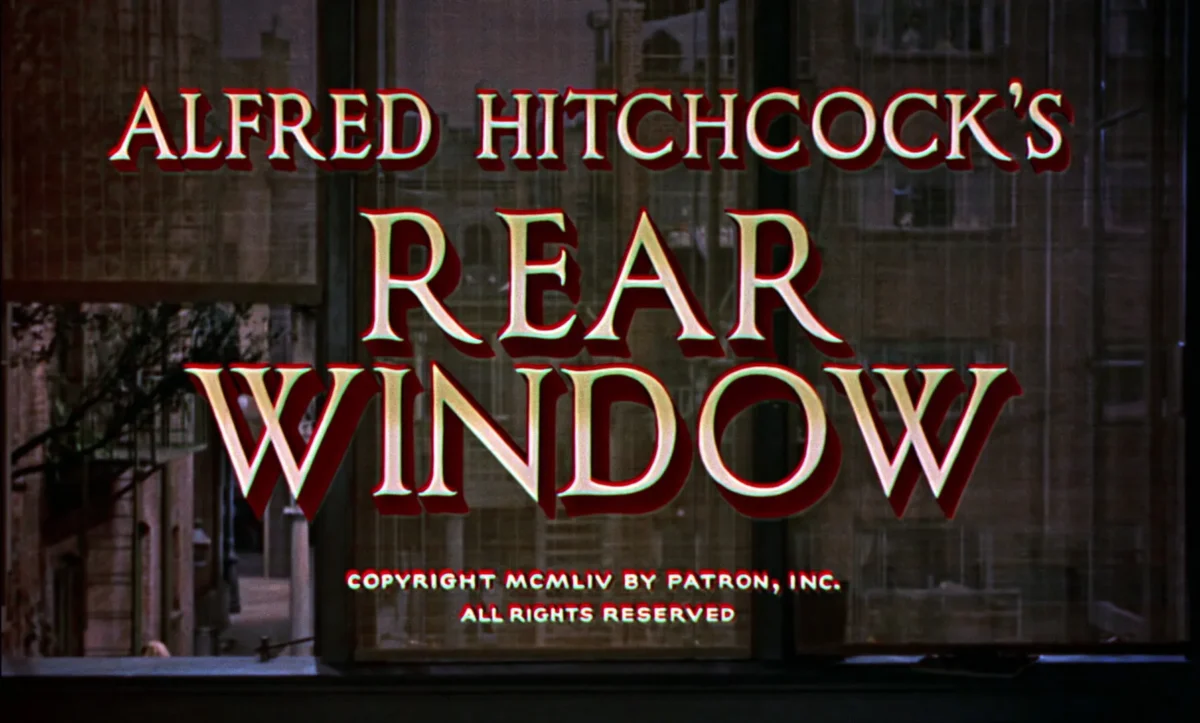
The conquest of thy sight
Cinema is twenty-four pictures per second with synchronized sound, and somehow it builds vast universes inside our imaginations. We sit down to watch something captured and assembled by strangers, but can only perceive it through our own memories and senses. We bring a little of our souls to the screen; we leave with our souls changed, maybe expanded. Filmmakers have been poking at these contradictions, the dependent relationship between camera and eyeball, since the medium was birthed, but few have done it as thoughtfully, beautifully, or disturbingly as Alfred Hitchcock in Rear Window.
The film is shown entirely through the perspective of L.B. “Jeff” Jefferies (James Stewart), a daredevil news photographer immobilized by a broken leg and stuck in his apartment, viewing the world through the titular glass pane. Jeff opens the film at a romantic standstill just as important as his physical one: He is reluctant to commit to Lisa Fremont (Grace Kelly, outrageously beautiful). He’s stewing, sweating through a heat wave, reduced to watching other people live. His camera is parked, but his instinct isn’t: he still hunts for stories and images, but his subject is ordinary life rather than exotic dangers. He prides himself on being self-sufficient and unattached, but is suffering from impotence; the cast may be on his leg, but the real splint is on his heart and his manhood.
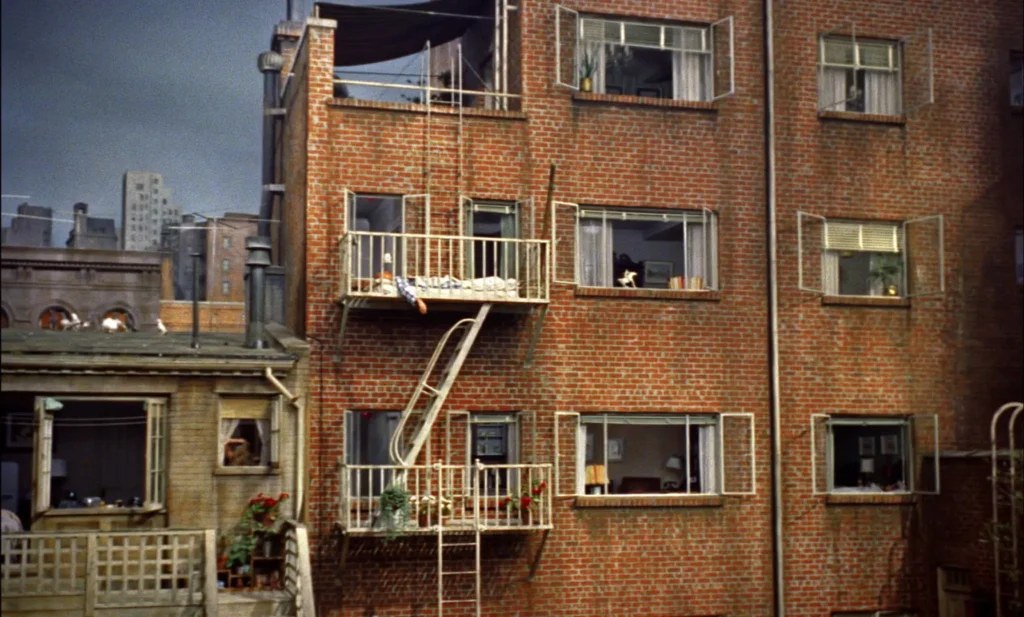
In Rear Window’s opening moments, Hitchcock raises the shades in Jeff’s room like a theater curtain. We join Jeff in peering outside at a courtyard that becomes a multiplex: Every window is a screen; every screen contains a story. Jeff is these stories’ audience (along with, you know, us, the actual audience). Each miniature movie echoes some version of Jeff, past, present, or imagined future: loneliness here, seduction there, domestic routine a few panes over, until we’re not sure whether the courtyard mirrors Jeff’s impulses or catalyzes them.
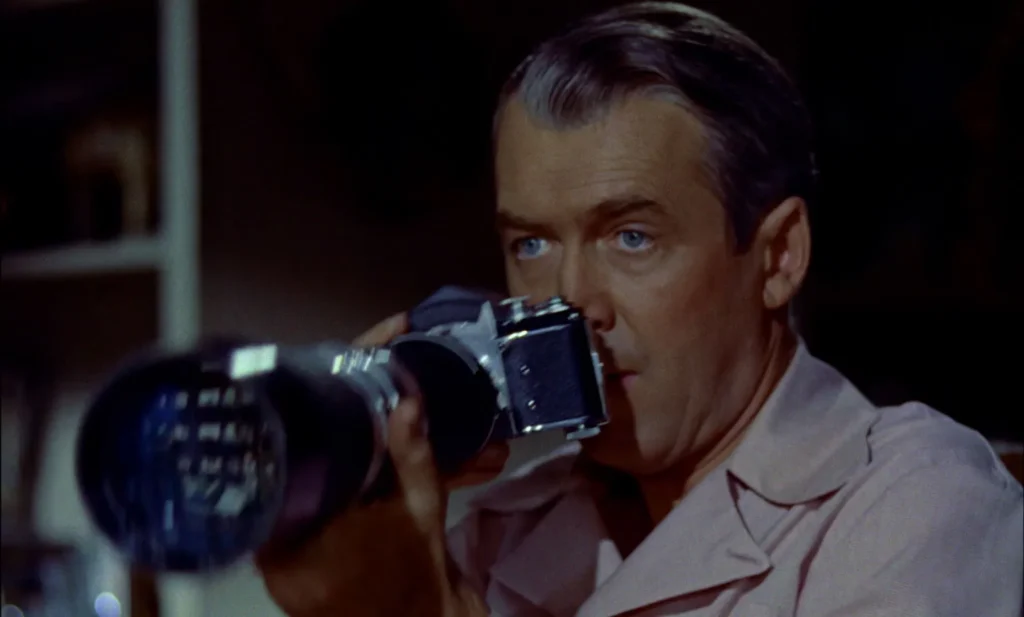
The trick is that Jeff isn’t just the audience; he’s also the director in miniature. Before long, he pulls out his camera and composes shots with his own lens. He edits them with his attention. The movie understands how we consume movies—projecting desire and dread, knitting motives out of suggestion—and then turns the blade around to implicate the creator. If the audience’s impulses are voyeuristic, the director’s might be something worse: constructing worlds to satisfy the same appetites, then pretending surprise when the appetites answer back.
The neighbors are a diorama of love and loneliness: Miss Lonelyhearts (Judith Evelyn) pouring herself a dinner for two; a newlywed couple vanishing behind blinds; Miss Torso (Georgine Darcy) showing off her beauty as men orbit; a songwriter (Ross Bagdasarian) depressedly plinking out broken notes in hope a song will emerge; a couple with a small dog, lowering and raising it on a basket each day like parents letting their kids out into the world. Each apartment is a possible future for Jeff and Lisa, and because he can only watch, never enter, he projects his anxieties onto them. Whether the dramas he narrates are real or invented matters less than the fact that they are, almost inevitably, about himself. Hitchcock’s fascination with cinema as therapy runs through all of this, as with many of his best films. Six years later in Psycho he drags it to a darker, more perverse terminus.
The plotline that hooks Jeff is the simplest and most poisonous: the husband across the way, Lars Thorwald (Raymond Burr), lives with a sickly wife who suddenly vanishes. Jeff decides Burr has done something unforgivable. It’s a convenient story if you’re a man made queasy by the nearness of marriage; it rhymes with a selfish fantasy that life would be easier without Lisa. Jeff always seems to grow fascinated with Thorwald as Lisa grows intimate with him. The suspicion flatters Jeff’s cleverness while indulging a more shameful wish.
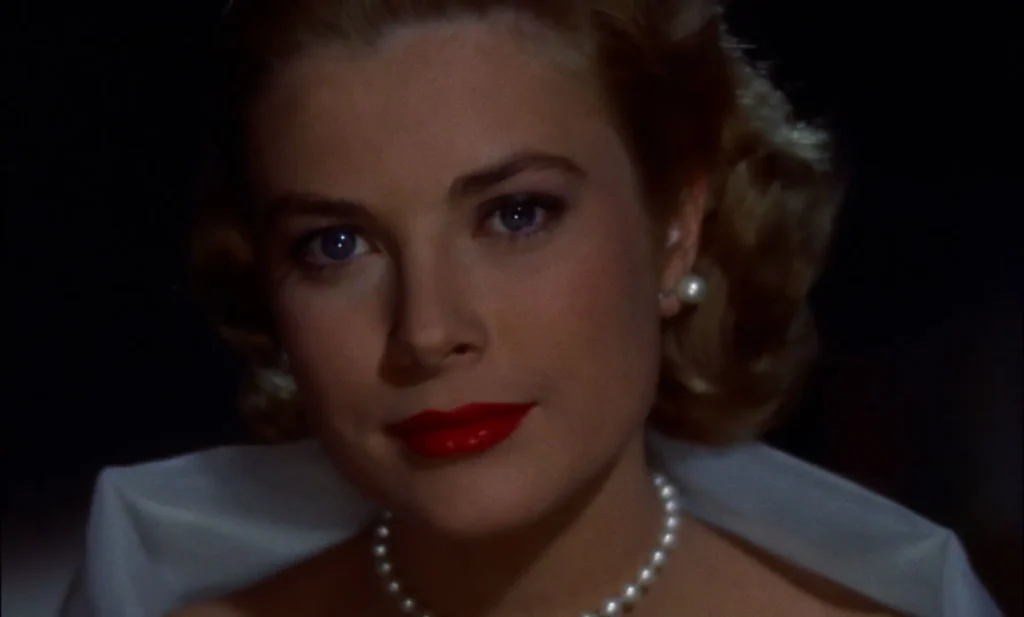
Hitchcock frames Lisa as both perfect and daunting, which offers a layer of horror for Jeff as he reckons with an imposing woman who still loves him. Lisa is otherworldly and immaculate, a Park Avenue dream who floats into Jeff’s room and dims the lights in a way that’s both sexy and frightening. She has one of the great entrances in all of cinema: she descends upon Jeff so close the lens can’t contain her, a vision of beauty so overpowering it curdles into dread. She’s also a mirror image of Burr’s missing wife, the pristine object that could either rescue or suffocate a man who worships his independence. Jeff loves the spectacle of her; he’s less sure about the obligations of the person.
Like any good storyteller, Jeff eventually sucks his companions into the narrative, though they have reservations. Stella (Thelma Ritter), his nurse, becomes the snarky chorus, diagnosing him as a Peeping Tom, but leaning forward to see better before long. Lisa starts troubleshooting the case with him, too; their speculation becomes a twisted courtship ritual. The more she engages, the more the “city girl” he underestimated reveals a taste for risk, which turns him on and fires his imagination for sordid deeds even higher.
Hitchcock delivers all of this with a clinic in pure cinematic vision, contained by the limitation of telling the story from the lens of a single room. He employs the Kuleshov effect, where meaning is made in the cut: the camera holds Stewart’s unreadable face, then supplies context in the next shot so our minds solder emotion between them. A glance right plus a knife equals alarm; a glance left plus a kiss equals yearning.
He pushes that controlled craft bordering on experiment into the soundtrack. Rear Window has no score in the conventional sense: only the world’s music, and chiefly the neighboring songwriter, as he drafts and discards phrases that eventually resolve into a finished tune. Hitchcock later complained the idea didn’t land as he’d hoped, and sure, it’s less stirring than the brilliant Bernard Herrmann collaborations to come in Vertigo and Psycho. But the conceit still works: the entire presentation of the courtyard, including that limited score, composes itself just as the story Jeff imagines about Thorwald takes shape.
The film has two antagonists: 1) potential murderer Thorwald, and 2) boring, logical reality. The latter takes shape via Detective Doyle (Wendell Corey), a friend of Jeff’s, who drops by to pour cold water on the story, the murder we aren’t sure even happened. Corey’s skepticism is a necessary counterweight to Jeff’s certainty. He punctures Jeff’s cinematic illusion, and after he seems to pour water on the case at the movie’s two-thirds mark, Lisa closes blinds on the little movie. The figurative and literal curtain falls. Intermission. For a moment, we let reality win. The darkest story in the courtyard is just a man’s boredom manifest.
And then a scream cuts through the night, and Hitchcock pulls us back into his dark game. We’ve already paid the price of admission, right? We’re hands are not clean. And here’s where the movie really gets good. A great director synthesizes different ideas into a powerful whole. Hitchcock did it for decades, and Jeff does it here: Those discrete, boxed-off stories he saw in the courtyard start colliding. And as they do, the audience gets fully sucked in: Lisa exits the room and crosses the boundary into the courtyard, essentially stepping into the screen like Dorothy stepping into Oz. And in the film’s most harrowing visual moment, the boundary gets pierced the other direction: Jeffs’s imagined murderer, Thorwald, looks up and stares directly into the camera. Our thrill at his crime story transforms into danger staring us directly in the eyes.
Hitchcock’s control of scale and point of view is unmatched in Rear Window, especially in its dynamic second half. He alternates between prying, zoomed-in, flattening telephoto shots with intimate close-ups of Jeff and Lisa, but when the dog is discovered dead, the visual grammar shifts a little: The angles are a little more askew; the wide shots start connecting different stories and characters.. In that moment the film gets a communal perspective and, with it, a communal shudder: connection erupts where compartmentalization once reigned. The stories bleed out of their frames.
All along the movie has carefully peeled away at a complicated core, one that’s more ambivalent than it might seem at the outset. We are voyeurs prying at windows that aren’t ours to open, our heroes threatened by the act. And yet, art changes us by letting us enter those windows. The film refuses to declare the act of looking purely corrupt or purely redemptive. It can be both: a violation that also teaches empathy; an impulsive habit that risks cruel thrill-seeking but sometimes saves a life by opening a door, a window, a heart.
The film’s climax is one of Hitchcock’s all-time breath-stealers: Thorwald ascends toward Stewart’s apartment, a shadowy judge. Jeff has nothing left but the tools of his trade: a camera and a box of flashbulbs. In case it wasn’t clear before, it is now: Jeff is Hitchcock confronting his mixed feelings about his craft. Jeff fires light like a weapon, each burst a desperate attempt to push back the man and the danger his imagination birthed. With each click, the screen whites out, over and over. Each flare becomes a heartbeat of borrowed time.
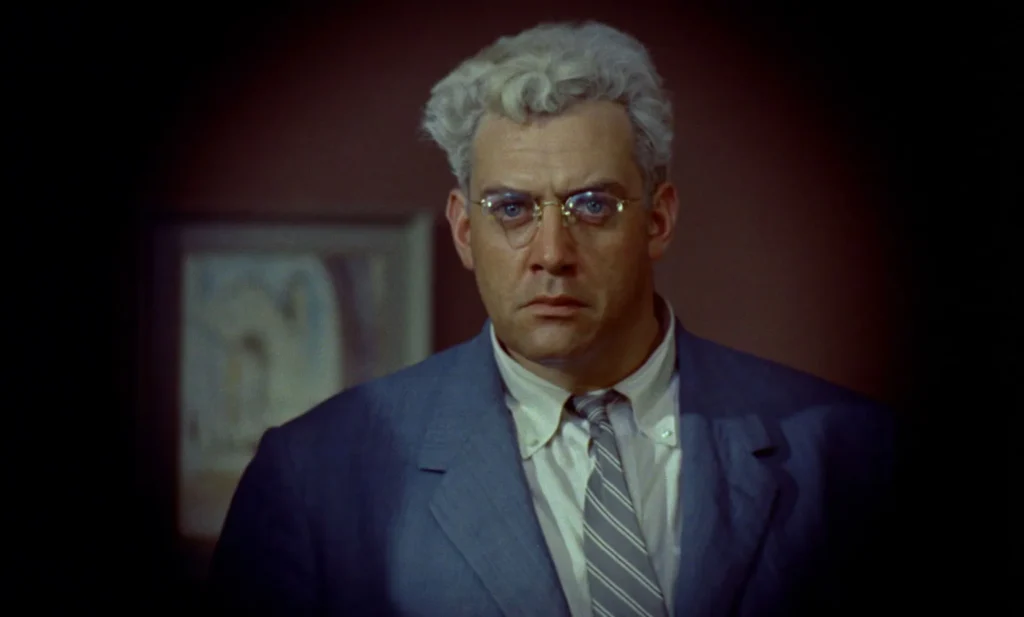
In those final beats, the film’s various ideas about masculinity and moviemaking come crashing together. Impotent Jeff becomes a stand-in for Hitchcock, making danger real with nothing except attention and arrangement, then discovering he can’t will it away. Thorwald and Jeff blur together the cutting, the rhythm accelerating: victim and author, subject and spectator, murderer and moviegoer, locked in an exchange of glances and blows with only the projector’s light between them. The thing in Jeff’s heart — his appetite for spectacle, control, violence — steps out of the frame and reaches for his throat.
The resolution offers an uneasy exhale. Balance returns, sort of. Stewart naps with a cast on both legs, an absurd, almost comic symmetry, while Kelly lounges nearby reading an outdoorsy magazine before cheekily swapping it for Harper’s Bazaar. The neighbors’ dramas bleed into one another: the composer’s melody finally lands with Miss Lonelyhearts his loving laudience; Miss Torso’s missing man returns like Odysseus, the suitors scattering. A new balance is achieved.
But what lingers is ambivalence: Jeff has been punished for looking, more immobilized than before, and also redeemed by it. He is chastened, cracked open, maybe kinder. The rigid, immobilizing cast is at once a phallic symbol and a weakness symbol. And Hitchcock puts a bow both on Jeff’s emotional journey and his broader observation about why he makes movies, and why we watch them: Rear Window’s finale suggests that watching is a risk worth taking, not because it’s safe but because it confronts what we’d rather not admit about ourselves, discovering something and growing in the process.
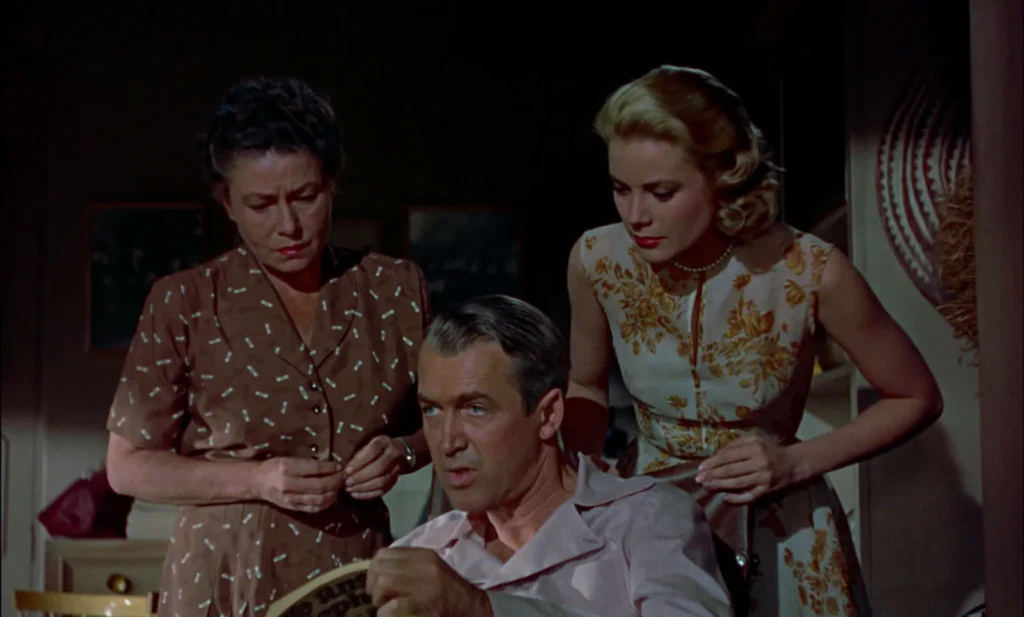
Rear Window plays perfectly well as a high-grade thriller, a mystery that keeps worrying at a death that might not have happened. On that level alone, it’s nimble, witty, impeccably built. The cast is outstanding — Stewart finds a dark core to his classic aw-shucks image (a use of Stewart that Hitchcock first tried in Rope and perfected in Vertigo). Kelly is wonderful and commanding; Ritter is hilarious and charming. The script spins gold, creating a profoundly engaging scenario out of its limitations. It practically invented a story template, where someone solves a crime in the outside world while stuck inside a room. “Doing a Rear Window” is as much a shorthand these days as “doing a Groundhog Day” or “It’s a Wonderful Life.”
But the reason Rear Window lingers is everything under the surface: the sexiness woven through its violent suspense; the fantasy of escape braided with the mirror it holds up to our messiest truths; the contemplation of why we seek out dangerous stories in the first place. Hitchcock makes a movie about the movies — about the terrible, beautiful intimacy of seeing and being seen — and, in the process, he lets the audience feel both the heat of the flashbulb and the chill of the night air from an open window. It’s a spectacular entertainment, self-portrait, and séance: light, shadow, blood, and us.
Is It Good?
Masterpiece: Tour De Good (8/8)
Dan is the founder and head critic of The Goods. Follow Dan on Letterboxd. Join the Discord for updates and discussion.
3 replies on “Rear Window (1954)”
Interestingly, I’ve seen this film and the remake featuring Mr Christopher Reeve: both are rather good, but not on my list of favourites.
On the other hand the original has Thelma Ritter AND Grace Kelly, so what more could an admirer ask?
…
One would say that I like the two of them for different reasons, but in all honesty it would be more accurate to say that they’re equally charming in different styles, rather than in different degrees.
Haven’t seen the remake. I wouldn’t mind giving it a shot. I like Christopher Reeve but I’m very skeptical a remake could match Hitchcock’s touch. Glad you like it though!
Ritter and Kelly are SO good in this!
If Thelma Ritter ever gave a performance where she was NOT a National Treasure, then I have yet to see it.