

Value sans sentiment
Every time a Scandinavian director gets praised for making a film “reminiscent of Ingmar Bergman,” I brace myself for two hours of immaculate misery and a big, chilly lesson about how people are flawed and feelings are difficult. And sure enough: Sentimental Value is the kind of movie that’s so wonderfully made — carefully constructed, brilliantly acted, thematically rich with schematic precision — that I can’t help but respect it and engage with it. And I did. I nodded. I admired. I took mental notes. And then, when it was over, I was mostly moved in the way you’re moved by a particularly enlightening museum placard.
The film is about breakdown between generation, and the role in art in both causing that divide and mending it. Nora (Renate Reinsve) is the grown-up oldest sister of a well-off family that’s eternally sore and distant for no clear reason except the existential pain we pass from generation to generation. Her father Gustav (Stellan Skarsgård) is an acclaimed film director whose career kept him away from his family so much he may as well have abandoned them. Nora, a successful but emotionally fraught stage actress, lives a life simultaneously in rebellion of her father and inevitably following in his footsteps, curdling in angst even as she’s actively trying to heal from it.
The metafictional hook is that Gustav comes crashing back into Nora’s life wanting to cast her in a film that may be his last, and is telling the story of his mother’s sad life. We recognize, of course, that’s also about Gustav, and also about Nora. Trier (with co-writer Eskil Vogt) pinpoints that exploiting pain is what artists do, and also what tears families apart; but what if your family is made of artists? The movie keeps pondering the spiritual cost of being a creative: Who pays the price when one person gets to turn everybody’s pain into a beautiful expression? Can such an experience be not just agonizing but therapeutic, like a deep tissue massage? Or does it rend the heart irreparably?

That’s the idea-level stuff, and it’s quite strong. The problem, at least for me, is that Sentimental Value can feel like it’s presenting those ideas in very clean, typewritten paragraphs. Scenes land, make their point, and then shuffle you along to the next. The emotional temperature stays so controlled that, outside of a handful of surprising moments (like Gustav’s reunion with his old cinematographer and Agnes, played by Inga Ibsdotter Lilleaas, professing sudden warmth for Nora’s role as an older sister), I felt like I was looking at these people through glass. Trier captures small variations in emotional state, and he gives the footage a pleasant glow, especially some scenes shot at golden hour, but the overall demeanor is still cool enough to keep you at a polite distance.
Reinsve is the best argument the film has for heat. Nora is written as a bit opaque, unlikely to monologue her way into catharsis or dictate the themes, but Reinsve gives her a soulful, devastating interior life. She captures both the natural beauty and charm of an actress like Nora, but doesn’t shy away from the character’s shriveling heart. It’s a performance built of restraint that still feels messy and tragic in the right places. You watch Nora and truly feel a suffering person who’s tried to work through it but doesn’t have the answers, depressive spirals and self harm always just one bad episode away.
Skarsgård, meanwhile, is doing something that’s both impressive and (for me) aggravating, which is certainly the point. Gustav is contradictory: arrogant and vulnerable, magnetic and self-obsessed, honest yet still incapable of addressing his own hangups. Skarsgård doesn’t soften the loser, and in fact probably should have softened him a bit so we were rooting for him more. I kept bumping on that issue: the central conflict here, the father abandoning his family for art, is totally alien to me, a fantasy for a regressive male ego that the film doesn’t critique harshly enough in my eyes. But I’m a dad myself, so I’m susceptible to strong feelings about movie dads. Sentimental Value understands the harm Gustav causes, but doesn’t really crack it open; the daughters on an emotional island go through a harsher gauntlet to contentment than he does.
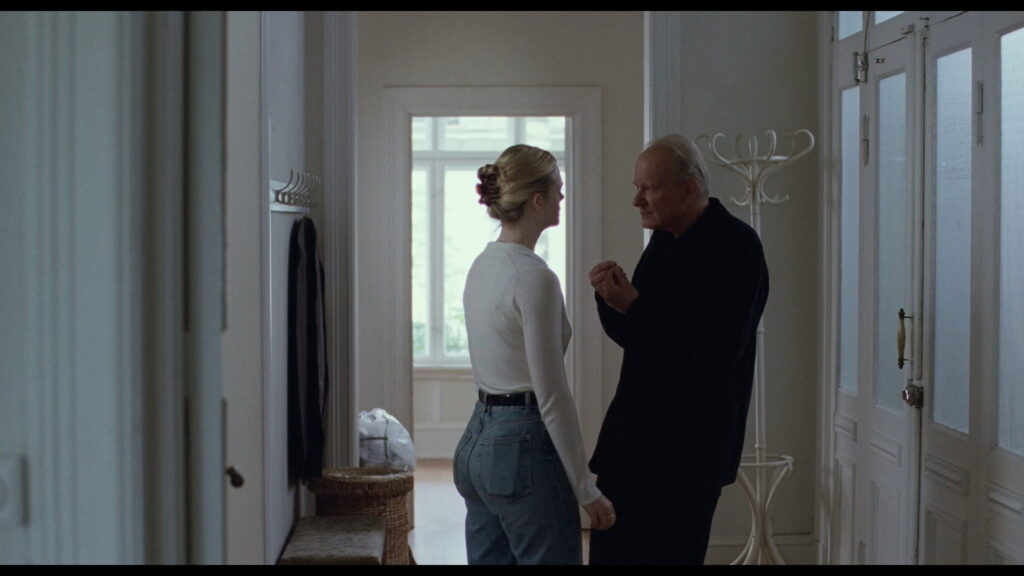
The most purely idea-driven character of the bunch is Rachel Kemp (Elle Fanning), an American actor who enters the orbit as a foil for Nora, filling in Nora’s role in Gustav’s film. Fanning is doing fine work with what she’s given, but the character is pretty purely a a narrative instrument rather than a fully realized person. When the movie shifts toward industry commentary around her, that’s also around the point the runtime starts to feel a little baggy (same with Agnes’s subplot of researching the family at a library). At 135 minutes, the film earns a lot of its space, but it also has stretches where I could feel the gears turning. The movie suggests some strange sexual tension between Rachel and Gustav in their early scenes, but backs off that rather than diving into uncomfortable, Freudian territory once it becomes clear that Rachel is standing in for Nora in Gustav’s recovery story.
So yeah: Sentimental Value is a solid movie, maybe better than solid. I don’t begrudge the acclaim it’s been getting, and I won’t rage against any of its acting nominations. It’s intelligent and beautifully performed, and genuinely fascinating to talk about, especially in how it layers its characters and subplots as the crossroads of its many themes about art and the inheritance of suffering. I just wish it made me feel those truths in my chest more often than in my brain; I think it says something that the movie’s saddest scene is montage of a renovated home interior, absent people. Rarely is the gap between distant respect and deep love I feel as wide as it is here.
Is It Good?
Good (5/8)
Dan is the founder and head critic of The Goods. Follow Dan on Letterboxd. Join the Discord for updates and discussion.