
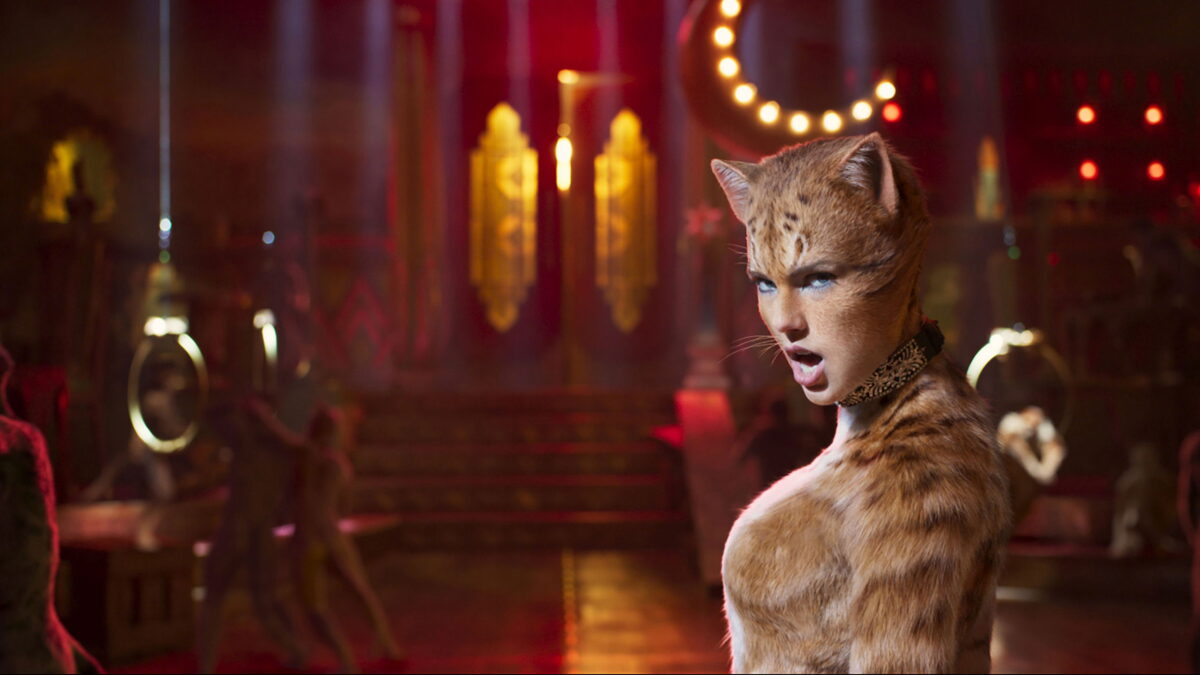
And if you meow long into an abyss, the abyss also meows into you
There’s a case to be made that the true line of demarcation between the before-times and the after-times is not March 2020, when the world shut down as COVID spread and quarantine began, but a few months earlier, when Cats arrived in theaters. It was already a boondoggle by the time it opened: a hundred-million-dollar monument to bad decisions that audiences rejected on contact. And then, almost immediately after, a global pandemic descended and most of the Earth shut down. Correlation is not causation, but I’m not ruling it out. Cats has the energy of something that broke a seal that should not have been broken, a cultural artifact so ill-conceived that the universe itself fought back, like when the Nazis opened the Ark of the Covenant in Raiders of the Lost Ark.
The film, directed by Tom Hooper, opens with a pedestal shot swooping down from the sky, scored to a jangly, nerve-shredding score, and before you even register a single image, you already feel assaulted. A human tosses a kitten in a bag out of a car window as strange figures move in the shadows, and what emerges is no mere feline but a cat-woman; and not a sexy leather-clad criminal, but a violation of the laws of nature. The character designs, inspired by the stage show but unholy on screen, got every conceivable choice wrong. These are human faces pasted onto smooshy, bipedal cat bodies with a digital fur texture. It does not suggest “cat,” it suggests “corruption.” They have human hands and bare human feet (except for maybe three out of the twenty-five who inexplicably wear shoes). The result parks itself so deep in uncanny valley that even a still image is enough to make you flinch, and then you remember that almost every person on screen is a genuine superstar and somebody spent the GDP of a small nation to inflict this on the world, and it’s simply too much to process.
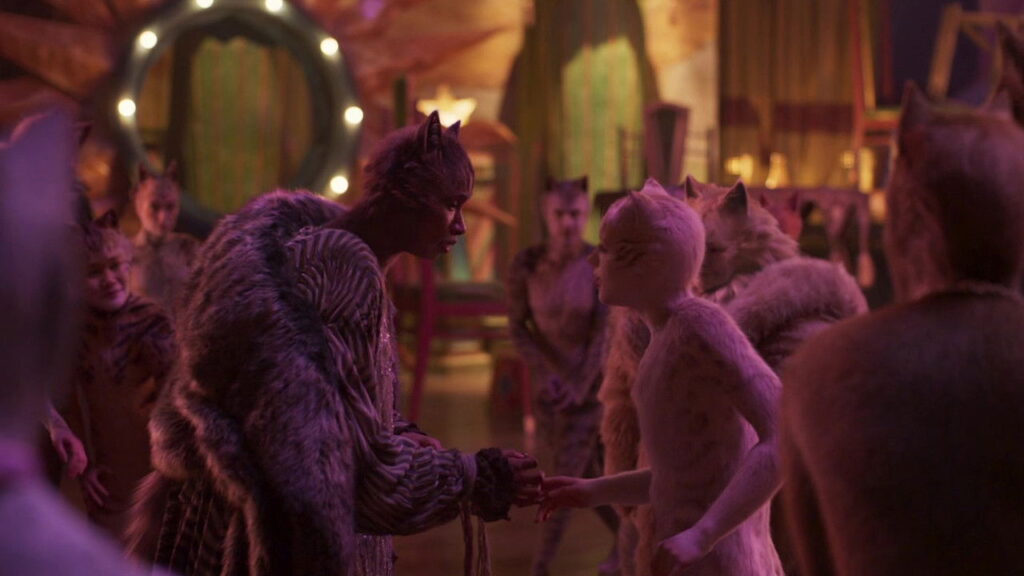
There’s a reason the stage version of Cats has not caused the collective cultural nausea that the film has, and it is: the abstraction of the stage. When you’re in a theater watching people in face paint and fur bodysuits doing acrobatic cat poses from forty feet away, your brain fills in the gaps. You imagine an anthropomorphized cat. It has a charm to it, a theatrical curiosity at the physical marvel before you. But rendering that exact same concept on film, where CGI is supposed to create more realistic rather than abstract imagery, reverse-engineers the magic into something grotesque. The almost-all-digital recreation of the stage costumes and sets that Hooper and his team landed on is simply misbegotten. The always-moving camera weaves around these digital bodies in a way that triggers both motion sickness and aesthetic sickness. For long stretches, I genuinely could not tell what, if anything, was physically real in the mise-en-scene. The digital gloss coats everything so thoroughly that even real objects look fake.
And the structure, such as it is, amounts to this: the first half of the movie is cats introducing themselves, and the other half is a talent show where the winner gets sent to heaven. Or something like that; everything is discussed in a garbled nonsense argot. A white cat named Victoria (Francesca Hayward) finds herself in an alley, and then for the next hundred minutes, one Jellicle Cat after another steps forward with a new wacky name, sings a song with some made up words, and generally has one trait: Here’s a fat one. This one’s a magician. And look at this femme fatale cat played by Taylor Swift. The cats start coming and they don’t stop coming. I was reminded, multiple times, of Alice in Wonderland (which I am generally not a fan of) if it had even less connective tissue and coherent character motivations; unordered encounters stacked on top of each other, none of it accruing towards anything resembling a narrative.
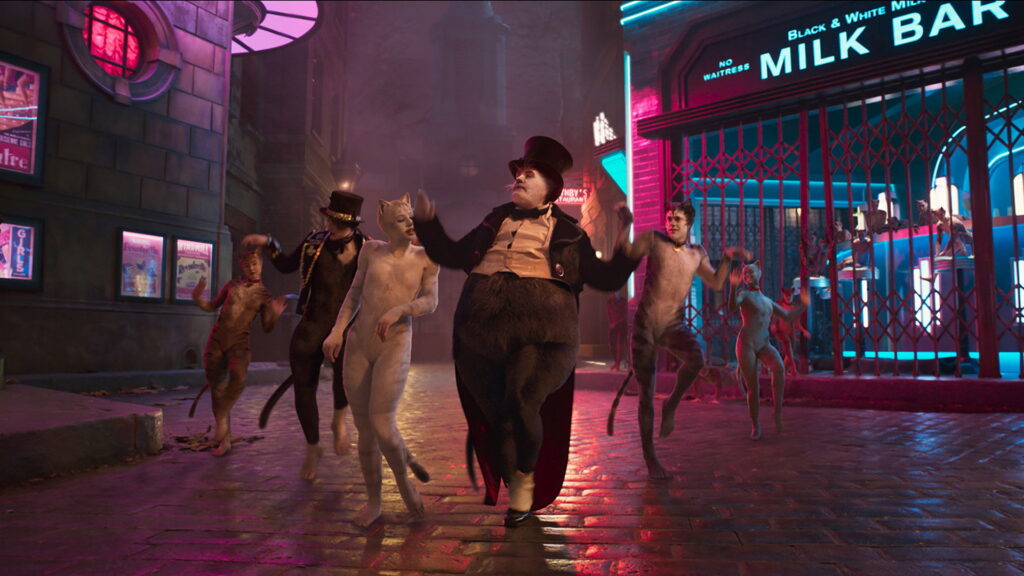
The entire affair is a litany of horrors, but here are a few memorable ones: Jennyanydots (Rebel Wilson) unzips her own fur like it’s a jacket, revealing human clothes underneath, and then more fur underneath those clothes before devouring a kick-line of tiny cockroaches. Later, Macavity (Idris Elba) spends most of his screen time in a human overcoat, then suddenly strips it off to reveal a body with no stripes, no markings. Just smooth, blank skin. He simply looks nude in a poorly-textured CGI body. Bombalurina (Taylor Swift) descends from the rafters tossing catnip like a controlled substance while cats collapse around her into induced slumber. (But doesn’t catnip stimulate cats?) Old Deuteronomy (Judi Dench) looks impossibly ancient, her whole body a wrinkled extension of her face. The movie keeps finding new floors beneath what you thought was rock bottom.
So why am I not bestowing Cats the lowest possible rating on the “Is It Good?” scale? I generally hold that to be dull is the worst sin a movie can commit, and that to authentically provoke is at least to be interesting in ways art should be. I walked into Cats half-expecting to swerve positive, that maybe its unholiness, its sheer baroque audacity, would horseshoe into something perversely entertaining like George of the Jungle 2. And it has flickers: the Jennyanydots sequence embraces its loopiness in a pleasing way, and plenty of other images present eye-searing monstrosities with earnestness in a manner that had me chuckling at the misalignment. Plus, Jennifer Hudson belting “Memory” as Grizabella is a moment where real talent cuts through the wreckage. But the fascination mostly curdles into bafflement rather than enjoyment, and that in turn translates to disengagement. Boredom. Nothing registers because nothing makes sense, and the absence of any coherent storytelling means there’s nothing for your brain to latch onto. Even as a sequence of nightmare music videos, it’s not flashy, stylish, or rhythmic enough to be fun. Cats is not so-bad-it’s-good, both because I don’t believe that concept exists (see, again, my tirade in my George of the Jungle 2 review), and because its baffling off-center aesthetic doesn’t circle back quite enough into joyful mayhem. It is, instead, so-broken-it’s-unmissable, which is a different and considerably lesser thing, but still special. Cats might be the single most memorable movie of 2019, the one that cuts through the noise and pierces your skull, though it’s more trepanation than subversive brilliance. Memorable and good are not the same word, and this film, a harbinger of the end of the world, never lets you forget that distinction.
Is It Good?
Not Very Good (3/8)
Related Articles
Dan is the founder and head critic of The Goods. Follow Dan on Letterboxd. Join the Discord for updates and discussion.
2 replies on “Cats (2019)”
If you wanted to make an argument that December 2019 was the moment that the industry of American cinema became demented slop where literally anything with a recognizable brand could and would have nine figures thrown at it whether it resulted in a functional movie or not, not only do we have Cats, but The Rise of Skywalker.
I do kinda like Cats, though. As you say, it’s somethin’.
Though as far as Andrew Lloyd Weber musicals with dubious premises go, and it’s arguable it might be even worse than Cats, I wanna see Starlight Express so, so bad.
Great point re: Palpatine returning being just as ominous a harbinger.
I am curious about Starlight Express for sure; in our podcast episode we talked about how it started in conception as Webber’s unofficial Thomas the Tank Engine adaptation, as he was a big fan of that franchise.
I haven’t seen too much of his material, but I have an appreciation for Webber’s loopy approach to musicals and the elaborate productions that resulted.