
A little parenthesis
I am clenching my jaw trying to resist making the obvious joke about the runtime.
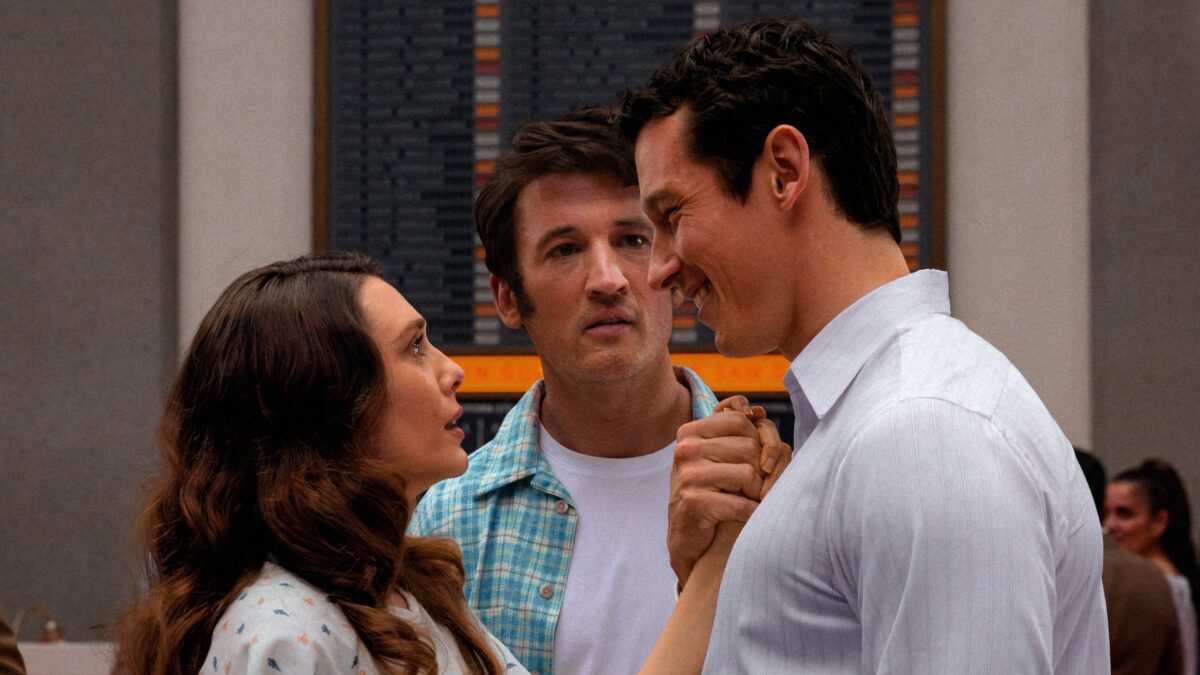
Eternity is one of the most frustrating movies of the year because there’s a lot I genuinely like in it — and yet it’s an utter calamity of tone and worldbuilding. The hook is strong: a recently deceased woman, Joan (Elizabeth Olsen), arrives in a bueracratic afterlife hub here she learns she can choose her afterlife with one of her two great loves, who are both waiting for her at the terminal. Will she spend eternity with her first love, Luke (Callum Turner) who died a war hero? Or her second love, Larry (Miles Teller), the one she actually lived with for decades: growing old, raising a family, building the ordinary, hard-won life that movies usually skip past? What, even, is love, oh viewers? Joan looks both back and ahead and tries to make sense of it all and make the ultimate decision. It’s a clean, high-concept premise, the exact kind that The Black List repository of acclaimed but unproduced scripts adores. The film promises real emotional teeth, and occasionally delivers.
And while some reviewers claim they clocked the ending by the ten-minute mark, I didn’t. I was genuinely surprised by a couple of the turns it takes… Not that they’re all good turns, necessarily, but because the movie keeps zagging in ways that suggest it might actually have a grand vision. For stretches, Eternity feels like it’s winding up to be something original and moving.

It also looks good. Eternity is refreshingly colorful: brightly lit, well-produced, with attractive costumes and pleasing, lived-in styling. Some of the sets are imaginative — honestly more imaginative than the story really justifies, which becomes its own problem later. Director David Freyne brings sincere visual joy to the whole thing. In a 2020s landscape where “serious cinema” sometimes means “gray people in gray spaces making gray choices,” and even the vibrant stories have a dim visual spirit, it’s nice to watch a movie that’s excited to render its own concept. I had a friend speculate that this will find an appreciative audience, maybe even a cult, once it hits streaming, and I can definitely see it. It’s easy to imagine someone clicking play on the eye-catching poster on a weeknight, then telling all their coworkers the next day, “you know what movie was good?”
And it’s headlined by three performances that do an enormous amount of heavy lifting. Callum Turner is the weakest of the lead trio, but just fine as a dreamboat, mostly asked to radiate “tragic romantic ideal,” to which he obliges. (It’s the male equivalent of Annie’s Disney face in Community, all emotional manipulation.) Better is Miles Teller, who is very funny and convincing as an old man trapped in a 37-year-old’s body; he has the best comic instincts in the cast and knows how to leverage his own slightly neurotic charm.
But the movie belongs to Elizabeth Olsen. She’s frankly sensational, playing an old woman and a young woman at once, hitting every emotional beat, acting like this is the most important role she’ll ever play. And whatever else I’m about to complain about, Eternity understands the importance of her performance and keeps putting a spotlight on her, often literally. (The art of lighting eyes is well-deployed here, enhancing Olsen’s generationally beguiling gaze.)

Okay. Here’s where I pivot.
What the hell is this world the story is set in?
Not since Wish have I spent so much of a movie pointing at the screen and saying: “Get a load of this idiot premise.” Eternity’s vision of the afterlife is such a failure of imagination and coherency. This could’ve been a cynical satire of corporate capitalism: the shallow, transaction-heavy, Fortnite-skinned nightmare of a dull, repetitive “paradise” engineered by middle managers. Or; it could’ve been something thoughtful, even mystical, in its agnosticism: a reflection on how different souls crave different forms of peace and have different inner truths, how “heaven” is personal, how our longing shapes what we are as people, here and evermore.
Instead, it’s a nothing. It’s nonsense trapped in between those ideas, and about five others. Eternity’s afterlife is a late-era Pixar-ass thoughtless goop. It’s not sharp enough to be satire, not textured enough to be ruminative, and not coherent or clever enough to be its own quirky blend. Some of the imagined eternities are funny, but just as throwaway jokes. The overall experience is a half-baked pile of rules that appear when the plot needs them.
If you want a thoughtful riff on what the afterlife might look like if it were completely anodyne, and what that would actually mean, go watch the first season of The Good Place, which ends with one of the great punchlines and payoffs in TV history. Eternity gestures vaguely in that direction, then immediately trips over its own shoelaces and spills the entire bag of metaphors down the stairs.

The movie is also “about love” in the sense that it throws some aphorism spaghetti at the wall and calls it a day. I genuinely believe a great writer and filmmaker could take the bones of this story and turn it into tearjerking, inspiring, soul-stirring magic. Freyne and co-writer Pat Cunnane are not those storytellers, alas. What we get instead mistakes exertion for insight, like the movie assumes that because it’s talking about Big Things (time! sacrifice! devotion!), it must therefore be saying something meaningful about them. It isn’t. It’s working very hard, and mostly to arrive at the emotional equivalent of a throw pillow embroidered with LIVE LAUGH LOVE.
(One critic pondered what this movie would look like if Ernst Lubitsch had been handed the outline, and I almost started weeping thinking about it. Edited to add: This was probably a reference to Heaven Can Wait that I did not understand.)
Eternity’s pacing is a disaster, too. It plays like a sluggish TV season, but compressed into two hours that feel like three. Scenes stretch past their natural endpoint, then the movie suddenly panics and chases some other idea or tone. The movie accumulates rather than builds.

And the comedy is completely erratic. When it hits, it’s genuinely funny: Teller ranting about MASH and the Korean War is the exact kind of weird specificity this movie needs more of. But when it misses, it’s nails-on-a-chalkboard stuff. John Early is so bad here as an afterlife worker. He’s grating, stranded in material that can’t support him. I found myself begging for Jack McBrayer who would have delivered every line better. And Da’Vine Joy Randolph, who I know from The Holdovers and by reputation as a real talent, is three parts miss to one part hit. (Another data point for The Best Supporting Actress curse, I suppose.)
So yeah: Eternity is at least different. It wears its heart on its sleeve. I did not regret watching it. It’s diverting, occasionally saccharine in a pleasant, old-fashioned way. The film is easy to watch, with some great acting and a genuine visual charm. But it’s still a miss, and I’m giving the film some leeway in the rating below. Eternity has the bones of something sharp and moving, and even flashes of it in Olsen’s face. But the movie around the strengths is too sloppy, too hollow, too committed to its half-baked “afterlife assembly line” nonsense to earn the feelings it keeps reaching for.
And goddamn does that runtime feel like an eternity. (Exhale.)
Is It Good?
Nearly Good (4/8)
Dan is the founder and head critic of The Goods. Follow Dan on Letterboxd. Join the Discord for updates and discussion.
9 replies on “Eternity (2025)”
I thought the trailer for this was vaguely interesting, but comparisons to Wish. Lol, oof.
I did feel like I was being a grump about a good-natured original story, so maybe follow your instincts and give it a shot?
Vaguely! I said vaguely interesting!
I dunno, the one Lubitsch movie I’ve seen that I don’t like is in fact his celestial bureaucracy movie (not that the celestial bureaucracy part is actually any huge fraction of Heaven Can Wait, but it might be the only Don Ameche vehicle I’ve seen that I don’t like, too).
But yeah, I’ve been curious about this and will probably check it out, but I’ve heard basically nothing good. I wouldn’t expect it to be as good as The Good Place (which is one of, what, three pieces of 21st century American television that’s full-on great? and the only thing I’m aware of that understood how to actually do “long-form storytelling” via episodes of television), and I suppose I’m not shocked to find it confused. There’s really not that many celestial bureaucracy stories that are particularly great; might be a list as short as It’s a Wonderful Life, A Matter of Life and Death (though don’t let Archers fanboys tell you its climactic celestial courtroom scene isn’t incredibly stupid), and The Good Place. I do have a bit of a presumption I’d side with the “oh, heaven enforces monogamy?” takes even if they’re undoubtedly being overly literalistic.
It is now occurring to me that the Lubitsch aside I read was probably a reference to Heaven Can Wait, which I have not seen, that I just didn’t pick up on.
The Good Place lost a little bit of its magic in my eyes a bit after the first season (well, really after the mop-up of the first season from the first handful of episodes of Season 2), and my wife and I never finished it, but we really ought to. I’ve been meaning to watch it again, as it’s been awhile.
You really should. IMO, the series finale earns every bit of the hype around it. Though I did prefer S2-3 to the first, so maybe we like different things about the show.
(Eternity has just good enough reviews for me to see it, given the premise and my love for Olsen as an actor, but I’m not letting myself get too excited).
I definitely should give The Good Place another shot. And I hope Eternity works better for you than it did for me; may my sour grapes become your wine!
“serious cinema” sometimes means “gray people in gray spaces making gray choices,”
Annie’s Disney face is so funny. “oh don’t worry about me, i can only connect with people through…movies”
dude i wanna watch this movie with you know and get the full ‘idiot premise’ treatment.
the shallow, transaction-heavy, Fortnite-skinned nightmare of a dull, repetitive “paradise” engineered by middle managers.
“occasionally saccharine in a pleasant, old-fashioned way.” will win me everytime.
Great piece of writing love the set up first line and pay off finish.
Thanks Mitch. I know I’m in the minority in being bugged by this! Olsen is so good though!