

Point bleak
Won’t someone please think of the canceled male celebrities?
Outcome is Jonah Hill’s third feature as a director, and it is more feature-length therapy billed to the audience than proper “movie.” Hill has not been strictly canceled the way James Franco and Armie Hammer have, but he has wobbled on the ledge for a few years now: two women have publicly accused him of controlling or manipulative behavior; precisely none of his A-list peers have stepped up to defend him; and a guy who never exactly had a public image as a sweetheart has slid into a reputation as an outright asshole. He’s still working, but the prestige lane he seemed to be merging into a decade ago on the heels of his second Oscar nomination has quietly closed. So here we are, with Outcome.
Reef Hawk (Keanu Reeves) is a world-famous movie star a few years into sobriety after a publicized heroin addiction. His career is just about back on track when an anonymous blackmailer surfaces with an incriminating video and threatens to leak it. His scandal-management lawyer, Ira Slitz (Hill), sits Reef down and advises him to mend bridges with all the people Reef has burned on the way up to try and determine who the blackmailer is and defuse the danger.

Outcome’s biggest problem is that it is not funny, insightful, sympathetic, or enjoyable to sit through. But let’s narrow that down a bit. The film has a serious structural problem: its arc runs in reverse. The film opens from a posture of assumed sympathy for a fabulously wealthy movie star and then, after an hour of apology-tour two-handers, works its way up to the conclusion that maybe, just maybe, rich celebrities can be a little entitled. Stunning discovery by Mr. Hill there. Any version of this movie that’s even remotely effective goes the opposite way: starting at entitled and slowly earning its way to sympathy, one bit of ego-scrubbing at a time.
The basic setup, of Reef getting emotionally flayed in a chain of confrontations by people he has wronged, could in theory work, turning the actor into a Sunset Boulevard Scrooge with some acting showcases. But what actually happens is a bunch of aimless flailing. Nobody in Outcome seems to agree on what kind of movie this is. The tone lurches all around garish Hollywood satire, cringe comedy (with the main joke being somebody saying the word “fuck”), and muted dramedy, which are near-incompatible registers, and the cast plays them at cross-purposes. A few actors seem genuinely embarrassed to be in the film. The script can’t decide whether it’s eviscerating the rich and famous, mourning the indignities of modern celebrity, or just detachedly describing the whiplash of it all, and each confrontation gets flattened into shrill caricature long before any of the implied emotion can peek through.
Reeves is badly miscast. It’s difficult to picture an actor less neurotic or paranoid about what strangers say about him online, so asking him to inhabit a shallow, image-obsessed heel is a catastrophe: he’s saying words that a selfish prick would, but not embodying it. (I imagined Sam Rockwell in the role.) The astonishingly busy supporting cast (I guess Hill called in all his favors) fare just as bad: Laverne Cox and Roy Wood Jr. get handed tiny, pathetic slivers of screen time that give them no room to do the thing either is actually good at, and Cameron Diaz (back on a screen opposite Reeves for the first time since Feeling Minnesota, nearly thirty years ago) is left to smile and squirm through three personalities in as many scenes.

The film has some genuine, albeit isolated, bright spots. Benoît Debie, the arthouse cinematographer best known for his work with neon freaks Gaspar Noé and Harmony Korine, shoots this with a provocative but astonishingly tasteful wash of saturation. Outcome is always delightful to soak in, but it’s purely decorative; the film’s look never connects to character or theme in any meaningful way.
And I like a couple bits of acting: Hill himself, as profane lawyer Slitz, is the only performer who has locked in on a promising register of brusque farce. His scenes are a pointed reminder of how good he can be in front of a camera. Martin Scorsese, of all people, turns up for a small part as Reef’s first manager and is so thoughtful and exact that he quietly laps the rest of the supporting cast; he’s the best single reason to see the film, if you’re determined to inflict Outcome upon yourself. I also really like a late scene where Reef finally confronts his blackmailer. It hints, just for a moment, at a more sensitive and sad movie buried under all the flop sweat, a movie I’d much rather see.
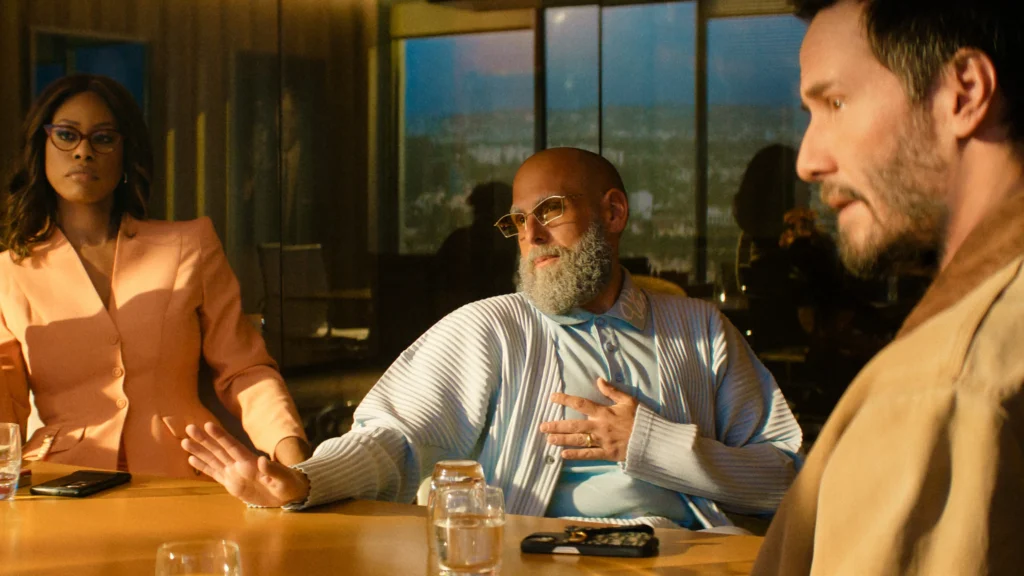
It is hard to watch Outcome and not read it as Hill’s attempt to recast himself, via the sympathy magnet of Keanu Reeves, as a misunderstood casualty of the outrage attention economy rather than someone whose woes are self-inflicted. This action, of course, exactly the kind of flattening, self-justifying gesture a real satire of celebrity would have torn to shreds.
One last positive: Outcome is only 83 minutes long. It’s a small mercy, but a mercy nonetheless. I’ll take a sub-90 runtime wherever I can get it, especially for a movie that is decidedly Not Good.
Is It Good?
Not Good (2/8)
Dan is the founder and head critic of The Goods. Follow Dan on Letterboxd. Join the Discord for updates and discussion.
2 replies on “Outcome (2026)”
They cast a dude who played THE BUDDAH as a messed-up neurotic corkscrewing through some spin-control?
… well I knew they cancelled Woody Allen (Bad cess to the man), but I didn’t know casting Mr Robert Downey Junior as Doctor Doom would cost him a really juicy comedy role so very, very quickly.
Yes! Misguided casting in my opinion!
I thought of Sam Rockwell but I think you’re spot on that RDJ would have crushed this role.