

Half agony, half hope
Since I responded very powerfully to Emma (2020) a few years ago, I’ve gradually become a Jane Austen appreciator. Not enough that you’d make a movie out of my obsession (the 2013 film Austenland is deeply strange and worthy of its own review), nor even enough for me to actually read her novels (yet), but I’ve been slowly checking out the many adaptations with my wife. This Persuasion (2007, my second take on the story following the Dakota Johnson-starring 2022 adaptation) is the rare TV-movie Austen that has ideas on its mind other than being “stately.” Instead it adopts a bizarre, crooked tack into something weirder, moodier, and occasionally almost arthouse. It rejects the pristine, tea-sipping polish we usually associate with Austen in the BBC vintage for something that feels a bit more jagged. It’s a gamble that doesn’t always pay off, but it certainly grabs your attention, and I ultimately liked it.
The story, as us aspiring Austen-heads will know, hangs on an unmarried woman in her late 20s, and therefore past her prime, named Anne Elliot (Sally Hawkins). She is still quietly aching over her broken engagement to Captain Wentworth (Rupert Penry-Jones) nearly a decade ago, until his return drags old regret back into the spotlight amid the usual Austen drama: mild class angst, family pressure, social performance in charmingly fusty Georgian-era nobility, questions of female agency, and a slow-boiling romance that’s basically 90% swallowed feelings and careful propriety.
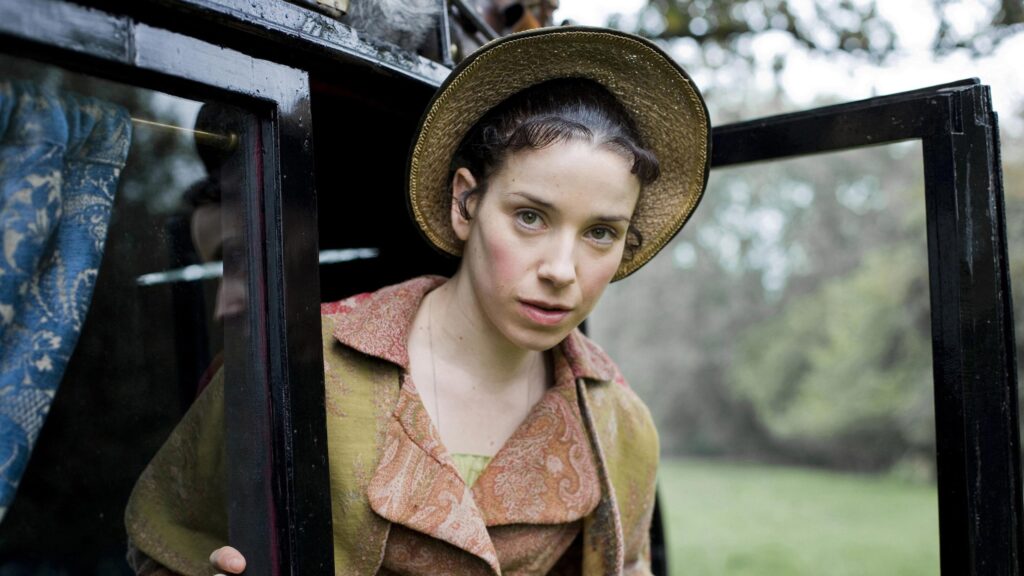
Director Adrian Shergold leans hard into extended handheld oners and tight close-ups, turning polite spaces into these oddly claustrophobic emotional corridors. The camera hovers and even shakes, refusing to give us the steady, objective wide shots we expect from period dramas. It creates a sense of anxiety that perfectly mirrors Anne’s internal state, even if it occasionally makes you want to reach for the Dramamine.
Another big swing is having Anne look directly into the camera at key emotional moments, not with a furtive glance but with an unblinking stare, like she’s appealing to some invisible author to intervene and write her out of her pain. It’s an undeniably distracting touch that I still found quite affecting. It breaks the fourth wall not like Jim from the Office or Fleabag (as in 2022 Persuasion), but rather as a veil-piercing gaze into some deep and strange truth. It’s a risky maneuver that threatens to shatter the film’s reality, yet somehow it pulls us deeper into Anne’s complicated and intense emotions.
The script, unfortunately, is the opposite of daring: streamlined in a messy way, occasionally repetitive, with pacing that sometimes ambles and sometimes sprints. Speaking of which, the film’s climax is basically several consecutive minutes of Hawkins running, and it’s so jarring it has to be intentional: we go from 80 minutes of Anne restraining herself to six minutes of her breathlessly sprinting around town. But the script, anyways, is a bit messy; some of the supporting characters and subplots are tossed in and arranged haphazardly. A few times characters entered scenes and started talking, and I couldn’t for the life of me place whether I was supposed to know who they were.
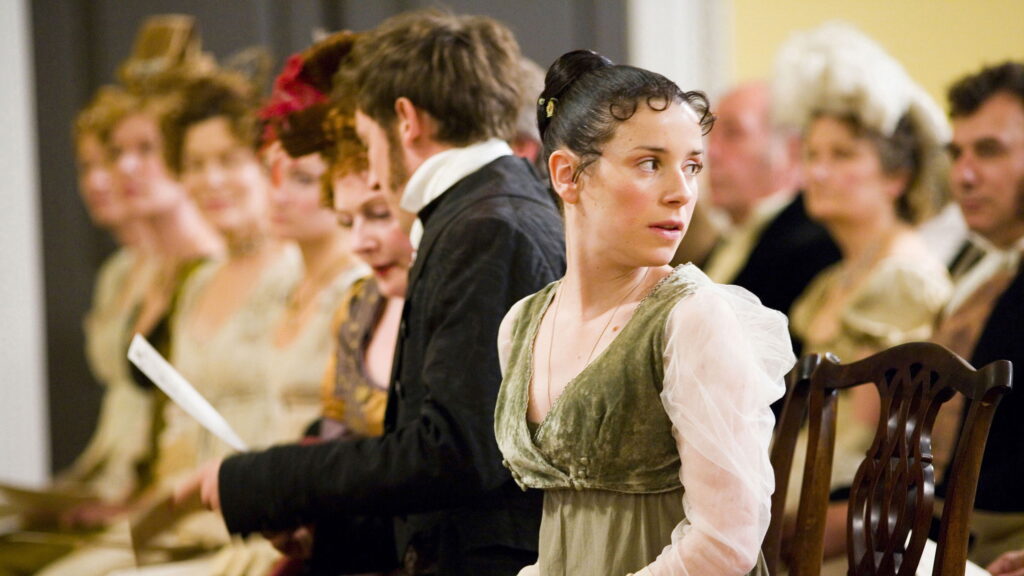
Austen adaptations almost always have strong performances in lead roles, and Hawkins is one of the very best I’ve seen. She’s the film’s main weapon, so sympathetic and watchable the movie can just linger on her micro-expressions and let them do the heavy emotional lifting (though, truly, the hair team was not doing her favors). The rest of the cast ranges from good enough to mildly off-putting, the latter including Amanda Hale’s Mary Musgrove, who suffers mainly from the cruel fate of existing in a world where the later casting of Mia McKenna-Bruce has spoiled other takes the role.
In the end it’s a satisfying adaptation that can’t fully hide the budget (anything remotely in the realm of stunts is either laughably flimsy or strategically off-screen), but it earns real points for committing to an emotional immediacy that lets Austen’s quiet pain pierce through the period trappings. For a TV movie, it has a surprising amount of a coherent vision guiding it, courtesy director Shergold. It’s not a definitive, hallmark version of the story, but it’s a fascinating rendition that finds a raw nerve in the source material.
Is It Good?
Good (5/8)
Dan is the founder and head critic of The Goods. Follow Dan on Letterboxd. Join the Discord for updates and discussion.
2 replies on “Persuasion (2007)”
Any movie with Ms Sally Hawkins in it is a very lucky movie indeed – just ask Paddington Bear.
She is, I strongly suspect, one of those unfussy, indispensable British thespians destined to be a National Treasure.
I haven’t seen every Hawkins movie but she rarely disappoints!