
They've given you a number and taken away your name
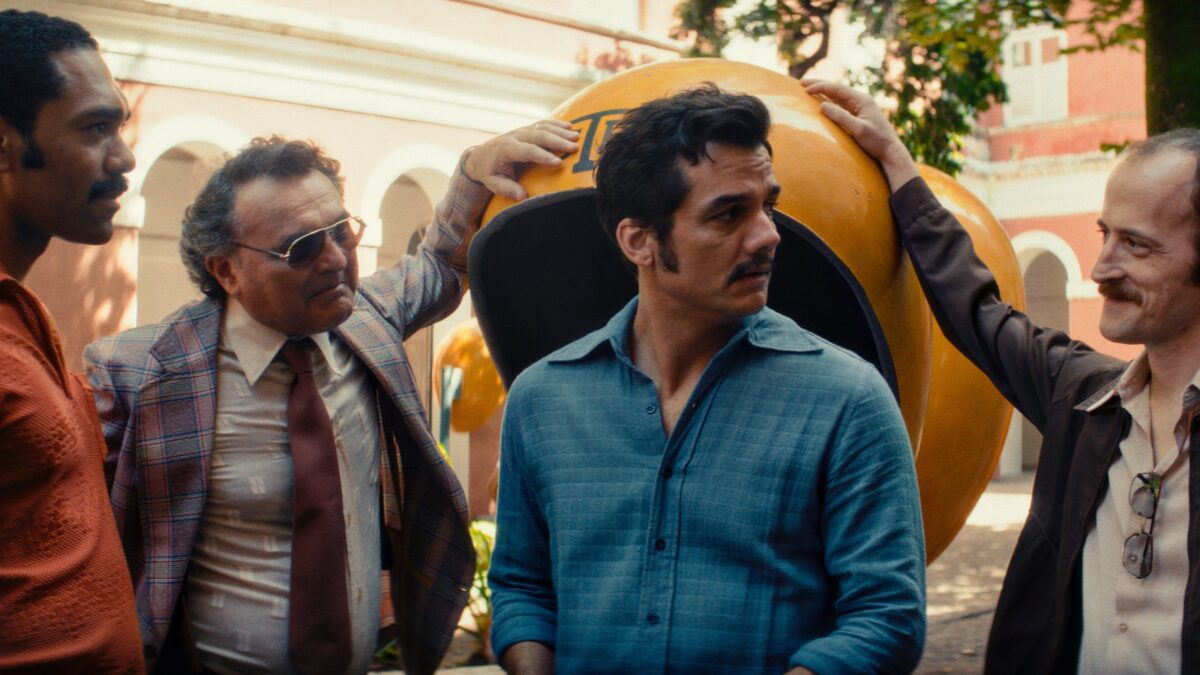
I find that the opening scene of The Secret Agent is a pretty good lens into the overall experience of watching the film. It’s a sunny day in 1977 Brazil when Armando (Wagner Moura) pulls up to a gas station to refill his tank. He notices something: a dead body lying at the edge of the lot. The attendant explains that the man tried to rob the station and was shot by an employee. Armando’s reaction is guarded: We can see him processing the situation, but we don’t know what he’s feeling or what he intends to do. Before long, a policeman shows up, delayed from investigating because of the carnival celebrations swallowing the region. We know from one look at this cop that he’s trouble: he shakes Armando down but finds no reason to arrest him, then presses him for a bribe. Armando offers a cigarette instead cash. The cop lets him go; Armando fills his tank and drives away, corpse still lying in the sun.
So here’s what we get from this scene: a beautiful piece of atmosphere and tension, sunny hues of blue and yellow contrasting a deep undercurrent of danger; unstable infrastructure and corrupt institutions; Armando thinking on his feet, the character deeply appealing on the strength of a terrific, lived-in performance by Moura. And also… nothing really happens. It’s a lovely scene with an evocative mood, ideas to think about, and yet negligible consequence. I can’t say I got much out of it. I also can’t say I mind too much. That is, for better and worse, this film in a nutshell.

The Secret Agent is a fascinating hybrid of tones and genres that resists easy categorization. It’s partially a political drama in which Armando and his friends operate in a small resistance cell against a fascist regime. It’s a cat-and-mouse thriller, with hitmen closing in on Armando before long. It’s a slice-of-life hangout movie where we casually observe the diverse population of a small Brazilian community. Maybe the most useful label is “neo-noir”: The warm, saturated visuals are about as far from shadowy chiaroscuro as you can get, but the knotty, hardboiled plotting involving a man pulled deeper into a conspiracy than he’s prepared to handle, and the cynical view of every institution he interacts with, certainly fits the bill. Director Kleber Mendonça Filho has structured the film into three distinct chapters with title cards, a choice that helps organize its overlapping story strands and gives the whole thing a novelistic sweep that suits its ambitions.
That sprawl is one of the film’s great strengths and also the source of its most obvious limitation. At nearly three hours, The Secret Agent is a languid affair, albeit confidently languid. It luxuriates in the grain-soaked texture of its 1977 Recife, Brazil with a tremendously tactile, almost sweat-saturated, texture. The period-accurate production and soundtrack create a constant cultural immersion that is hypnotic. But the pace will test anyone expecting a conventional thriller’s momentum. Mendonça is more interested in how the trauma of dictatorship lingers in the physical spaces of a city than he is in propulsive plotting, and while cinema holds a place for such works, it leaves the film coasting on atmosphere when a tighter hand might have sharpened the stakes for people who want their movies to be about “an interesting thing that happened.”
What kept me engaged is Moura, Death himself, who delivers a career-defining performance. He plays Armando with a quiet intensity and grounded humanity that anchors the film even the handful of times it reaches into more surreal and subjective elements, including a recurring thread involving the “perna cabeluda,” or “hairy leg,” a Brazilian urban legend that functions here as a metaphor for how state violence gets drowned out and merged with myth in the public consciousness. (These images baffled me as I watched, and only after conducting some extracurricular reading afterwards did it register as anything other than absurdism.) The film really only works because Moura makes us believe a man can live inside both the real danger and the fuzzy cultural memory where even names are deceptive. The latter idea is explored in the second half especially, when the film ponders the way media and storytelling shape (and warp) our collective memory: newspapers, movies, audio recordings, government records, even music.
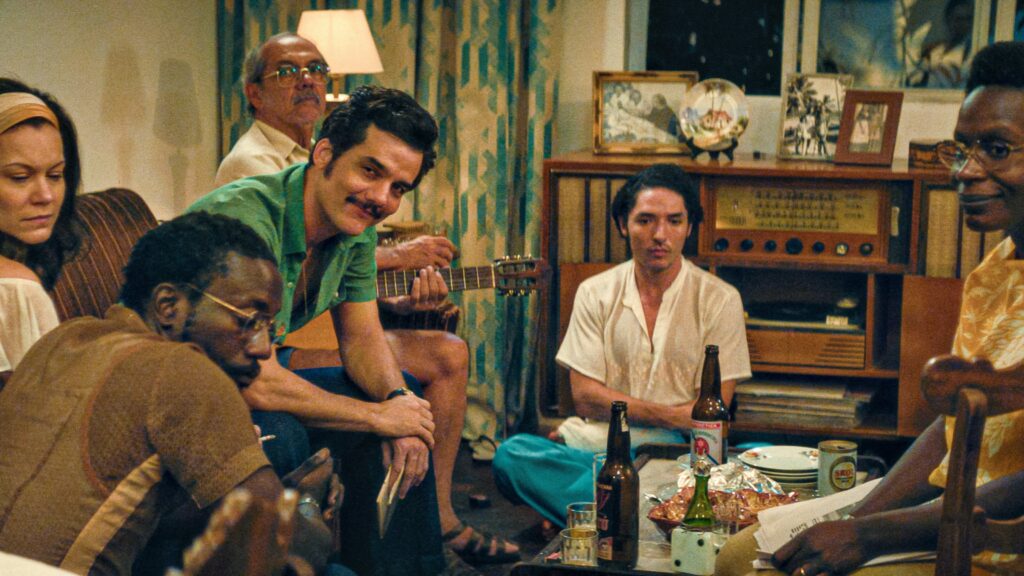
Moura is not the only excellent performance. The entire cast, including many non-professional actors, is strong; I really enjoyed a lovely supporting turn by Tania Maria as Dona Sebastiana, the grandmotherly safehouse keeper and who radiates warmth and resolve. Weird-movie legend Udo Kier has a small, sad turn as a troubled tailor, his final screen role before passing recently. (That tailor, though, provided my only audible groan when he’s revealed to be a Holocaust survivor — we can’t go one movie depicting fascism without rubbing our noses in Nazis parallels.)
Overall, I’m glad that The Secret Agent exists and glad I watched it. It’s such a wonderful and distinct piece of craft that it goes down super easy. It trusts its audience to have patience and enjoy its tempo. It’s a rich and deeply atmospheric work, confidently made, with a lead performance that might have slipped through the cracks 15 years ago, but is in serious consideration for Best Actor in this more internationally-aware era. But for it to be any sort of all-time favorite thriller of mine, it would need a little more urgency in its narrative: If it were a little more of the paranoid potboiler it keeps promising it could be, I think I’d have adored it. Still, when the credits rolled, I felt like I’d been somewhere real and been told a story not quite like any I’ve ever heard before, and that’s not nothing. That’s actually quite a lot.
Is It Good?
Very Good (6/8)
Dan is the founder and head critic of The Goods. Follow Dan on Letterboxd. Join the Discord for updates and discussion.