
Until recently, I had never seen a Rocky movie. Then I watched all nine films in the Rocky and Creed saga in a single week, a gauntlet that pushed me to the outer limit of what a human can achieve from a couch. The 1976 original gets a full-length review of its own, and the Creed trilogy can wait for another day. That leaves the five sequels in between, which follow Rocky Balboa (Sylvester Stallone) from overnight sensation to elder statesman. Stallone wrote all five and directed all but one.
Watched back to back, they blur into one long movie; each numbered sequel even opens by replaying the final minutes of the one before it. They share a formula, too: Rocky has a reason not to fight, then a reason to fight, then a montage, then a bludgeoning. But each has its own flavor, and each doubles as Stallone checking in on his own myth: What does the world make of Rocky now? What does he make of himself? No single one of these movies is special on its own. In conversation with each other, though, they add up to something richer, which is why you’ll notice a certain consistency in the ratings below.
Goodie Bag is a collection of capsule reviews on a theme. Goodie Bag selections are all candidates for future full-length reviews.
Rocky II (1979)
Is It Good? Good (5/8)
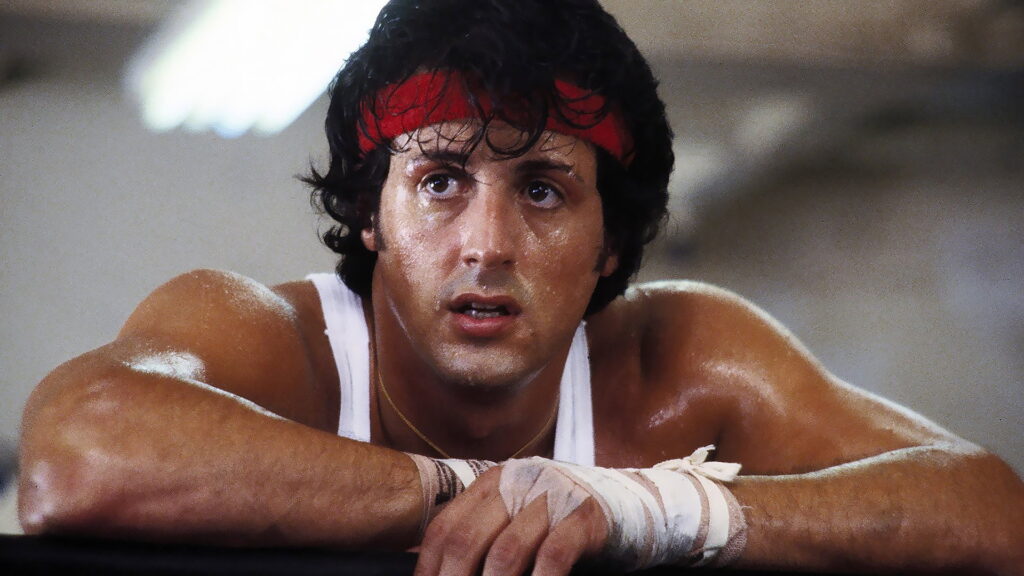
The first sequel in any series has a unique job: It has to decide what a sequel to this thing even is. Like Friday the 13th Part 2, Rocky II draws the template that every later entry will trace. It’s also the least memorable of the bunch (though not the worst): There’s no flashy new opponent or tonal swerve, just Rocky and Apollo Creed (Carl Weathers) running it back with the result flipped.
What it adds is breadth. Rocky proposes to Adrian (Talia Shire) at the zoo, in front of the tigers, in a scene as sweet and dopey as he is. He tries to cash in with an aftershave commercial and can’t get through the cue cards, which I read as Stallone winking at everyone who’d decided he couldn’t act. Apollo, meanwhile, stews over hate mail calling his victory a sham; it’s hard not to hear the grumbling about a certain boxing movie that beat Taxi Driver and Network for Best Picture.
Then Adrian falls into a coma after giving birth (don’t ask me for the medical specifics), and the movie stops cold so Rocky can keep vigil. It’s a contrivance, but a useful one: It establishes that she will always matter more than the boxing. However many sequels pile up, these scripts never manufacture cheap melodrama between the two of them.
The rematch delivers the win that the first film so pointedly withheld, and it’s a thrill. But that film ended so perfectly that any follow-up was bound to feel like an encore. A baseline sequel, but a sturdy one.
Rocky III (1982)
Is It Good? Good (5/8)
My favorite of the sequels (by a thin margin) threads a needle:\ It lets the series get sillier and more cartoonish without losing its grip on the characters. It also solves the problem every underdog story faces once the underdog wins: With no mountain left to climb, the champ gets comfortable, and someone hungrier comes for his belt.
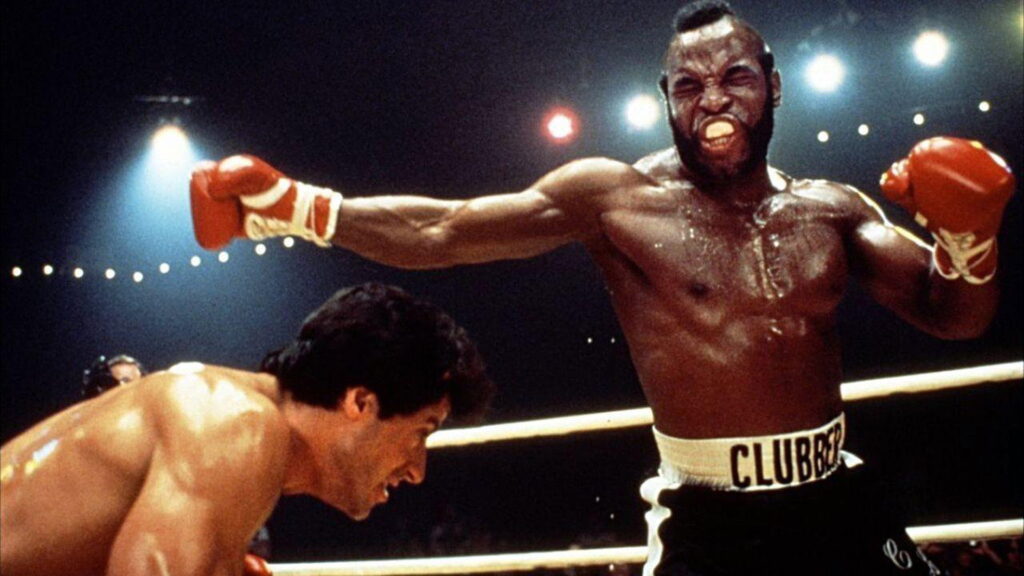
That someone is Clubber Lang (Mr. T), and he’s a blast: ferocious, funny, and very easy to root against. I do wish he were more than a meaner, louder Apollo, another brash, charismatic Black showman with the nuance sanded off. But the man has bars. Asked for his prediction for the fight, he growls a single word: “Pain.” (This is also where “I pity the fool” comes from. I’d always assumed it was The A-Team.) Add Thunderlips (Hulk Hogan), a pro wrestler who tosses Stallone clean out of the ring, and the ’80s have officially arrived.
The movie’s big shift is turning Apollo from rival to trainer after the death of Mickey Goldmill (Burgess Meredith). It keeps Weathers in the picture, and it expands the core group with some color (literally and figuratively). It also gives us the most homoerotic montage in the series: two glistening men racing down a beach in slow motion. And who can dispute the power of “Eye of the Tiger”? If the original’s training sequence is the platonic ideal of the montage, this is the platonic ideal of the corny ’80s inspirational anthem.
This is also where the series starts looking in the mirror, aggressively warping Rocky’s in-universe fame with his real life fame: He guests on The Muppet Show (real footage of Stallone’s appearance), a bronze statue of him goes up at the art museum (it still stands today), and a drunk, jealous Paulie (Burt Young) smashes a Rocky pinball machine that’s a unit of a real life model. My wife walked in during that scene and asked why there was a Rocky pinball machine in a Rocky movie. Reasonable question! But so go the surprisingly introspective Rocky sequels.
Rocky IV (1985)
Is It Good? Good (5/8)
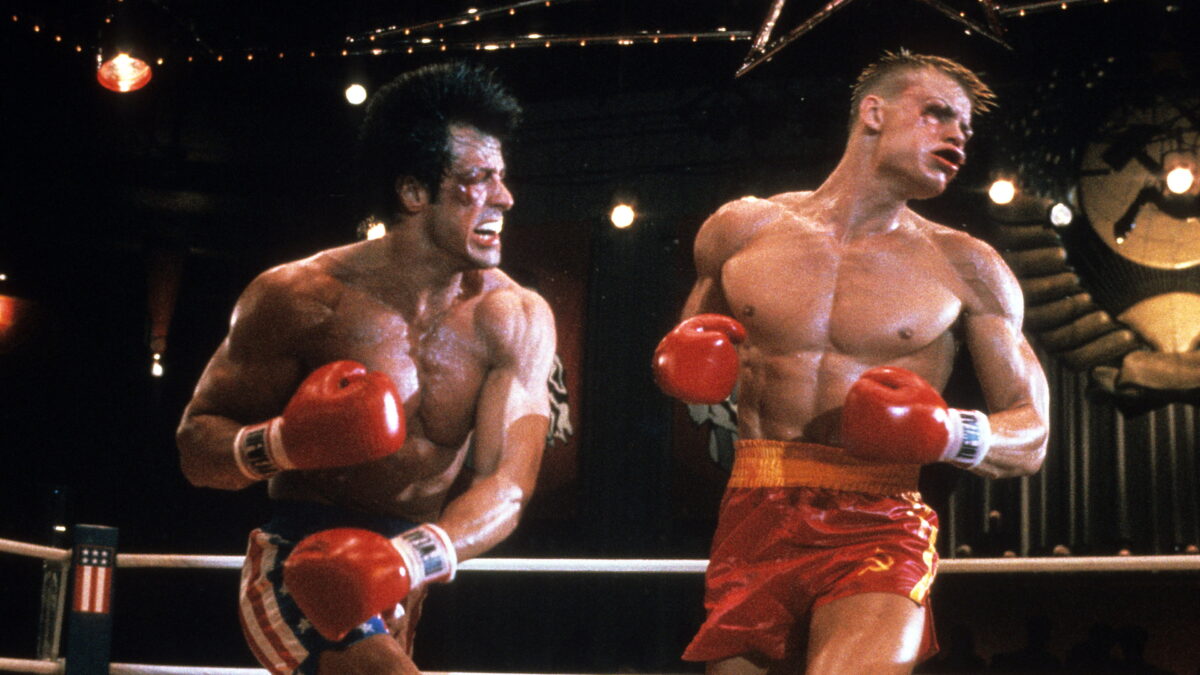
This is the one where Rocky wins the Cold War. It’s also the one where Paulie gets a talking robot for his birthday. (It’s the best Paulie subplot in the series, though Stallone scrubbed it from his 2021 director’s cut.) The grimy realism of 1976 is long gone: Ivan Drago (Dolph Lundgren), a Soviet colossus built by scientists and syringes, kills Apollo in the ring, shrugs “If he dies, he dies,” and sends Rocky to Russia for revenge.
I went back and forth on whether any of this is a good idea, and I’ve made my peace: This is the heightened, comic-book Rocky, and the characters still act like themselves amid the nonsense.
It’s also wall-to-wall montage, and what montage. Rocky drags a sled through the Siberian snow and sprints up a mountain while Drago gets wired to machines in a red-lit lab: natural man against manufactured man. It’s the most confident, stylish filmmaking of Stallone’s run as the series’ director, and it carries a delicious irony. Montage was pioneered in the 1920s by Soviet filmmakers like Sergei Eisenstein (see Strike and Battleship Potemkin). Sixty years later, here is Hollywood turning the Soviets’ own invention against them.
The outcome is the least plausible of the series: The movie insists that Drago hits harder than any human alive, and Rocky beats him anyway, winning over a hostile Moscow crowd along the way and capping it with a plea for peace. (“If I can change, and you can change, everybody can change!”) But I admire the nerve. Like Casablanca, of all things, it takes on a geopolitical conflict from the middle of it, with no hindsight to hide behind. It’s ridiculous. Its best moments are also really special.
Rocky V (1990)
Is It Good? Good (5/8)
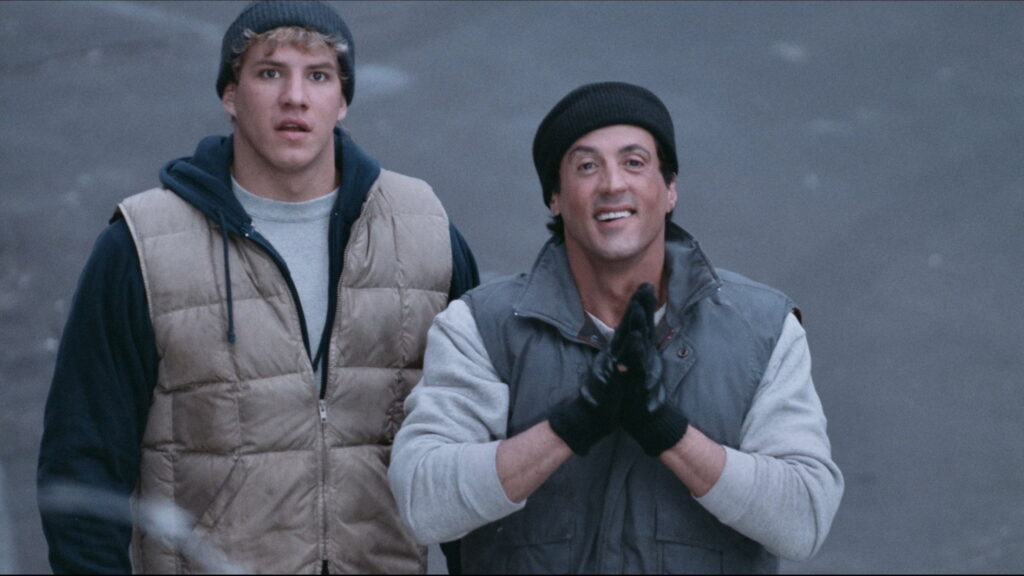
Rocky V sits at the bottom of nearly every ranking of the series, including Stallone’s own (he once scored it a zero out of ten). Also mine, by just a hair. And yet I can’t dismiss it. There was no topping Rocky IV in cartoon energy, and Rocky V doesn’t try. Instead, it’s the bleakest, least fun, and most honest film of the bunch.
Rocky returns from Russia with brain damage and no money, since Paulie, of all people, signed away control of the family fortune to a crooked accountant. So it’s back to the old neighborhood and even the old hat, with original director John G. Avildsen returning for the homecoming. (A fourth sequel about a man who badly needs a payday: You can’t say it isn’t self-aware.)
What follows is a sour, grown-up story about legacy. Rocky pours himself into training Tommy Gunn (Tommy Morrison), a young heavyweight in whom he sees himself, and neglects his actual son, Robert (Sage Stallone, the star’s real-life son). When a Don King-esque promoter lures Tommy away, Rocky is left with a damaged brain, an empty bank account, and the family he ignored while chasing his own legacy.
It’s also barely a boxing movie, and the climax, a street brawl between Rocky and Tommy, feels shoehorned in. Stallone’s script originally had Rocky die in that fight, in Adrian’s arms; according to Avildsen, a studio boss vetoed it mid-shoot, reasoning that Batman, Superman, and James Bond don’t die. “So Rocky didn’t die, but the movie died,” the director later lamented. I’d love to know how that version plays. As is, Rocky V is the least enjoyable film in the series, and maybe the one with the most on its mind.
Rocky Balboa (2006)
Is It Good? Good (5/8)
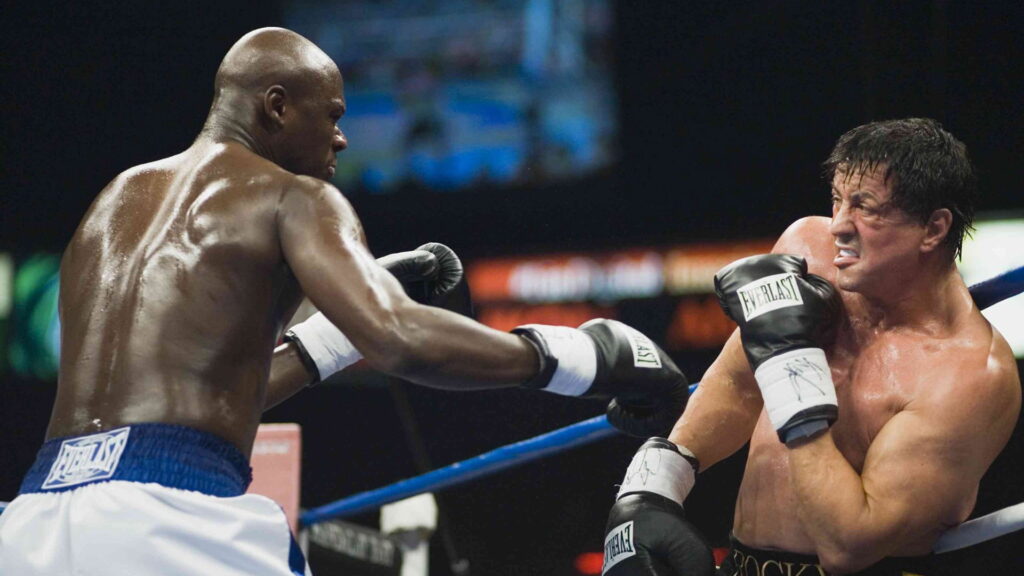
Sixteen years later, Stallone climbed back into the ring for what we’d now call a legacy sequel, though the concept wasn’t so normalized as to have a standard name back in ’06. I don’t mind the missing Roman numeral, since this plays as a coda more than a sixth chapter. (The title it took instead promises a deeper truth about the man that the movie never quite delivers.)
We find Rocky widowed (Adrian has died of cancer), running an Italian restaurant named for her, and at odds with his grown son, Robert (now Milo Ventimiglia). The excuse for a fight is silly: A computer simulation declares that Rocky in his prime would beat the reigning champ, Mason “The Line” Dixon (Antonio Tarver), so the two stage an exhibition. And in a real Glup Shitto move, Marie (Geraldine Hughes), a neighborhood girl Rocky lectured for one scene in 1976, returns as a major character and romantic interest.
It also looks like 2006, all digital gloss and fussed-over color; the climactic bout, shot in high definition to mimic a pay-per-view broadcast, has aged worse than anything in the original. But this is Stallone reclaiming Rocky, and himself, from the punchline bin. By 2006, both were ’80s relics; this movie insists they’re institutions. It’s sentimental and more than a little self-congratulatory. (After 12 hours of Rocky in a week, I’ll admit it felt nice to get a pat on the back.)
Rocky Balboa is often (and justly) remembered for its iconic speech: “It ain’t about how hard you hit. It’s about how hard you can get hit and keep moving forward.” I knew it from motivational supercuts without knowing its source, and it explains the whole series in hindsight: Rocky isn’t the best fighter. He’s the one who endures. The final bout mirrors the first, a split-decision loss he couldn’t care less about, and when he visits Adrian’s grave to tell her “Yo, Adrian, we did it,” I got a little misty.
Other sports movies reviewed on The Goods
Still hungry? Here are a few more I’ve reviewed:
- A League of Their Own (1992)
- Rudy (1993)
- The Sandlot (1993)
- Varsity Blues (1999)
- Undisputed (2002)
- King Richard (2021)
- Air (2023)
- F1 (2025)
- Him (2025)
Dan is the founder and head critic of The Goods. Follow Dan on Letterboxd. Join the Discord for updates and discussion.
One reply on “Goodie Bag: Rocky sequels”
I recently saw a Foo Fighters pinball machine. I believe in Rocky pinball in the Rocky universe.