
Misery made me a fiend
Guillermo del Toro has finally dragged his dream project Frankenstein across the finish line, a decades-in-the-making adaptation that arrives with the weight of cinema prestige and awards expectations on its sewn-together shoulders. And yet, for all the care and obsession that del Toro supposedly poured into it, the movie is strangely hollow. It’s a beautiful production devoid of images or style; a magnificent story absent any subtext or resonance. As we follow Victor Frankenstein (Oscar Isaac) and his creature (Jacob Elordi), the film bustles and exerts itself but never finds much to do or say.
Frankenstein’s tone is a catastrophe from start to finish: the exciting moments are perfunctory, the emotional moments are mawkish, and the gory moments are haphazardly gross. Its pacing is just as bad: 2.5 hours plod by and yet plenty of important beats are clipped or rushed. del Toro rarely exhibits an inclination to modulate time and space to increase the story’s impact, so the film is a slow but unthinking march through a screenplay that’s both overcooked and missing any sense of unifying sweep. You can sense the dashed dreams of a great, operatic tragedy in the movie’s bones, but it just keeps thumping you with underwhelming scenes.
The cinematography not only fails to develop a consistent texture to help immerse us in the story but, in fact, manages opposite: I just kept noticing and noticing the awkward backlighting in nearly every scene. It’s as if Dan Laustsen watched too many Janusz Kamiński movies and learned all the wrong lessons: every light source gets blown out and glares at the screen, to the point that it’s hard to admire the production. The color grading is bad and baffling, heavily blue–orange coded like this is a blockbuster from 20 years ago. (Maybe Robert Eggers just spoiled me; Nosferatu’s two-minute trailer has more potent imagery than this entire film combined.)
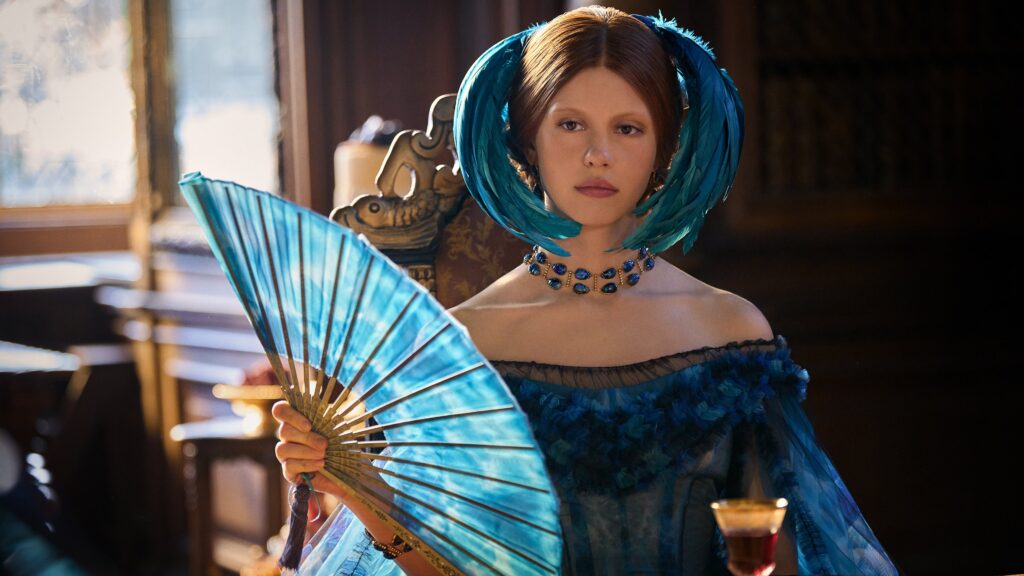
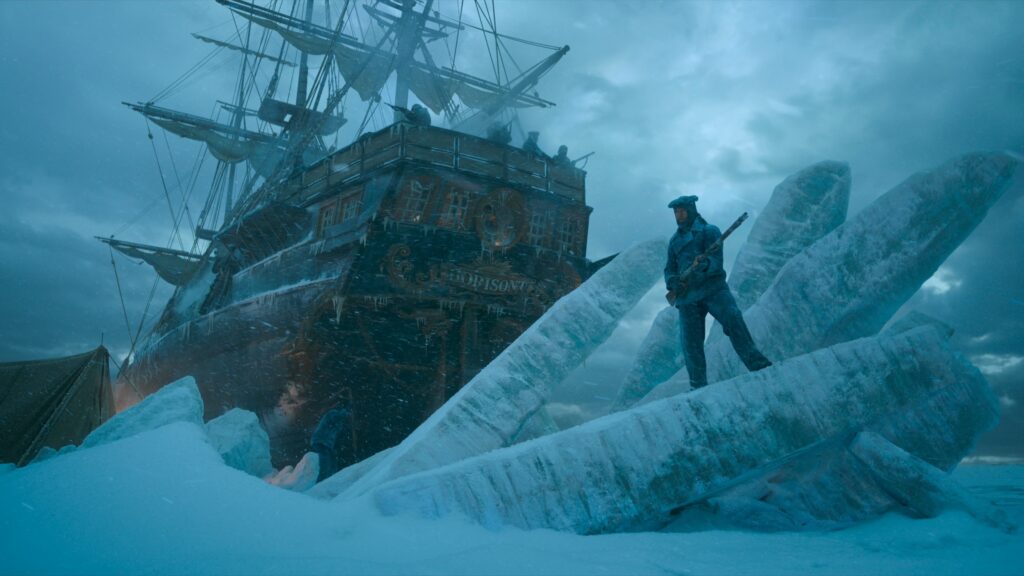
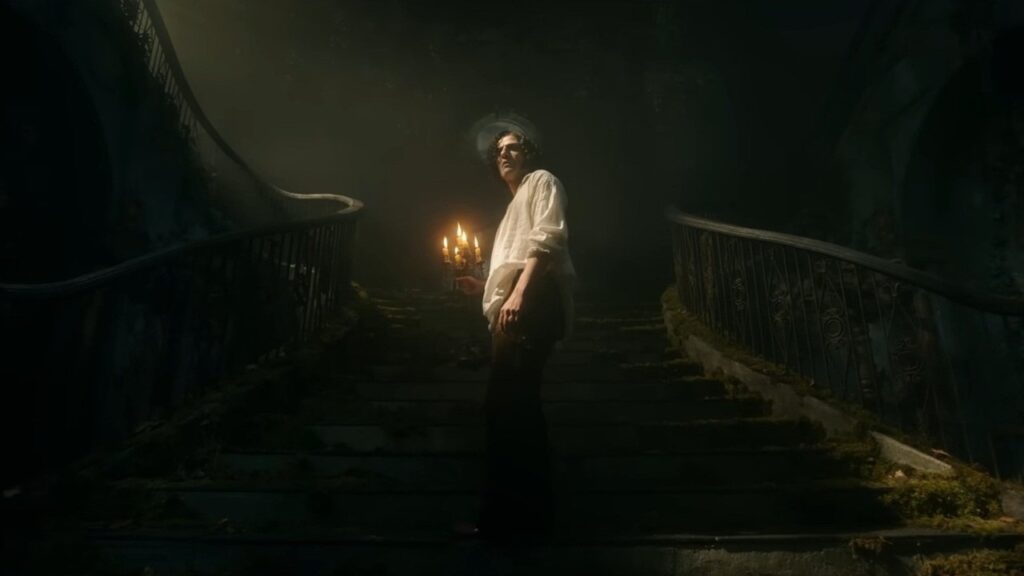 The period production, much ballyhooed in movie press, is certainly good, though it’s not exactly historic stuff. Mia Goth’s dresses are ravishing; other costumes, less so. Isaac looks dull in a white shirt, almost anachronistically so, and I confess I find the actor a bit dull here, too. The interior sets are hit or miss, but mostly unremarkable. The tower is cool, though the lab itself is basically just a warehouse with old timey doctor equipment. What does work, though, is every shot of the hulking, very physical arctic ship as it cuts through the ice (and the digital haze). I could have used even more of that: the Creature kills people on a boat.
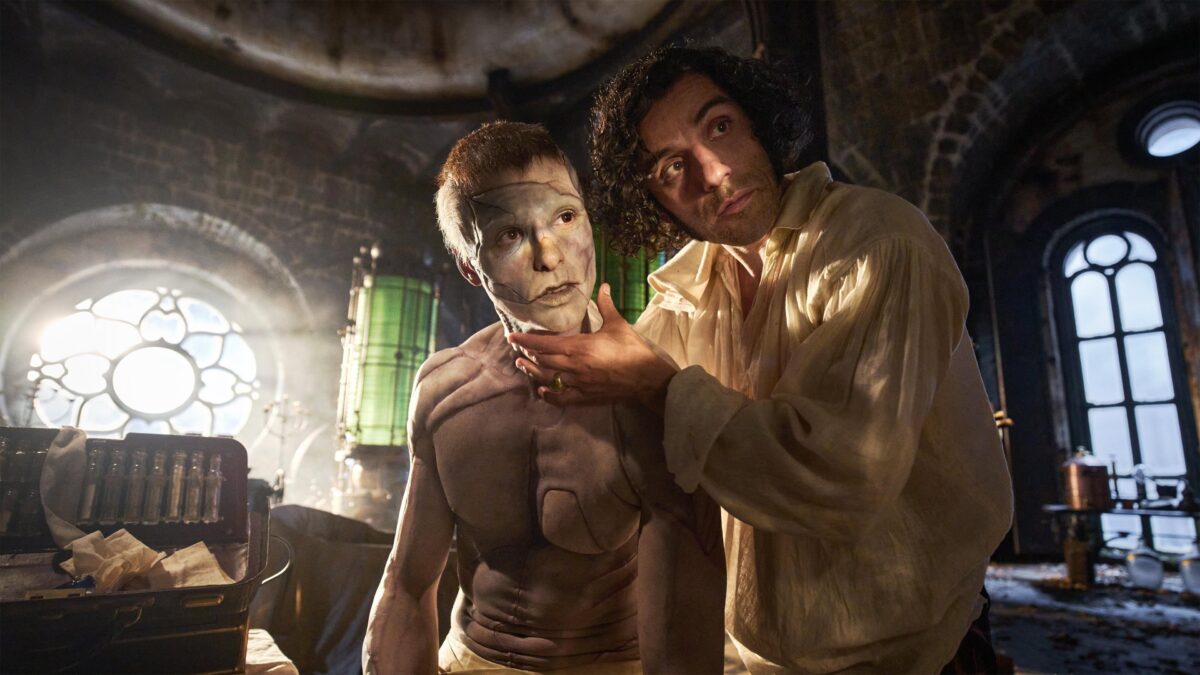
The Creature (Jacob Elordi) is a mixed bag. I admired the tactility of the makeup: the seams, the bruised flesh, the sense that this body really has been reassembled from spare parts. (One unsourced article I read claimed it took 11 hours to put the makeup on, which is just insane.) But as an overall design, this Creature is oddly bland and unmemorable, a generically handsome slab with a few scars. The look never lodges in your brain the way Boris Karloff’s did, which is a problem when the whole story orbits this face and ponders how much humanity lies within. Elordi does his best with what he’s given, leaning into physical awkwardness and wounded-dog eye contact as a contrast to his massive frame. Some of his simple line-readings are downright heartrending. And yet he doesn’t quite make anything lasting or iconic out of this Creature.
Mia Goth, on the other hand, cuts through the malaise despite an underwritten character. As Elizabeth, she brings a piercing gaze and dangerous presence that the film badly needs more of. That the character has very little to do in this telling of the story is frustrating, as it undercuts the inciting incident of the death of Frankenstein’s mother (also played by Goth!). This moment would seem to register Freudian, even Oedipal, urges in young Frankenstein mirrored by Elizabeth, if only del Toro would chase that idea (or any idea). The lack of femininity in this adaptation particularly frustrated my wife, who pointed out to me that the original novel (which I have not read), written by the daughter of a famed proto-feminist, offers a male reckoning with the concept of the female act of birth. del Toro minimizes any consideration of the role of women in this story. I wish the movie trusted Goth’s energy more, instead of constantly hustling her off so we can get back to stare-offs between men and their over-explicated metaphors.
I’m usually fond of Alexandre Desplat, but this score is a major miss. He’s composing for five different movies and none of them is the one on the screen. When Frankenstein is brooding, an Elfman-esque anthem soars; when danger lurks, a pleasant tinkle fills the air. And now that I’m writing this, I’m sure it will get an Oscar nomination. (Oh well; we can count it as a makeup nomination for getting no recognition for Birth.)
But the biggest disappointment of the movie for me is that this is never suspenseful or scary. Frankenstein is a scary story! I should feel the awe of man pushing too far beyond the veil, the crushing and gutting existential danger of a world that wants to destroy The Creature as he experiences earthly cruelty and human emotions for the first time. None of that here.
Chunks of the film do work, though they’re always less than the sum of their parts. Frankenstein goes out on a few of its best notes: the arctic cat-and-mouse makes great use of negative space for visual storytelling and gives us that wonderful ship. Frankenstein’s spirited demonstration of his partially assembled, electrified body parts to a crowd of doctors has some verve and offers Isaac’s best acting moment. One minor scene I quite enjoyed is set at the church confessional, Frankenstein stalking Elizabeth — it is one of the few moments you might describe the film as “fun.”
I also will admit that the film, as a thorough rendering of the Frankenstein story, inevitably has an appealing grandeur to it, crashing headlong into the Big Questions. What I will also point out is that the grandeur loses its effect if you have to state the themes out loud as a substitute for actually rendering them with dramatic material, usually narrated at awkward moments, sometimes multiple times. (I only wish someone had pointed out who the real monster was.) And since I’m on the script again, I’ll point out one more nitpick: So many scenes in this movie, genuinely maybe ten, hinge upon a character arriving about thirty seconds too early or too late to a scene. Lazy writing.
I don’t enjoy disliking a film. I really want this to be good. At least… I think I do. It would be sporting to cheer this on as one of cinema’s great achievements of 2025. del Toro loves Shelley’s book so much; he makes movies the right way, with practical effects; he hates AI; he’s just a geek like you and me who wants to bring stories to life. Right? And yet for all that, this still feels like a big ol’ undisciplined streaming dump, with ugly CGI and flat visuals to spare like any Netflix movie. And so I must, sadly, conclude that del Toro’s exalted reputation is as much a marketing technique as it is a herald of a visionary.
Is It Good?
Not Very Good (3/8)
Dan is the founder and head critic of The Goods. Follow Dan on Letterboxd. Join the Discord for updates and discussion.
4 replies on “Frankenstein (2025)”
Yep.
Thinking on it, the music might be the most perplexingly bad part; maybe Desplat didn’t want to be inconsistent.
For my part, I’m looking forward to this winding up with *numerous* Oscar nominations. Especially cinematography!
Meanwhile The Phoenician Scheme, which I loved, is probably on track to get none.
I’ve only seen 2 of the 10 movies that Variety projects as Best Picture nominees, but this brings down the average (as I enjoyed Sinners)
https://variety.com/lists/2026-oscars-best-picture-predictions/1236444217/
If this film did nothing else, it gave me a mental image of Ms Mia Goth delivering the immortal line “GIZMO! my name is Mia Goth and I was promised a tale of Gothic Horror: WHY AM I NOT A VAMPIRE, GIZMO?!?”
No, I have absolutely no shame about stealing from WHAT WE DO IN THE SHADOWS (US), let’s move on.
Now I definitely agree that this film is not all it could: for my money it’s problems can be summed up in it’s Creation Scene, which is completely rational – let me repeat, a film about a medical student who didn’t complete his degree because he was so insanely enthusiastic about his bizarre cocktail of lunatic fringe science (Spiced with a little alchemical witchery) that he threw himself into his very own science project with such terrifying intensity that the very Laws of Physic flinched, took a step back for JUST long enough to allow for “A Triumph of SCIENCE over GOD!” and then quite literally fell into complete physical collapse gives the scene where Victor Frankenstein tears Reality a hole big enough for a flesh golem to walk through the vague sense of a moderately tricky technical issue solved through bad-tempered application of basic principles, rather than sheer driving Will terrorising the Laws of Nature into submission because that dude is CRAZY.
The problem, really, is that the film is all Rousseau and no Hobbes: actually, my suspicion is that the film would have befitted immensely from a RASHOMON approach (With more than the traditional two narrators and a stronger sense that none of these is an entirely reliable source), if only because even if Mr Del Toro sided with The Creature (As he was bound to) this would have allowed a rather solid ensemble cast rather more to sink their teeth into (As well as added a novel twist to the usual Frankenstein plot).
Also, you are dead-on when you say that the composer simply did not Bring It in this particular film: just listen to Mr Patrick Doyle’s score for FRANKENSTEIN
Ahem.
“… just listen to Mr Patrick Doyle’s score for FRANKENSTEIN (Kenneth Branagh) and you’ll hear exactly the towering passions that a good adaptation of THE MODERN PROMETHEUS requires.”