
Lawrence of cinephilia
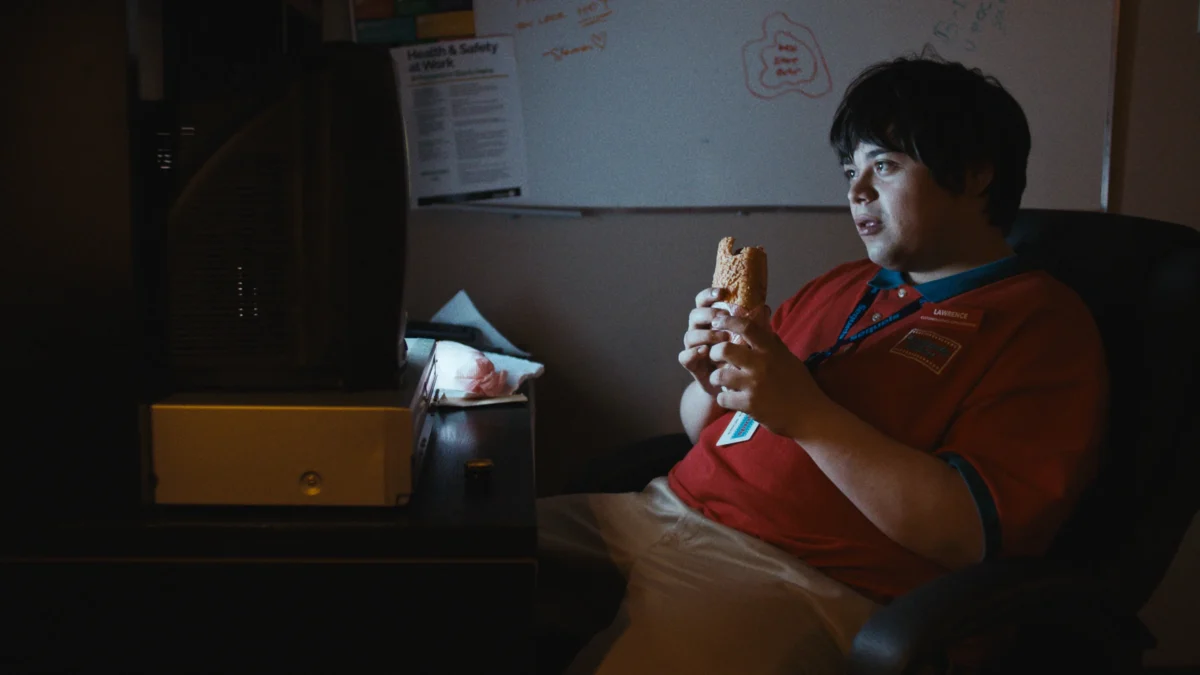
“I like movies” might be the most harmless sentence in the English language. It ranks somewhere between “I enjoy food” and “I breathe air” on the scale of things that do not need saying. And yet Chandler Levack manages to charge that little phrase with startling sadness and need, and something close to pathology. When it comes out of the mouth of Lawrence Kweller (Isaiah Lehtinen), it lands not as an unobjectionable statement of appreciation for the arts but as a broken, repeated answer to every question a seventeen-year-old gets asked and dreads. What are your dreams? What do you do for fun? Who do you turn to when things go bad? What are you going to fill your one, priceless life with? To all of it, Lawrence has the same reply: “I like movies.” His self identity is mostly a stack of VHS rentals and multiplex stubs wedged into the holes where a personality is supposed to go.
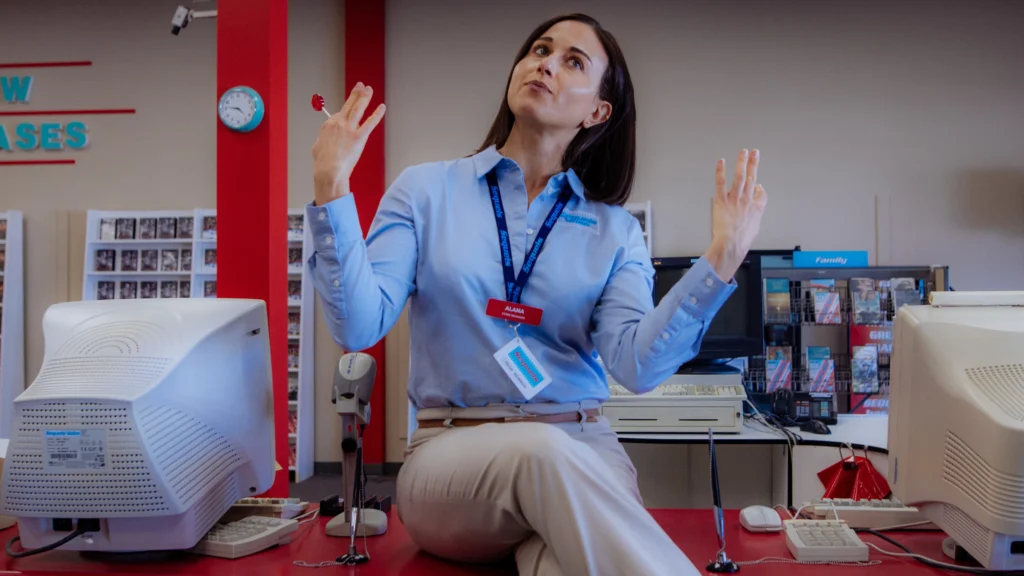
The film tracks Lawrence across a senior year of high school in Burlington, Ontario, in which both too much and too little happen. He has exactly one friend, Matt Macarchuck (Percy Hynes White), with whom he shares a weekly ritual they call Rejects Night — watching SNL and acting out their own “cast member” street intros — and a pipe dream to escape suburban Canada. Lawrence has his sights set on NYU’s Tisch School of the Arts’s filmmaking program and becoming the next Martin Scorsese or Paul Thomas Anderson. (The latter looms largest; Lawrence is deep in an obsession with new release Punch-Drunk Love, which places us in dreary 2002.) To fund his dream, he takes a job at a Blockbuster-style video rental store called Sequels, where he falls into an unlikely (and unromantic) connection with his manager, Alana (Romina D’Ugo).
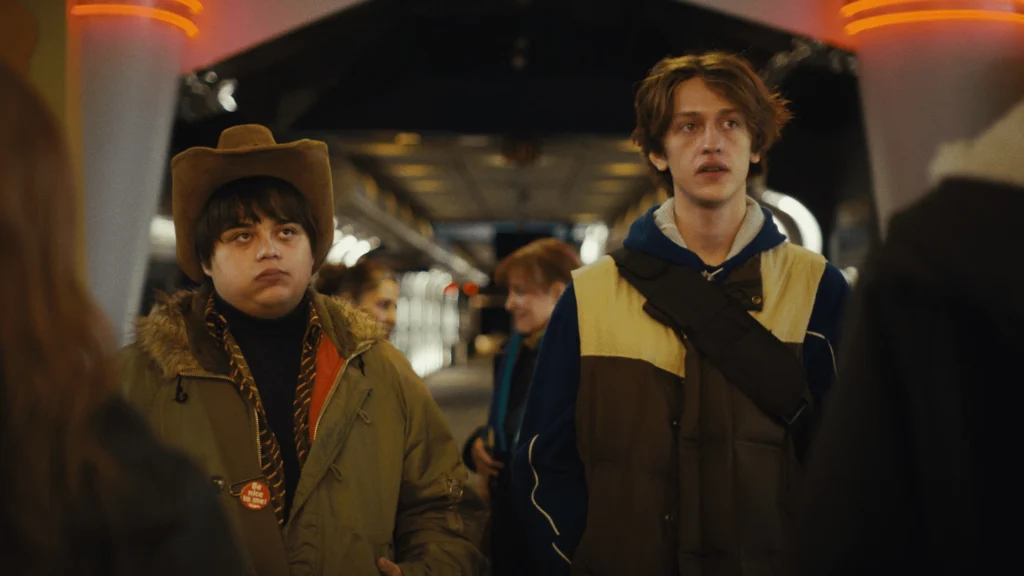
Most of I Like Movies is devoted to the considerable challenge of spending time with Lawrence. Levack nails the specific frustration of loving someone prickly, the way charm and cruelty can share a single breath. Lawrence is, at times, a grounded, tender Michael Scott: oblivious, grandiose, sympathetic against your better judgment. One of the movie’s most memorable scenes is one in which Matt finally opens up to Lawrence, who shuts him down with a few precise, devastating words. It’s one of the most harrowing, cringe-inducing sequences I’ve sat through in a while, watching Lawrence torch the steadiest relationship he has. And it is made worse because we detect some self-awareness and truth in Lawrence’s words: He and Matt are different enough that they probably won’t be friends forever. Throughout I Like Movies, I kept thinking of Superbad and its co-dependent teen boys drifting apart, except Levack’s portrait is the more honest and bittersweet version, clear-eyed about how important and fragile a male friendship at that age really is to two “rejects.” (Matt writes Lawrence a yearbook message so understated that its obvious sadness broke my heart into pieces.)
What deepens the film beyond a simple cringe-a-thon is that Lawrence isn’t the only character that cinema has wrecked. Alana, it turns out, has her own complicated, buried history with the medium, which she lets out in pieces: most memorably in a long, unbroken after-hours confession that D’Ugo plays wonderfully. She’s sharing something she can barely admit to herself. Both Alana and Lawrence have been made smaller and lonelier by movies. Both are still, somehow, reaching for grace through them. As also depicted in the classic documentary American Movie, loving and making movies can be a coping mechanism for grief, aimlessness, and a low-grade panic about the future that Lehtinen and D’Ugo capture perfectly.
I Like Movies is, on nearly every front, a remarkably assured but small-scale piece of craft, and Canadian up and down the crew. Levack and cinematographer Rico Moran, also making his feature debut, build a consistent, low-key visual grammar around Lawrence’s tunnel vision: clean, gently dollying shots that grow busier and dirtier as other people start crowding into his self-centered movie. They shot on Panavision glass to lend, in Moran’s words, a touch of Hollywood to the deeply un-Hollywood Burlington, and the warm amber-brown palette gives everything a cozy early-2000s fuzz (but not scuzz). Murray Lightburn of The Dears (a Canadian band that emerged right around when the movie is set) supplies a lovely score evocative of In the Aeroplane-era indie music, and the endless beige sprawl of Ontario strip malls crafts a very real, depressing, familiar place. It makes Lawrence’s ache to get out much more palpable than your typical teen comedy protagonist normally has. The whole affair was assembled for roughly the price of a Blockbuster rental late fee. It’s a perfect, slightly-jaundiced suburban texture.
A quick word on the delightful Levack, because her path is its own charming story. She came up as a film and music critic before crossing over to making her own movies, and she has been a part of the emerging Canadian cinema scene: In 2016, she won a contest in which Matt Johnson’s Zapruder Films gave away its annual Telefilm grant to a first-time female screenwriter. Jonhson and co. subsequently partnered with Telefilm Canada to turn the contest into the Talent to Watch program, the springboard for a smorgasbord of talented Canadian filmmakers the past decade. I Like Movies itself was eventually funded through the program. It almost goes without saying that I Like Movies is partially autobiographical for Levack; she even worked at a video store herself.
With I Like Movies, Levack announces herself as a promising talent for drama-comedy cinema, with an especially steady hand for controlling tone, exploring precarious friendships, and reining in troubled characters without sanding them down. She makes me think of both Elaine May and Greg Mottola, operating in that register where a precise character study is both painful and warm (and also quite funny). She is having quite a year, too: her sophomore writer-director feature, Mile End Kicks, just reached theaters this spring to strong reviews and is one of my most anticipated watches for the rest of 2026. Mile End Kicks incidentally shared an American release date with Levack’s third film, Roommates, a straight-to-Netflix Adam Sandler production that I found rather charming in spite of its Happy Madison tics.
When movies are as sharp and funny as this, even if they’re tough to sit through, it’s hard not to like them.
Is It Good?
Very Good (6/8)
Dan is the founder and head critic of The Goods. Follow Dan on Letterboxd. Join the Discord for updates and discussion.
10 replies on “I Like Movies (2022)”
You and I have a vast difference in the optimism with which we receive “I like movies” – my instinctive response is to suspect that either this fellow is about to explain (in EXCRUCIATING detail) why they only like an enormously-specific sort of film or explain why they love movies at a level of detail that leaves the audience nauseated to the point of fleeing the very prospect of a cinema screen the way vampires generally avoid churches.
Clearly I’ve been consuming Film Noir, Detective Fiction, Political Thrillers, Gothic Horror, Dark Fantasy Epics and Dystopian Science fiction to the point of being more shocked when there IS no Dark Secret or sting-in-the-tail.
Or perhaps the 21st century has just left me suspicious-minded.
I suppose I was thinking of Ratatouille when Anton Ego says “I don’t like food, I love it, and if I don’t love it, I don’t swallow” or something similar with “like” being the harmless, non-snobby word. I think it’s fair to be skeptical of someone who uses movie-loving as part of their identity, which is definitely a point the movie makes. To your point, it’s more true in the “fandom” era of movies in the 21st century than ever before!
Great review title!
“Both Alana and Lawrence have been made smaller and lonelier by movies. Both are still, somehow, reaching for grace through them.” Man that really hits for me. Great review top to bottom
Thanks Mitch!
I have at least one other “Lawrence of…” title in the archive, Causeway starring Jennifer Lawrence, which I declared “Lawrence of suburbia.”
I dunno. I’m live with someone who if asked to affirm or deny the statement “I like movies” might only do the former with a substantial amount of reluctance. I blame the 2020s.
My wife is significantly more movie ambivalent than I am, too. I think it was How I Met Your Mother that posited “the olive theory” — that most pairings have someone who love olives and someone who doesn’t. Maybe something like that is true for movies, too.
I’ve been thinking a lot about whether the 2020s are actually a worse era for movies, or if I’m just older and they’re more recent, so less of the output feels classic or even charming at replacement level. But I really do think it’s worse on average — the infection of studio craft systems with dull “fix it in post” digital filmmaking dovetailing with the dying movie middle class, and also diminishing trust in screenwriters… well, I guess I’ve basically just described the entire movie-making apparatus as the problem, so there we go.
Around the holidays in late 1995, you could’ve walked in a multiplex and had the option of seeing Heat, Casino, GoldenEye, The American President, Sense and Sensibility, Mr. Holland’s Opus, and Toy Story *at the same time.*
A little earlier, in ~October of that year, you could’ve had the choice of seeing Seven, The Usual Suspects, Kicking and Screaming, To Die For, Get Shorty, and Leaving Las Vegas at the same time.
Not to mention several other less famous but quite watchable offerings in both of those windows. (And, uh, Showgirls.)
And that’s not even considered one of the all-time best movie years.
I may be biased, but to me it’s unfortunately clear that movies in the 2020s aren’t at anywhere near the level they used to be.
Those 1995 lineups are insane. I find it so frustrating that most of the genre I go hardest to bat for — light dramas, comedies, twisty crime stories — are relegated to streaming or arthouse fare. Then I have to squint or hold my nose a little with the lower production values and star power. At least we can still go back and watch those glory years.
I like black olives, she likes green ones.
Anyway, the 2020s get an unfair asterisk in the form of 2020 itself, which is almost undeniably the worst cinematic year of all time, or at least in a hundred years. (I mean, I don’t think anybody really tries to sell the 1900s and 1910s as “good decades full of great cinematic experiences.” Most people don’t even act like decades really start counting until 1920, though I’m very doubtful that if through some magic every time we went to the theater we were sent back to 192X, and we had to choose from whatever was playing precisely one hundred years ago, we would *actually* find the experience superior.) But even *without* 2020, it’s strikingly weak. Like, 2021 sucked (two 10s, two 9s, iirc). 2025 sucked (two 10s, *one* 9, though I do need to catch up with Universal Language). 2023 produced literally no American 10s: my by-far favorite American movie from 2023 was A Haunting In Venice, and God bless Branagh’s Poirots, but that’s certainly not ideal. Only 2022 was a very good year, and 2024, while producing some truly excellent films at the top, runs out of masterpiece and near-masterpiece gas rapidly enough that I have a top ten list that includes, like, Cuckoo (a fine shocker, but shouldn’t be in the top tier of things). And maybe it feels especially bad because the 2010s were actually above average, as I recall.
I think everything you point to is a factor but it still seems mysterious to me that systems that seemed to work pretty okay have broken, e.g. WDAS cannot make a genuinely good cartoon to save its life. It’s okay though because some people made a couple of small-budget horror movies that broke through and made real money. This has never happened before–it’s not, you know, the way the modern horror genre has always worked, starting in 1978–so we should talk about how that’s some huge, HUGE paradigm shift.
I do think there’s something to the current rise of filmmakers who have mostly penetrated through in the horror genre as resembling something of a tide shift, partially because of the small wave being led by YouTubers and sketch comedians as a wildcard origin for the talent. Certainly the success stories ebb and flow in horror movie history and we’re in… an ebb is the good one, right? I doubt Kane Parsons and Curry Barker are John Carpenter and Sam Raimi, but if their success crossed with Supergirl and Avengers 4 (5? i lost track) sinking below projections, it could be good for the prospect of funding original stories and new voices, so I’m still slightly heartened about their success, though you’re right that horror has always worked that way.
I’m stingy and whimsical with my top ratings so it’s not a great metric, but I’ve given out about twenty 7/8 ratings in the seven years-to-date of the 2020s (~3/yr), a couple of those definitely stretches, and zero 8/8s, though I have a few on my radar that are candidates to bump up when I watch again. But that’s compared to the many, many 7/8s and several 8/8s of the 2010s. I do still think some of that is that I’m older and more jaded, and part of me wonders if I was more thorough in searching out indies and foreign films to find diamonds in the rough, my perspective would be different, but I’m with you and Nate that whatever age we’re in will not be retroactively called “golden.”