
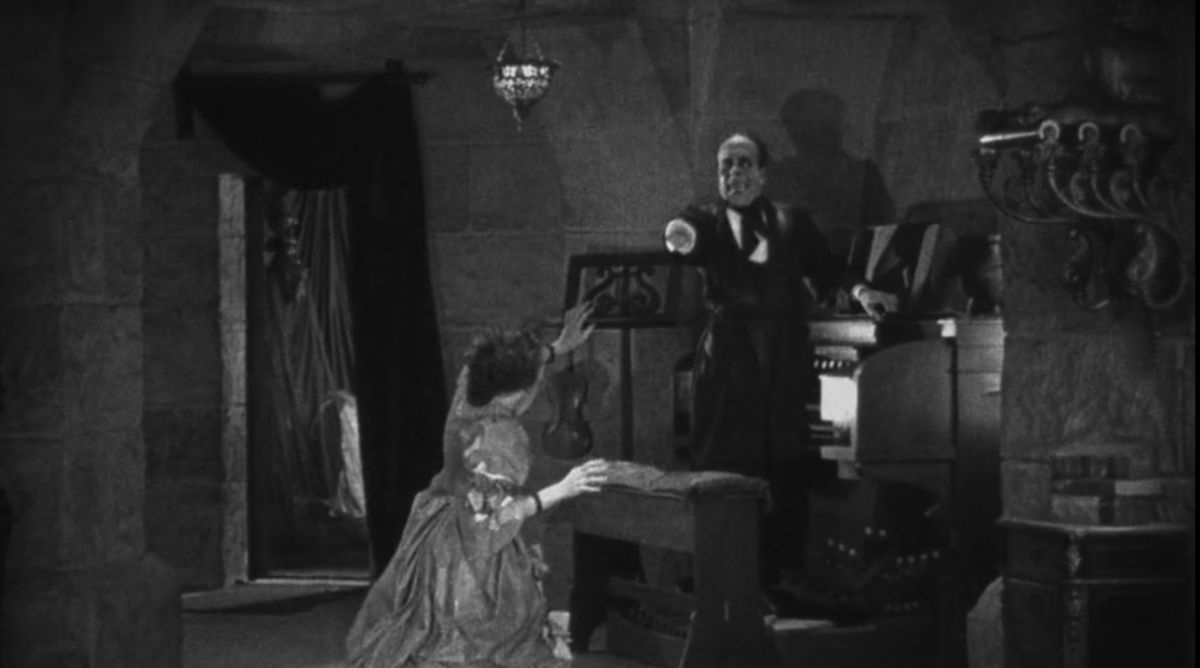
"Feast your eyes — glut your soul on my accursed ugliness!"
Phantom of the Opera might be the most adapted horror story this side of Dracula. Gaston Leroux’s 1910 book has been adapted so many times (silents, talkies, Hammer horror, a De Palma rock opera, and most inescapably the Andrew Lloyd Webber musical that played on Broadway for 35 years and Joel Schumacher turned into a Hollywood hit) that the story now floats free of any single telling. Like most people, I came to the Phantom through its descendants rather than the source, and I’d never found the story itself particularly rich or satisfying. So I read the first few chapters of Leroux’s novel to see if maybe it’d just been sanded down. The truth is that there isn’t much more to the story than what any given version captures: a simple, pulpy ghost story light on incident and character depth.
But what the material has in genuinely staggering quantities is everything that isn’t plot: Subtext. Mood. Imagery. The themes pour out of it: Monstrous longing curdling into menace; the abjection of a creature who lives under the world because the world above won’t look at him; a face that people refuse to see, but is in truth as ugly and scarred as the ghost’s soul.
This brings me to the version I should have watched first, anyways, its original silent incarnation: Universal, 1925, Lon Chaney’s frightening visage. Phantom of the Opera is one of the great achievements of silent horror, and, to my mind, the strongest single candidate for the American horror film of the 1920s, and I’d say that with more confidence if you further exclude American films made chiefly by recent imports. (Most of the great silent horror films, like Nosferatu and Dr. Caligari, are European, and German Expressionist specifically.) A hundred years later, its imagery is still potent and its impact is still unsettling, occasionally terrifying, even with a slow pace that often accompanies films of the era.
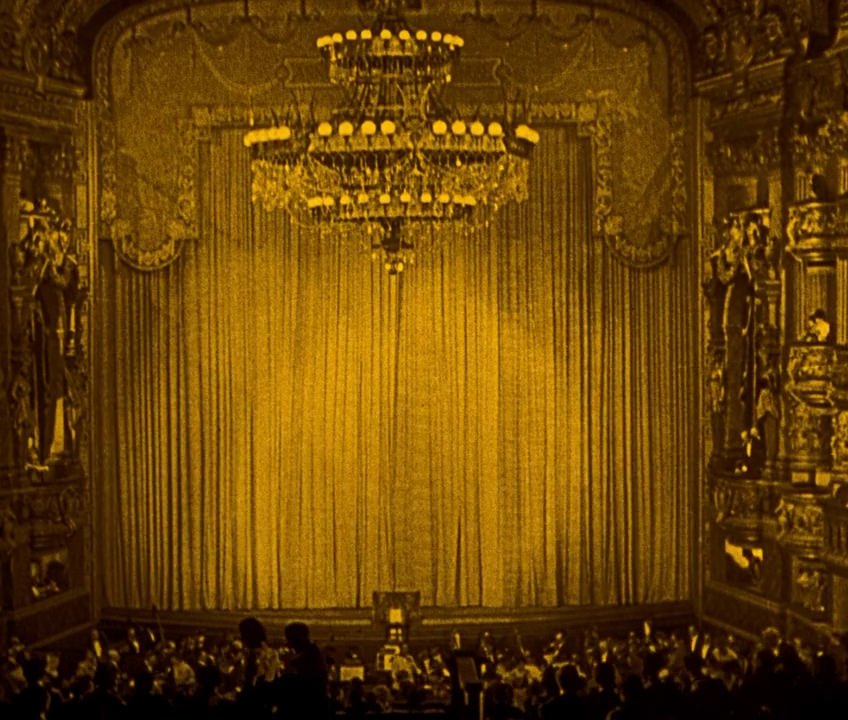
The film opens with the Paris Opera being terrorized by an unseen figure the staff call the Opera Ghost, who claims a standing reservation on Box Five and tolerates no argument about it. He has fixated on a young soprano, Christine Daaé (Mary Philbin), whom he intends to make a star by whatever means necessary, and whom he eventually draws down through the mirror of her own dressing room into the catacombs beneath the theater. But the phantom’s scheme to woo Christine is complicated by her growing relationship with the debonair Raoul (Norman Kerry). There is a chandelier, and you are probably aware that it does not stay on the ceiling.
You come to this 1925 adaptation for a very specific reason, a very specific face. Erik, the Phantom, is Lon Chaney’s invention: The actor designed and applied the makeup himself, with no studio artist and no sculpted mask. He raised his cheekbones with cotton and collodion, blacked out his eye sockets and glued his ears flat. His boldest face sculpting came in threading loops of wire up into his nostrils to wrench them open into two raw skull-holes, a rig that reportedly left him bleeding under the putty. He cultivated an air of mystery around his work during production, applying the makeup at home in the morning and wearing an ordinary human mask while he commuted onto the lot so that not even the crew could see it.
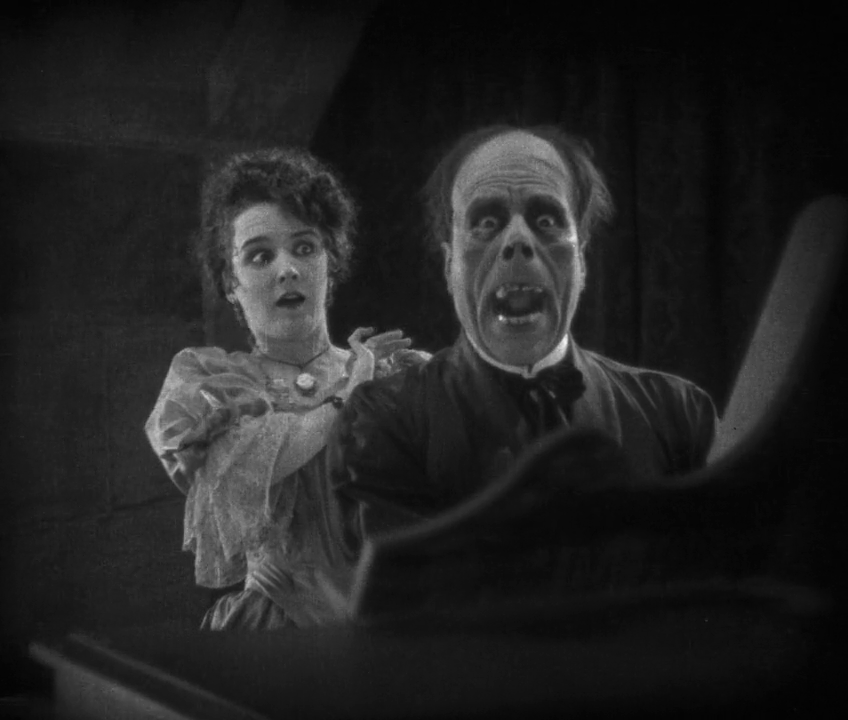
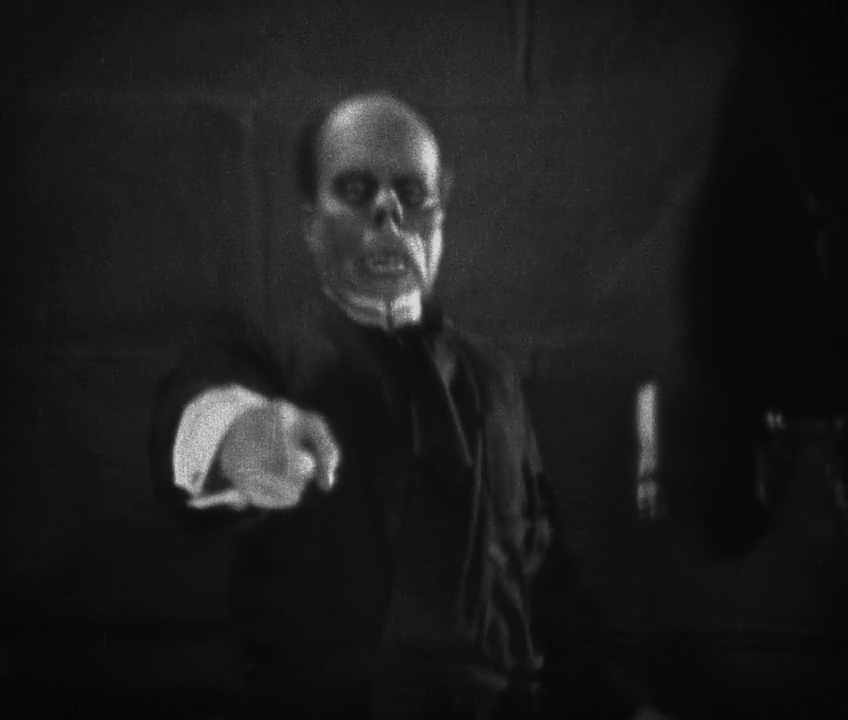
The first revelation of The Phantom’s face is one of silent cinema’s most legendary and stirring images. Christine creeps up behind the seated Phantom at his organ; the camera holds; she reaches for the mask; and the film makes you wait, and wait, in a trance-like tempo that’s almost unbearable, before the mask falls and the camera gives a brief, reeling lurch of focus as if it too can’t quite stand to look. Philbin’s shock is genuine (Chaney never let her see the face until the cameras were rolling). And then the shot shifts to Christine’s point of view, and Chaney points at the camera, accusing both Christine and the audience of plunging into dark waters better left undisturbed, of gawking at the ugliness of the world instead of contentedly enjoying its beauty.
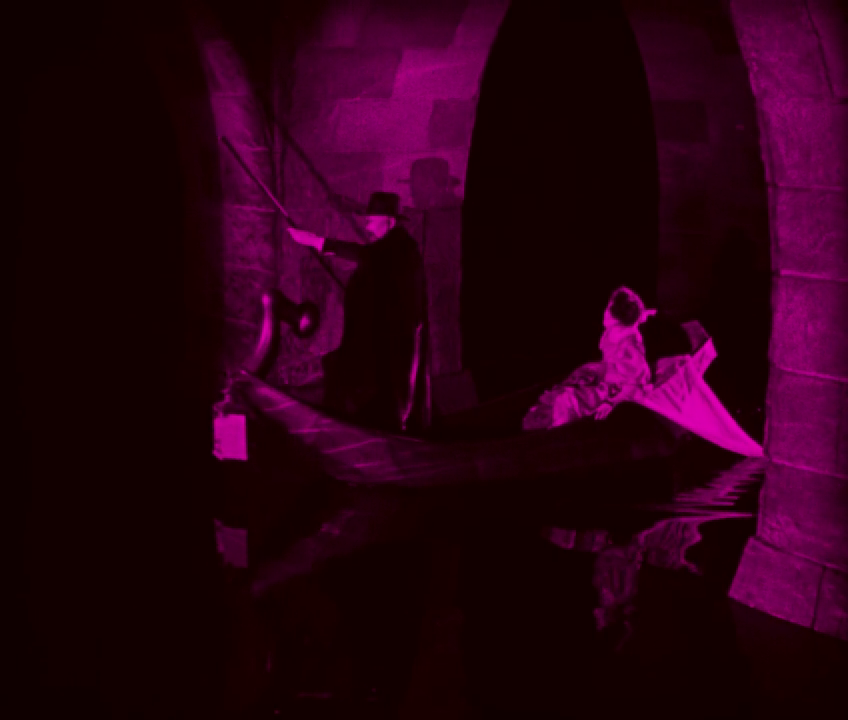
Chaney’s makeup is not the only production triumph. Indeed, this Phantom is an astonishing piece of imagination and classic Hollywood craft from top to bottom. Universal reconstructed portions of the Palais Garnier, the grand staircase and gutters and all, at full scale on a soundstage, and because the auditorium had to hold thousands of extras, the studio applied some then-cutting-edge civil engineering with concrete and steel girders to construct a sturdy set. (It outlived nearly everyone involved, standing until 2014.) The staircase is a wonder, a vertical ocean of marble, matched by the geometric vertical folds of the enormous curtain. But the grandeur sours the deeper into the theater’s bowels we go: from the decadent balconies and administrative offices, down to the sprawling and boxy stage, down to the shadowy backstage labyrinths, down into the chiaroscuro grime of the cellars and its black subterranean lake. It’s in those intestines of the opera house where the Phantom poles his little boat through the dark, a sinister gnat of moral decay that the upper class can’t swat away. The heaven upstairs rests on the shoulders of the underworld below, and a monster commutes between them.
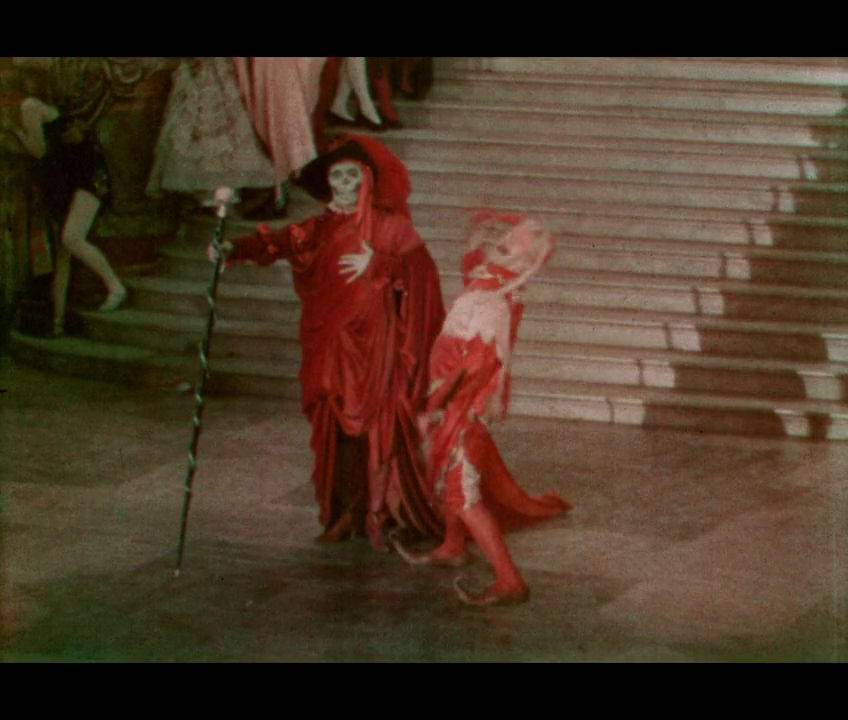
The film makes remarkable early use of color. The bulk of the film is tinted monochrome, all shadow and grain like Nosferatu, until the Bal Masqué erupts into a fascinating sight: two-strip Technicolor, which looks alien and stained to our human eyes (as opposed to the resplendent three-strip made famous in Wizard of Oz and the like). The Technicolor was supplemented with post-production dyes, including the film’s most striking splash of color: Chaney comes striding down among the costumed revelers as the Red Death, a slash of arterial scarlet cutting through the crowd. It’s one of the boldest uses of color in silent cinema, offering a deathly jolt like a wound in the film itself.
So the film is a technical marvel, but we must consider the extent to which the film has endured as watchable to modern storytelling standards. I’ll be honest about the knocks against it: The narrative has creaks and lags, and the characters are not cinema’s richest. The romance between Christine and her bland young nobleman is thin, a piece of plot machinery, and a couple of stretches of the back half get tangled in repetitive, almost slapstick, chase mechanics. It feels longer than its runtime of 75-90 minutes (depending on the cut; more on that in a second), though I’d never punish it for its pace given the context: It’s downright fleet compared to, say, Fritz Lang’s Dr. Mabuse or Woman in the Moon.
The film’s twisty production history is almost as interesting as the story itself. Phantom is not an auteurist piece of horror, but a committee affair assembled by people who actively could not stand one another. Director Rupert Julian and Chaney loathed each other so completely that at a certain point Chaney simply stopped speaking to him, and the two communicated through cinematographer Charles Van Enger, who relayed direction back and forth like a hostage negotiator. Some have taken this anecdote to mean that Chaney blocked and directed his scenes himself. Indeed, many of the most iconic moments of the film center around Chaney and the way he engages with the camera: not just the reveal, but his gargoyle posture when he spies on Christine from the roof of the opera and his skulking as he schemes in his underground lair.
It only gets messier when you consider the many resulting cuts of the film. Julian’s original cut was grim, gothic, and heavy; it previewed, and audiences hated it. So Universal handed the picture to Edward Sedgwick, a comedy-and-action man, who re-shot and re-cut it into a lighter adventure with new romantic subplots and a mob-chase climax, and that previewed even worse. With two failed versions on the shelf, the studio brought in editors Lois Weber and Maurice Pivar to salvage something releasable out of the wreckage, stitching footage from both attempts into the cut that finally went out in 1925. And then, four years later, Universal slapped a synchronized soundtrack onto a re-re-re-edited version and issued it as an early talkie in 1929.
This leads to a genuine viewer-beware that makes it tougher to appraise the film: There is no single definitive Phantom of the Opera. The 1925 general-release cut was lost for decades, and what you’re most likely to find today is a silent reduction of that 1929 reissue rather than the version audiences flocked to in 1925. Comparing cuts is not mere film-nerd hairsplitting as they differ in structure, in scene inclusion and sequencing, in how much Phantom you get onscreen, and even in the ending. Kino-Lorber released a well-regarded restoration on Blu-ray with multiple cuts, projection speeds, and soundtracks.
However you watch it, the film’s legacy is the same, and it is enormous. This is the film that cemented Lon Chaney as American horror cinema’s first true icon: the “Man of a Thousand Faces.” And even more importantly, its box office success is what convinced Universal there was a fortune to be made in monsters. You can draw a straight line from the Phantom’s unmasking to the iconography of Universal’s early horror cinema and, as such, the basis for horror iconography in all of modern American culture. Dracula, Frankenstein, The Wolf Man, The Mummy, and the entire Universal monster cycle followed; the silent Phantom was the first and most significant domino.
A century of adaptations has gone looking for more story in Phantom of the Opera than was ever there to find, because the material’s richness was never in the plot. It’s in the tension between those words: between beauty and monstrosity, art and sin, glamour and grime, love and lust. All perfect fodder for image-driven cinema, as seen in this uneven but brilliant film. The darkness is there underneath whenever we’re ready to pull the mask off.
Is It Good?
Very Good (6/8)
A few words on "Is It Good?" ratings for early cinema.
Dan is the founder and head critic of The Goods. Follow Dan on Letterboxd. Join the Discord for updates and discussion.
5 replies on “The Phantom of the Opera (1925)”
“silents, talkies, Hammer horror, a De Palma rock opera, and most inescapably the Andrew Lloyd Webber musical that played on Broadway for 35 years and Joel Schumacher turned into a Hollywood hit”
Plus one time he haunted a shopping mall! (Also the ’71 Murders In the Rue Morgue is basically a terrible Phantom of the Opera remake, even starring Hammer’s Phantom as the rather non-pongid murderer in the Rue Morgue.)
One of my favorite films of the 1920s, and very much my favorite horror movie of the silent era that I’ve seen (I prefer it quite a great deal to Caligari or Nosferatu or Waxworks or The Man Who Laughed or whatever), for all the reasons you highlight (also very much my favorite use of two-strip Technicolor). Haven’t watched it in a long time, really need to rectify that.
You know, I guess I’ll add I guess it must be my favorite Universal Horror, too; The Invisible Man (and to a slightly lesser extent The Mummy) would be the competition there.
I have a soft spot for THE WOLF MAN myself (Honourable mention to DRACULA, but the first Universal take is too clearly a movie that would have been much, much stronger had poor Renfield and his tragedy been it’s central arc throughout*).
*Also if it’s director had been able to keep on the Wagon throughout.
I’ve actually seen both of those. The Wolf Man is pretty great; Dracula felt a bit stodgy to me both as a story and as a film, but it’s undeniably a cornerstone of horror.
Glad to hear it’s one of your favorites. Definitely a great one, I’m on the line between this rating and the one above it.
I honestly can’t think of too many notable two-strip technicolor movies, but I’m sure lists are out there that could point me towards them.
Only seen a few Universal horror movies, but it’s a blindspot I’d like to fill in the next couple years (I don’t think I’ll do a completionsit binge, but at least the highlights.)
Brian for the podcast watched a recording of Love Never Dies and said it’s one of the worst things he’s seen.