
Forget it, Abe, it's Willowbrook
One mental exercise I sometimes play with certain actors and directors: Rerun their career a dozen times from some starting point, nudge the variables a hair, and ask what the best version looks like, and whether we got that. With Adam Brody, the gap between what happened and what could have is uncomfortably wide. Anyone who watched the first season of The O.C. saw a future leading man, a nu-Hanks: funny, self-deprecating, a little dorky, a little prickly, a lovable loser, always able to sell a dramatic or romantic moment. Handsome but not intimidating. Then he faded into the background. To be clear, he never vanished, but the A-list Brody got mislaid somewhere in the multiverse and we got stuck with C-list. The Kid Detective is the best argument that we got robbed of a real star. (The viral success of 2024’s Nobody Wants This is at least some delayed justice, though it’s not his most complete turn.)
Alas, The Kid Detective, a terrific neo-noir, is not something that moved the needle, at least in terms of acclaim. This terrific little Canadian picture got dumped into the teeth of the 2020 pandemic on a $3 million budget, where it promptly evaporated.

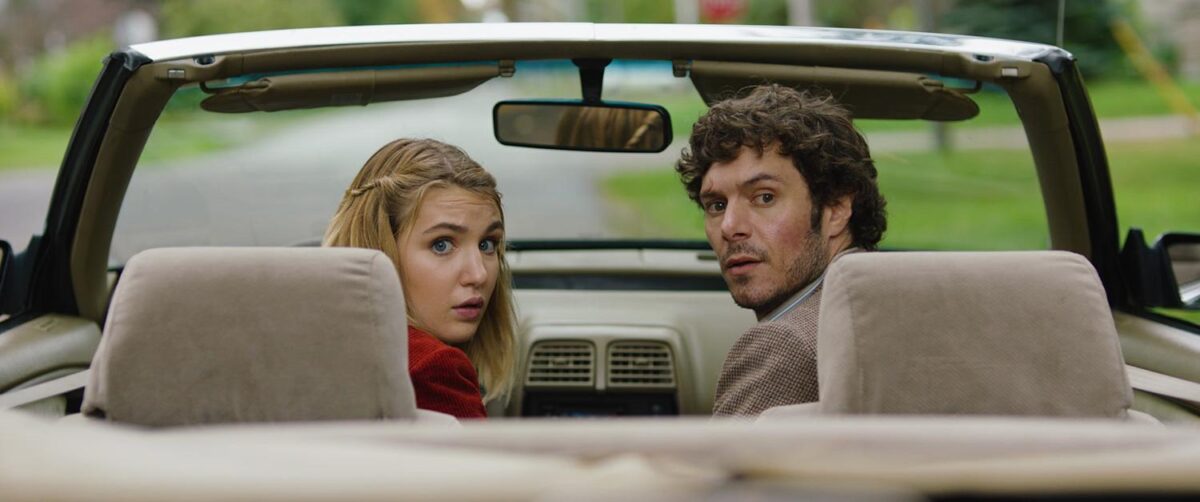
Abe Applebaum (Adam Brody) was, at twelve, the pride of sleepy Willowbrook: key to the city, a wall of solved cases, free ice cream for life from the local soda shop. Then his friend Gracie Gulliver, the mayor’s daughter, vanished on her walk home. Abe couldn’t crack his biggest case, and he never grew up, stuck indefinitely in a stasis, reeling from his big failure. Now he’s thirty-two, working the same kid-detective shingle with a entirely disinterested receptionist (Sarah Sutherland) and a case of alcoholism. He drinks his way through dinky cases about missing cats and whether a local dad is secretly gay (answer: “a little bit”). Then a dame, high schooler Caroline (Sophie Nélisse), walks in with a real one: her boyfriend, Patrick Chang, was stabbed seventeen times, and Abe has to find out what he’s actually made of as he figures out who killed the kid.
What lifts this past its SNL joke premise is the screenwriting, the best thing here by a mile other than Brody’s performance. Evan Morgan, in his feature debut as writer-director, builds a mystery of almost showoffy precision: throwaway gags circle back as plot points or payoffs, images rhyme across the runtime, and clues you’d forgotten were in plain sight all along. I watched it twice just to revel in its machinery.
It’s also a bleak comedy that is funny exactly as often as it wants to be. The humor is bone-dry rather than zany — wry deliveries and background jokes rather than memorable punchlines — and the best bits are runners that compound: the day of the week he can never get right (he’s a drunk; time stopped for him), the closet he hides in whenever he’s casing someone, a stakeout that repeatedly detours into watching a suspect plays Pong. The ice-cream-for-life reward gets cashed daily at a counter from a guy who eyes Abe with disdain. The latter is the whole movie in one image: a grown man redeeming a child’s trophy, and the sadness within that scenario.

The case grows nastier as it builds, darkening by degrees until it lands somewhere genuinely devastating, closer to Chinatown than to Encyclopedia Brown. Morgan stabs you, twists the knife, then twists again in a searing, terrific finale.
Where the film hits its ceiling is the direction: it’s clean and professional for the budget but definite low-budget indie material, never finding images as well-designed as its writing. Its closest kin is Rian Johnson’s Brick, another high school-adjacent neo-noir that gets darker across its runtime. Brick built a whole visual language; The Kid Detective doesn’t quite reach that level.
Brody carries the movie: It’s the best use of him since The O.C., maybe ever, because Abe demands every register he’s got: wit, self-pity, wounded pride, bone-deep loserdom, some heroism, plus a seam of pathos he hides until the closing moments. If anything, he’s pitched a hair too prickly and mean, but I think that’s better than making him too soft. Nélisse makes a lovely foil as an anti-femme fatale, her Caroline locked in perpetual wide-eyed gawking, and the film mines good comedy from the role reversal of a teenager chauffeuring, feeding, and parenting the dazed thirty-two-year-old who’s meant to be the grown-up.
The film ends on a freeze-frame of the title, at which point “The Kid” of the title takes on a layered and much sadder meaning. The film hands its broken hero an ostensibly happy comeback and lets you feel its hollowness; he’s famous again but still a kid at heart, frozen at the age of his worst day, when his friend vanished. Various other figures have frozen in time, too. Willowbrook as a town has. Nancy Sinatra’s “Sugar Town” plays us out the way it played us in, the loop closing on a man who never escaped or grow up. Which brings me back to Adam Brody: This is a film about wasted potential starring someone trying to make the most of his own — the rare case where the kid the world moved past finally gets his showcase and makes it work. We got robbed of the big Brody career. At least we got this.
Is It Good?
Very Good (6/8)
Related Articles
Dan is the founder and head critic of The Goods. Follow Dan on Letterboxd. Join the Discord for updates and discussion.
4 replies on “The Kid Detective (2020)”
I remember watching this film and thinking it good, but cannot make a more intelligent point than that having not yet rewatched it.
As for Mr Brody, while an actor is still working there’s always hope: some make it Big from the start, some take years to get there and some take decades (Consider Dame Judi Dench or Mr Morgan Freeman, for instance – in front of us for years before things CLICKED).
I do think we’ll be seeing more of Adam Brody following his success on the Netflix romcom, but who can be sure? At least it seems he has pretty steady output in indies, which is enough.
I loved it! I was hooked on the comedy angle I felt it was initially presented as and I think it stuck its heavy ending.
And on the Adam Brody of it all, I really liked his appearance in Jennifer’s Body.
Glad you checked it out and dug it! Always fun to find a diamond in the rough.
He was good in Jennifer’s Body for sure. One friend recently asked me after reading this review what movies I think he would have been good in that he wasn’t cast in. Going to think on that a little.