
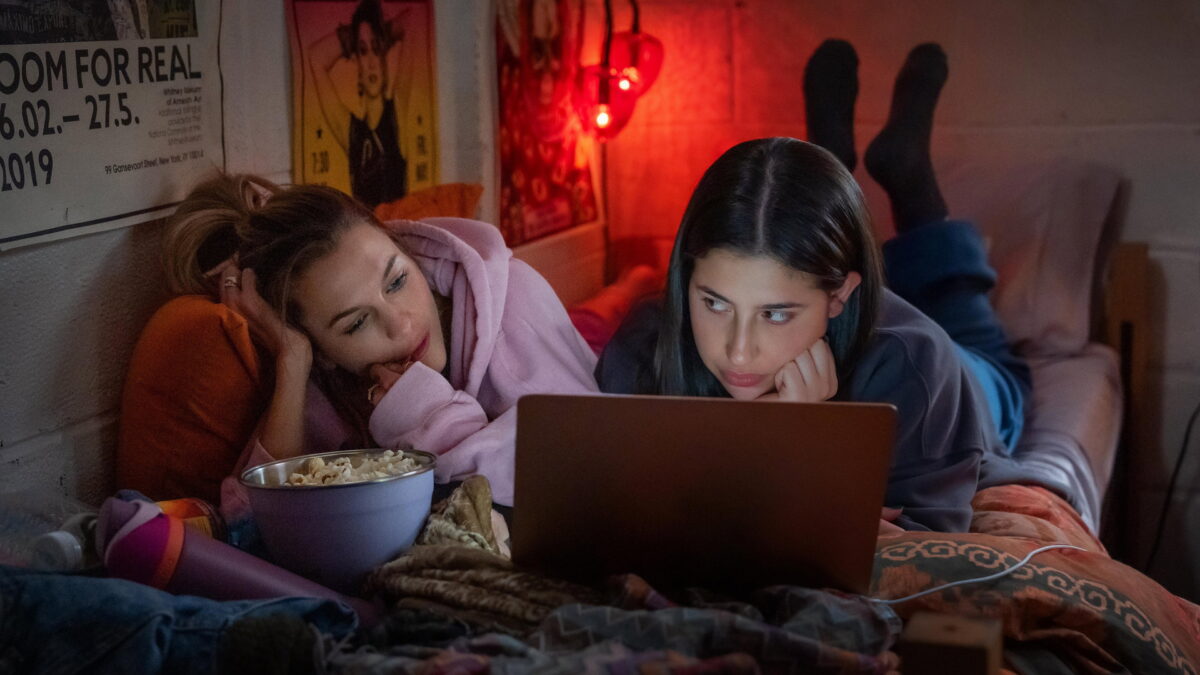
Girl, it's so confusing sometimes to be a girl (girl, girl, girl, girl)
For starters, Chandler Levack is the real deal. The Canadian magazine writer-turned-director is bubbling just under the mainstream, but has a shot at breaking out this year with her sophomore writer-director effort Mile End Kicks, which incidentally hit theaters for a limited release on the exact same day Roommates hit Netflix. (Canadians are having a moment on the indie scene: Charlotte Le Bon’s Falcon Lake, Pascal Plante’s Red Rooms, and Sophy Romvari’s Blue Heron, plus Levack’s work, have all earned laurels from critics over the past few years.) But to the extent that anything in Roommates functions, it’s due to Levack’s just-right touch. She exhibits outstanding empathy and savviness for cringe comedy, understanding that the subgenre works best when it’s a deep tissue massage of a character study that helps you appreciate the inner humanity and complexities of abrasive people rather than a mean-spirited study in denigration.
Even still, the movie is victim of a baffling screenplay at odds with Levack’s sensibility: Roommates is an escalating series of indignities on its characters that never pivots back to emotional honesty. You can tie that to the fact that it’s a production by Happy Madison, Adam Sandler’s company, known for projects with all of the grace and human touch of a foghorn. It’s the same hurdle that You Are So Not Invited to My Bar Mitzvah faced, of tender realism vs. cartoonish excess, though Roommates comes out marginally more satisfying as an honest coming-of-age story.
The premise is straightforward college comedy fodder: Devon (Sadie Sandler), a wide-eyed freshman wallflower, shares a dorm with free-spirited Celeste (Chloe East), and the two embark on a barbed, codependent friendship that has a few highs and many toxic lows. The story is bookended, and serially interrupted, by a present-day framing device in which a dean (Sarah Sherman) recounts Devon and Celeste’s saga to two feuding current-day roommates. That framing device deflates the movie every time it rears its head: It’s dramatically inert and written in a quasi-ironic style that clashes with the main narrative. Each cutaway kills the momentum.

When the movie stays on Devon and Celeste, though, it more-or-less works, and the main reason why is that Levack coaches two terrific lead performances from Sandler and East. Sandler (Adam’s daughter) emerges as a genuinely intriguing screen presence (like her sister in Bar Mitzvah, but better), refusing to play Devon broadly the way you’d expect the movie around her to demand. The shadow of the obvious nepo baby casting gradually dissolves under the consistency of Sandler’s performance; it’s easy to imagine her dipping her toe into arthouse movies in the next couple of years. East, a real talent, matches her, finding small moments of both menace and vulnerability inside Celeste that hint at a more nuanced character than the screenplay will let her have. Based on this and Levack’s wonderful debut I Like Movies, the director has a knack for the specific discomfort of friendships fracturing, which Sandler and East both inhabit well. The best scenes here are the ones where Devon and Celeste smile at each other while their insides fume and/or wilt.
It’s a shame, then, that the supporting cast has so little to do. The movie has some big names on the bench with Janeane Garofalo, Natasha Lyonne, Storm Reid, and Nick Kroll; and somehow it manages to use almost none of them. Lyonne and Kroll get stuck doing overqualified parental comic-relief shtick any working sitcom actor could’ve delivered, and Garofalo and Reid almost certainly shot their scenes in a single afternoon.
The biggest problem (and curiosity) of the film is the third act. After two acts of precisely calibrated cringe, Roommates capitulates into the broadest physical comedy and ritual humiliation, the kind of stuff you’d expect in an Adam Sandler comedy that Happy Madison typically produces. This tonal shift to mean-spiritedness would have torpedoed a lesser director, but Levack barely keeps it afloat in spite of itself.
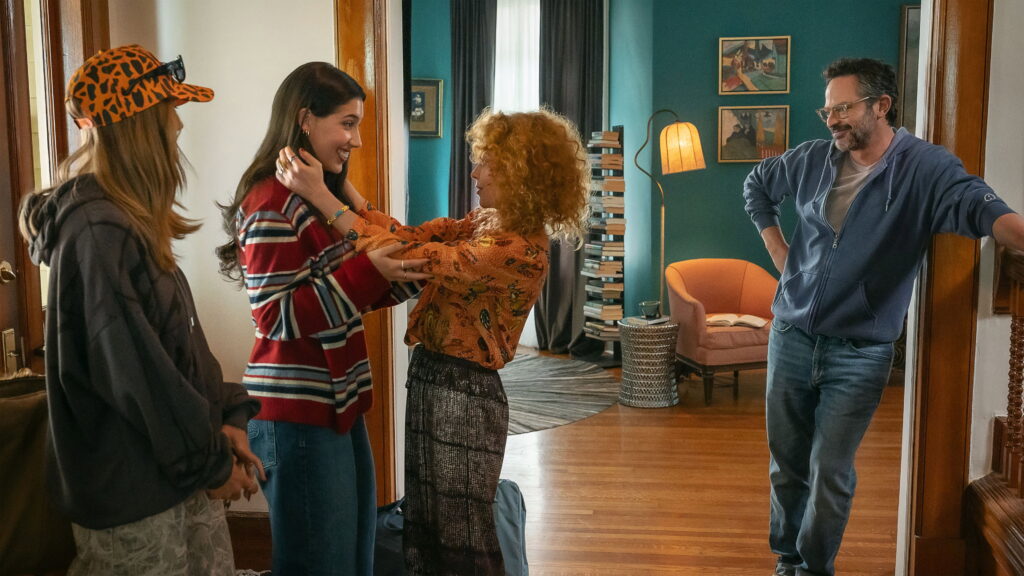
Levack controls the film with a variety of tricks and moments, but is especially in tune with using music to set the mood. For example, the karaoke sequences set to “Driver’s License” and “Mr. Brightside” offer moments of release, and the needle drop of Charli XCX and Lorde’s “Girl, So Confusing” plays perfectly in this movie about a fragile, jealousy-streaked female friendship.
This is the first time Levack has directed from someone else’s script, and you can feel the dilution of her voice. Roommates is a fascinating clash of an empathetic, vocal authorial sensibility crashing into the cynical script and production apparatus surrounding it, and the resulting movie is equal parts intriguing and disastrous. But Levack’s instincts are strong enough to survive a compromised script.
And whether it’s intentional or not, a self-reflexive streak comes through; Roommates occasionally subverts the tropes of college comedies, especially the half-baked happy endings that get tacked onto the moral chaos of collegiate shenanigans. That tepid hint of self-awareness is especially present of a cacophonous final act, but offers just enough of a provocative undercurrent for me to feel warmly as the credits rolled.
Is It Good?
Good (5/8)
Dan is the founder and head critic of The Goods. Follow Dan on Letterboxd. Join the Discord for updates and discussion.