
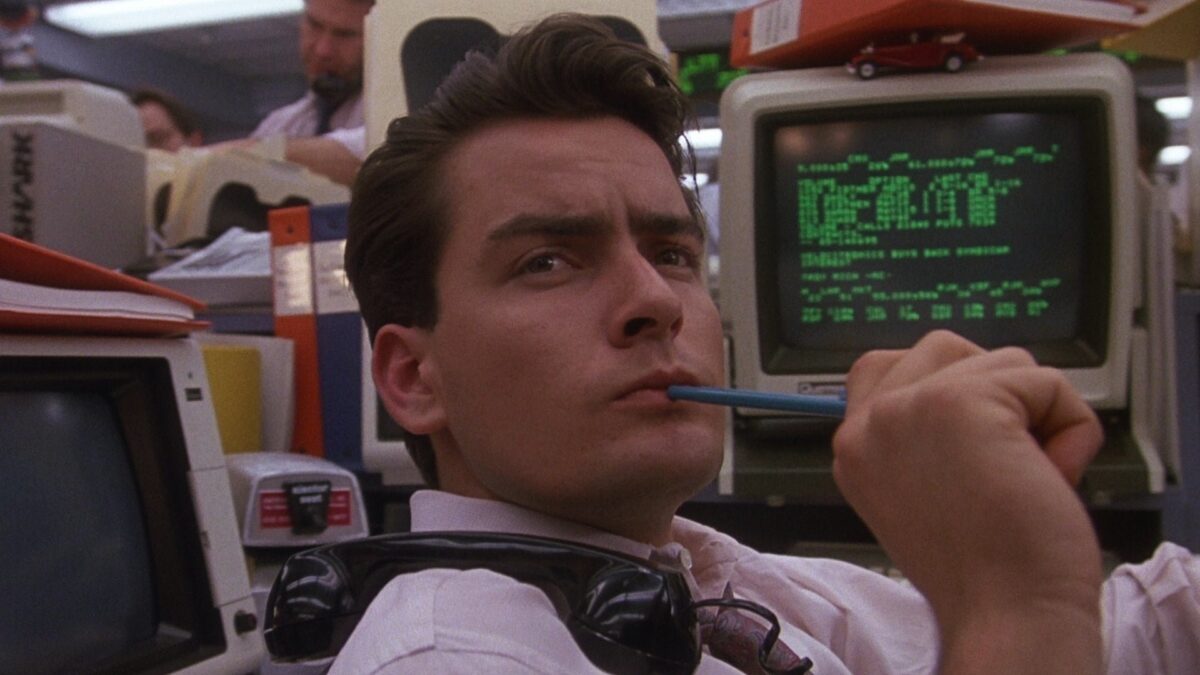
"Stop going for the easy buck"
I was not yet born in 1987, let alone watching Oliver Stone crime dramas. (As a teen, I always held Oliver Stone in my head as the epitome of a “grown up” filmmaker, probably because his films I knew of dealt with boring stuff like “politics” and “the stock market,” and also because the name Oliver was an old man name, not yet reclaimed for Gen Alpha babies.) But I have to imagine that Wall Street is a more interesting film in 2026 than it was upon its release. It is both a visual snapshot of the high-flying gaudiness of the late ’80s, and a spiritual snapshot: a tug-of-war for the soul of yuppies and, consequently, of American financial capitalism at an inflection point. What we couldn’t have known for sure (though the ending suggests Stone guessed) is that the avalanche of corporate corruption and wealth consolidation would only get worse from there. Some of the dollar figures and financial crimes depicted look downright quaint in 2026.
A movie being “interesting” is not the same as it being “good,” though, and Wall Street only barely achieves the latter, primarily on the strength of Michael Douglas’s charismatic villain, Gordon Gekko, the cutthroat, financio-sexual multi-millionaire who doesn’t hesitate to declare his villainy. “Greed is good,” he convinces an auditorium full of shareholders, and he lives the mantra from start to end. Douglas won an Oscar for the role, and I’m not objecting.
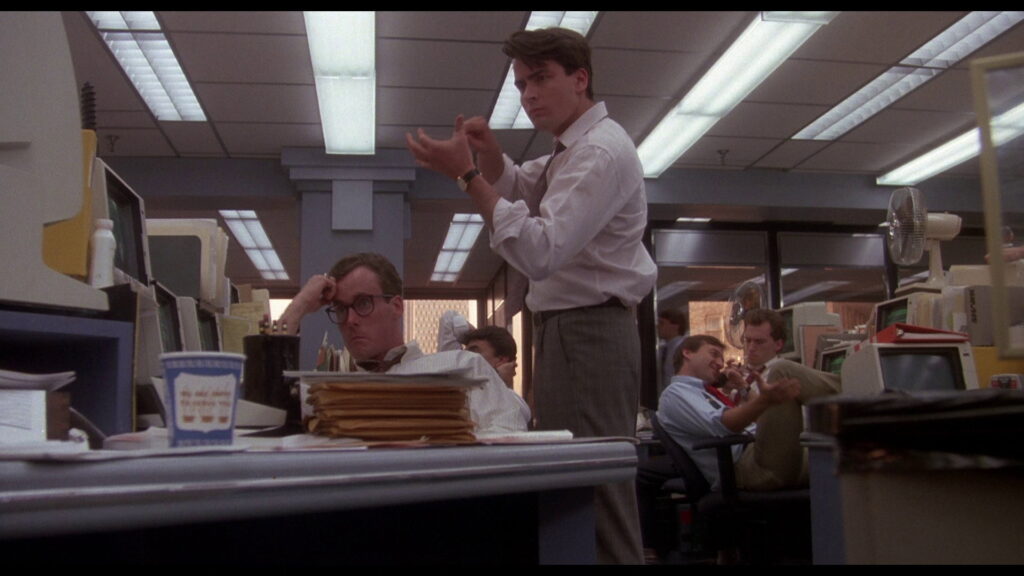
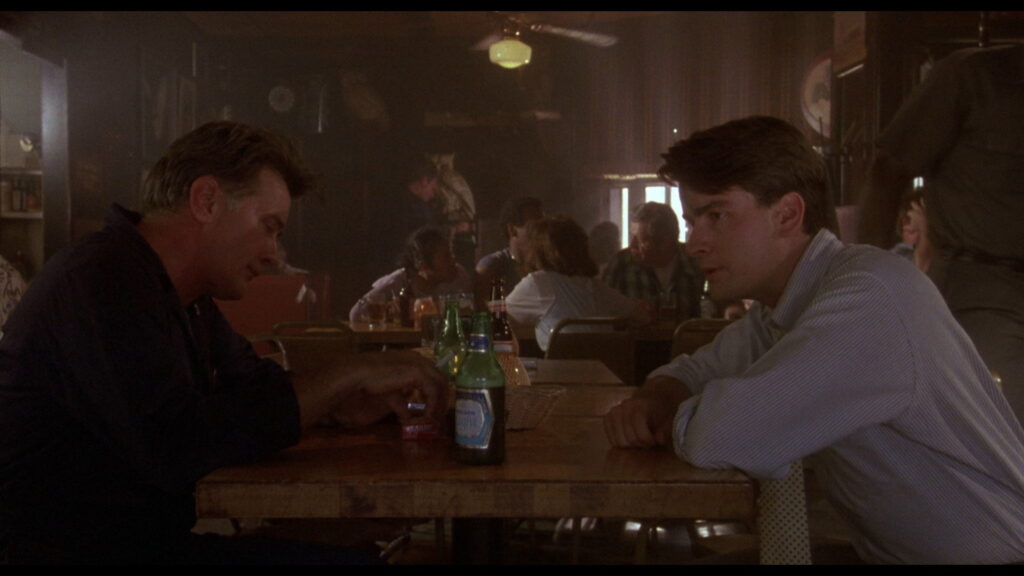
The story follows Bud Fox (Charlie Sheen), a hungry junior stockbroker whose father Carl Fox (Martin Sheen) is a working-stiff union leader at an airline. Bud cold-calls his way into Gekko’s orbit and gets seduced by the trappings: penthouses, designer suits, and a girlfriend named Darien (Daryl Hannah) who is as much a luxury accessory as the bizarre sushi-wrapping device in his condo. Bud finds himself trading insider tips and committing increasingly serious financial no-nos. Eventually, his two father figures, biological and corporate, collide, and Bud has to pick a moral lane. Beneath the ostentatious ‘80s decadence, Wall Street is a secular Pilgrim’s Progress about modern manhood and inheritance.
The film stays afloat due to Stone and screenwriter Stanley Weiser’s effective translation of the arcane mechanics of insider trading, leveraged buyouts, and corporate raids into something a layperson can follow. (I am such a layperson.) Stone has cited Paddy Chayefsky as a model, and Wall Street definitely has some DNA of Network, albeit more straight-faced and about stocks instead of TV. Even so, the actual financial machinations inevitably feel a bit ethereal: dollars getting shuffled around to harvest more dollars, nothing made, nothing built. Of course, that’s the point, as Carl points out to Bud.
What hurts the film is its inability to trust the storytelling. Stone keeps shoving the themes directly into characters’ mouths: Bud gives a “who am I?” monologue as he gazes at the New York skyline, and Carl and Gordon alternate “here’s why I’m right” speeches throughout the screenplay. The soapbox quality of the writing flattens what should be the film’s most interesting topic of interrogating two clashing worldviews.
The deeper revisionist critique, which I share, is that Wall Street settles for a “few bad apples” diagnosis rather than bemoaning the festering systemic rot underneath it all. Gekko gets framed as a singular monster — most of the strokebrokers in this movie, including the charming Marvin (John C. McGinley), are, in fact, good guys — rather than the predictable and inevitable output of a system where ethics are irrelevant and the law can be easily skirted. It feels like a cop-out.
The acting is a mixed bag. Douglas is the obvious highlight, but Martin Sheen is not too far behind: He is sympathetic and weathered, grounding the whole film whenever the story shifts into his union hall. The real life father-son chemistry of the Sheens really powers their scenes together: In one late moment in the movie, Bud sits weeping beside his father ailing in a sick bed, and the exchange is genuinely tearjerking.
Charlie Sheen otherwise is a burden more than a boon; his inexpressive stiffness was something Stone supposedly wanted for the blank slate Bud, but Stone was wrong. Sheen is pretty boring, until he’s over-compensating; his bigger emotional scenes veer into campy overacting. Hannah, meanwhile, is an obvious weak link, under-written and flatly performed, making the romantic subplot a zero.
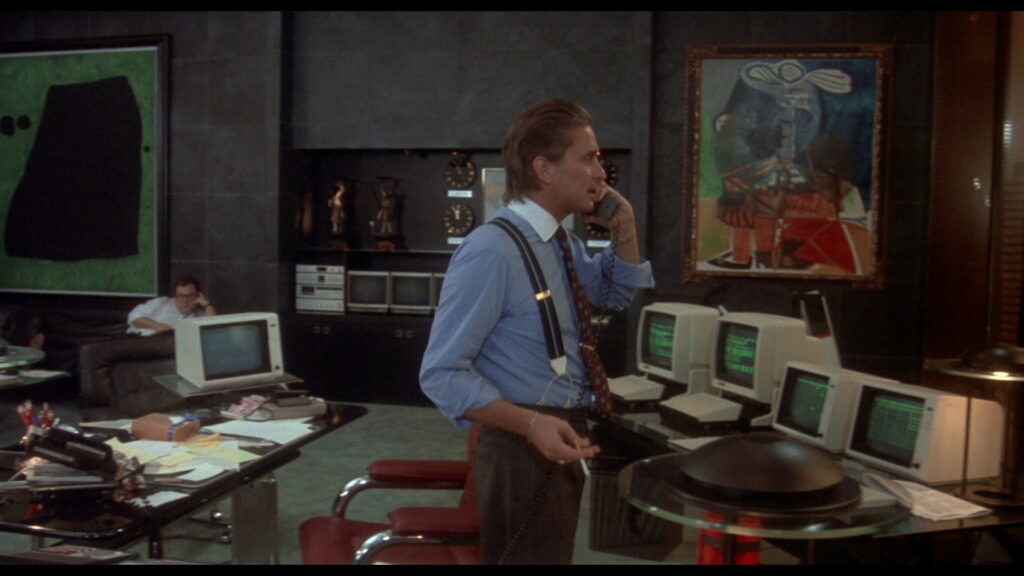
Where the film finds personality is in the texture of its presentation: offering a fascinating time capsule of over-the-top craft (that still might have benefited from being even more decadent). Robert Richardson’s camera prowls when Gekko is on screen, circling like a predator, and only locks into stillness in scenes with Carl, setting the tone for each character. Stone shoots mid-’80s Manhattan as a yuppie wonderland: orange sunrises off mirrored glass, gleaming sharkskin suits, a saturated neon-tint sheen: It’s a perfect vessel for the seduction the film is critiquing. Stewart Copeland’s percussive synth score has a dated, synthy sound, but is still great, propulsive and coked-up and matching the film’s visual rhythm. I also enjoy the bookending of “Fly Me to the Moon” and Talking Heads’ “This Must Be the Place,” the beginning and ending selections telling a story of uneasy American values by themselves.
Stone made the film as a tribute to his own father, a Depression-era stockbroker, and originally titled it Greed. But the film is a reverse-image of Erich von Stroheim’s early cinema epic: Bud’s agony comes in spiraling upwards rather than downwards, his conscience dying of metaphorical thirst in the amoral desert of Wall Street rather than his body daying of literal thirst in Death Valley. Gekko is a composite of infamous investors of the time (e.g. Dennis Levine) blended with Stone himself, whose speaking cadence shaped Gekko’s rapid-fire patter. The casting carousel was one fascinating near-miss after another: for Gekko, Fox wanted Warren Beatty, and Stone wanted Richard Gere, but fate intervened (positive). Meanwhile, Tom Cruise pursued the role of Bud before fate intervened (negative), as Stone committed to Charlie Sheen off the back of Platoon. A Cruise-Douglas sparring might have lifted the whole film a notch upwards.
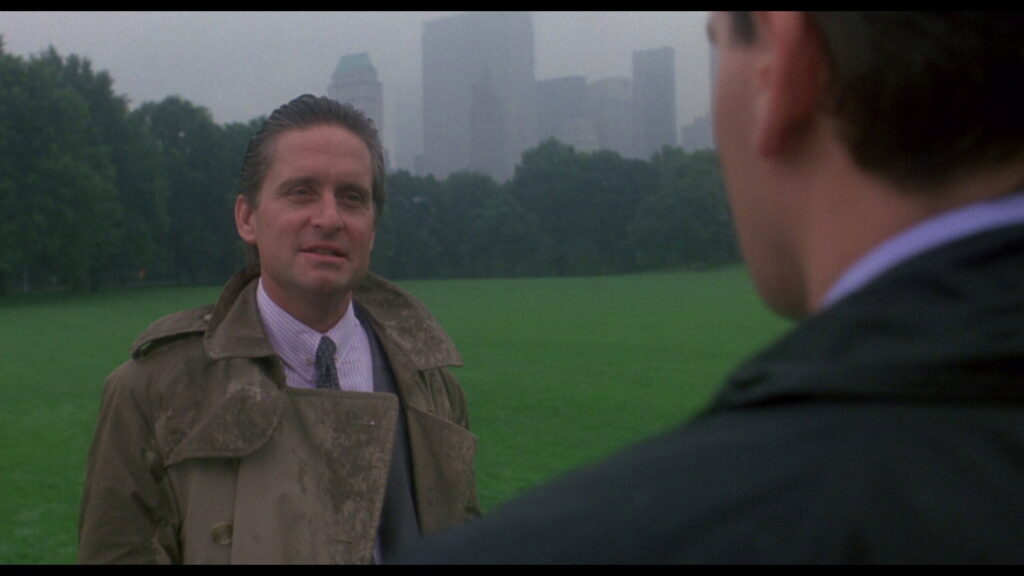
One historical wrinkle that elevated Wall Street’s profile came in the film’s release timing: production wrapped before Black Monday of 1987, but Wall Street hit theaters that December with the crash still at the top of the headlines. That accidental quasi-documentary urgency is in line with the reason Wall Street keeps getting rediscovered every time a new financial catastrophe occurs: savings & loan, dot-com, 2008, crypto, whatever’s next. It’s aged well compared to most other ’80s zeitgeist pictures in this regard, even as Gekko famously had the opposite of Stone’s intended effect: a generation of finance bros took him as inspiration rather than warning (this includes one of my college roommates, who studied finance and had a sign reading. “money over bitches” hanging over his bed). Stone, with Douglas in tow, eventually made a sequel post-’08 crash, and I’m curious how Stone’s lens on the ethics of Wall Street shifted over the following two decades.
So yes, the film is ultimately much more interesting than it is great. But interesting, sustained over almost forty years, eventually becomes its own kind of worth. Wall Street, for lack of a better word, is
Is It Good?
Good (5/8)
Dan is the founder and head critic of The Goods. Follow Dan on Letterboxd. Join the Discord for updates and discussion.
4 replies on “Wall Street (1987)”
Whoa, I never knew Cruise was almost cast in this. I like Sheen in the right role (including, actually, Platoon), but I agree he’s underwhelming here, and Cruise would’ve been a great fit.
Casting what-ifs like that can be so frustrating. Speaking of Cruise, but in the other direction, the one I’ve always lamented is that they initially wanted Russell Crowe as the hitman in Collateral. imo that’s a better fit and a better movie.
Generally agree with the tenor of your review here. The best Wall Street movie remains Margin Call.
I really need to see Margin Call. And Collateral!
Speaking of Douglas, Katy and I just watched The Game for the first time. Gonna need to sit on that one a little haha.
Nothing I’ve heard about this film makes me like it for the very reason you point out – it made young financiers want to BE Gordon Gekko, rather than want to hang him from the yardarm.
On the other hand it DID contribute one of the more gleeful jokes from HOT SHOTS PART DEUX.
Crime movies have had this problem since the medium was invented (see: 1915 serial The Vampries or even 1903 proto-western Great Train Robbery) — they almost inevitably make the bad guy look cool and appealing!