
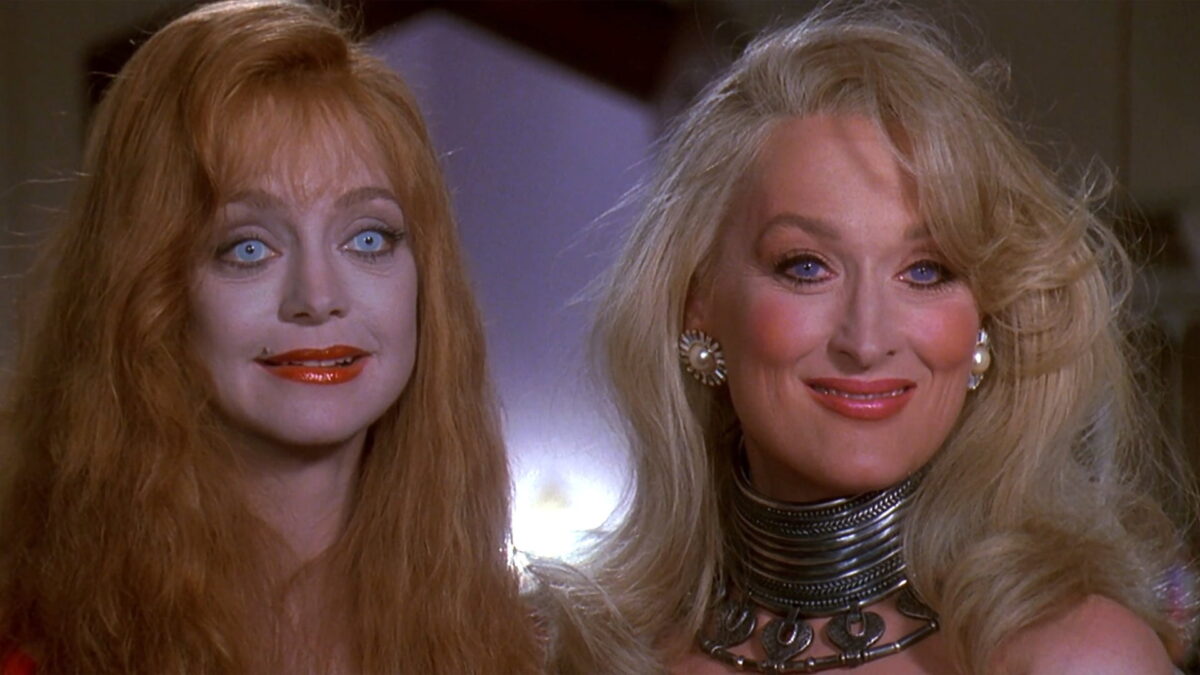
Wrinkled, wrinkled little star
Robert Zemeckis has built a career as a premier techno-artist, almost always finding some groundbreaking visual effect to center his films around. He doesn’t merely use special effects, but assembles stories welded to some impossible image that’s necessary to tell the story properly. Two Marty McFlys hanging out in the same diner. Tom Hanks shaking hands with JFK. Bob Hoskins walking among cartoons. Even in his most recent film, Here, which almost nobody liked but me, he was cutting centuries of composites into one fixed setup and continuous shot. With these Zemeckis films, the visual trick and the story arrive fused at their root. It’s impossible to tell whether the story he wanted to tell inspired the effect or vice versa.
For Death Becomes Her, the effect is comic body mutilation and manipulation: Some of it is destructive, with necks twisted the wrong way and gaping holes in torsos. Other times it’s reconstructive, like when Meryl Streep drinks a youth potion and her wrinkles vanish, her skin pulls tight, her butt and boobs suddenly get firmer. It all happens with a mix of early CGI and practical effects that still looks good 34 years later, and, like the majority of the director’s special effects, always will look good. (Sorry, mocap, you’re not included in that.) I guess Zemeckis figured the next logical step after putting bodies in unexpected places in his first few movies was to manipulate the body itself.
Death Becomes Her lands smack in the middle of his ascent as one of the biggest directors in Hollywood in the late ’80s and early ’90s, after Who Framed Roger Rabbit and the Back to the Future trilogy, immediately before Forrest Gump, but was treated in the moment like a stumble. It earned mixed reviews from critics and grossed $149 million worldwide against a $55 million budget, which is profitable but not prime Zemeckis profitable. Death Becomes Her has been steadily reclaimed in the years since, and, in my eyes, that reclamation is thoroughly deserved.
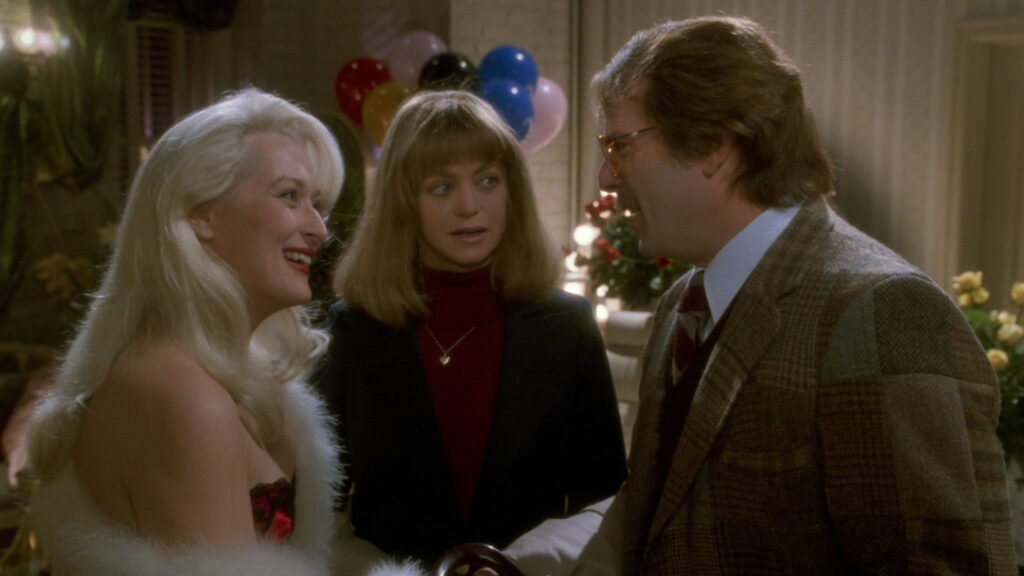
It’s not hard to see why reaction was a bit muted at the time, and why it remains tough to pitch someone on the film: Death Becomes Her doesn’t even have a clear genre. You kinda have to go through the story in segments to make sense of it: Madeline Ashton (Meryl Streep) is a fading actress; Helen Sharp (Goldie Hawn) is her lifelong frenemy; Ernest Menville (Bruce Willis) is the celebrity plastic surgeon Madeline steals from Helen. The film executes said romantic betrayal by smash-cutting from Ernest assuring Helen that he’s meeting Madeline just for a medical consultation, straight to Ernest and Madeline’s wedding, a terrific, story-trimming punchline. During these early scenes, the film establishes a pace and tone that resembles Old Hollywood screwballs, down to the one-upmanship and wall-to-wall repartee.
But before long, supernatural body horror enters the picture via the mystic powers of Lisle von Rhuman (Isabella Rossellini), and the movie transforms into a horror comedy. And since Madeline is an actress and Ernest works in plastic surgery, manipulating the images of people, it’s also a Hollywood satire. The terrific production, whose arch LA and huge manors feel faintly Burtonesque, suggests a Gothic fable. The phrase circling my head the whole time was sui generis, as Death Becomes Her is ultimately a thing of its own kind, a blend of many ideas. It has many cousins and connections: the mansion where an over-the-hill actress slowly rots evokes Sunset Boulevard, for example. But the biggest connective thread from recent years is The Substance, which borrows from this film hand over fist, down to the anonymous stranger who slips a desperate actress the contact info for a miracle drug during an appointment. Still, Death Becomes Her has no true peers that match its exact concoction of tones and pacing, and that’s testament to both Zemeckis’s direction and a screenplay by Martin Donovan and David Koepp, the latter on the verge of breaking out as one of the biggest screenwriting forces in Hollywood.
So Death Becomes Her sat as one of the forgotten entries in Zemeckis’s filmography for years, but the main group who kept it alive were queer audiences, who adopted the movie early even when the culture at large shrugged the film off. Though I’m a straight man, a queer reading makes sense to me on some levels: the feud between Madeline and Helen to steal Ernest is barely veiled as their obsession with each other; in fact, one of the big laughs later in the movie is how quickly the pair decide to ditch Ernest when they befriend each other. By the end of the movie Helen and Madeline have adopted each other as quasi-eternal life partners. Death Becomes Her also has a bit of a frothy nasty streak to it I’ve seen in other works adopted as queer classics.
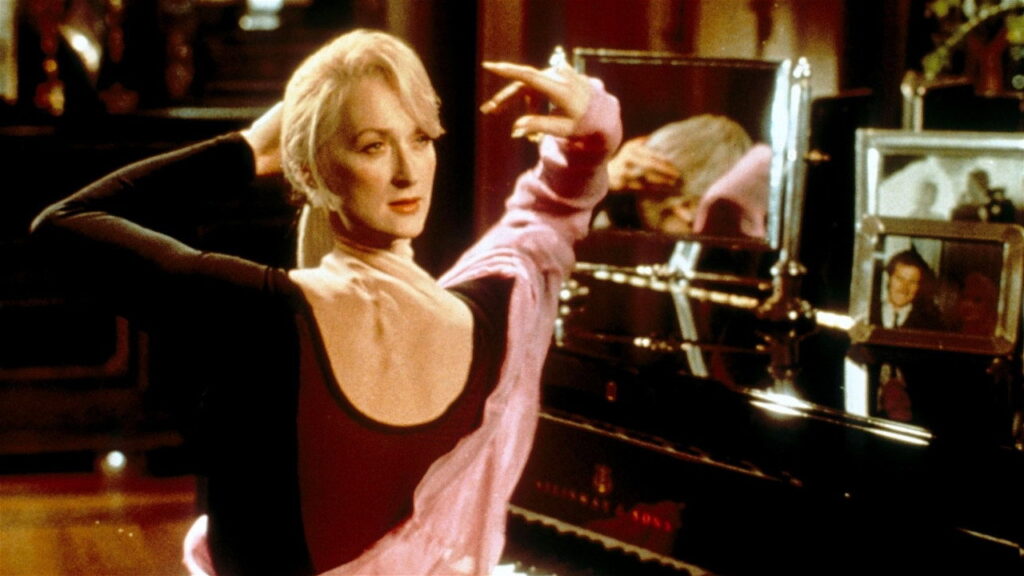
Joshua Grannell, i.e. the drag performer Peaches Christ, was so smitten he wrote and staged a full-scale parody of it, Drag Becomes Her. Grannell has cited his fondness for the film deriving from its depiction of one’s social worth adjusting based on how well you hold up as an object of visual desire, especially as you age. He argues the film captures this real but unsavory dynamic in gay male culture of obsession over polished image, poking fun at its subjects for subscribing to it while still sympathizing with them to some degree.
This edge cuts both ways, though, and the flip side of the prickly, shallow depiction of Madeline and Helen is frankly quite mean. What’s worse, that cruelty is unevenly distributed by gender. Death Becomes Her is very nasty about these two women, then declines to be the same towards the man between them. This can be read as ironic or as an impish zigzag, but it has strong whiffs of misogyny. In all his movies, Zemeckis has tended to be a bit more generous in lending kindness or depth to his male characters than his female characters, who are often put through a gauntlet or become the butt of a thematic joke. See: Jenny in Forrest Gump, Claire in What Lies Beneath, and all the young women in I Wanna Hold Your Hand. (Part of why I admire Welcome to Marwen is that it literalizes and confronts this reputation during Zemeckis’s underrated, introspective late career: Mark Hogancamp turns the females in his life into literal dolls as a stand-in for Zemeckis himself, a scalding self-examination.)
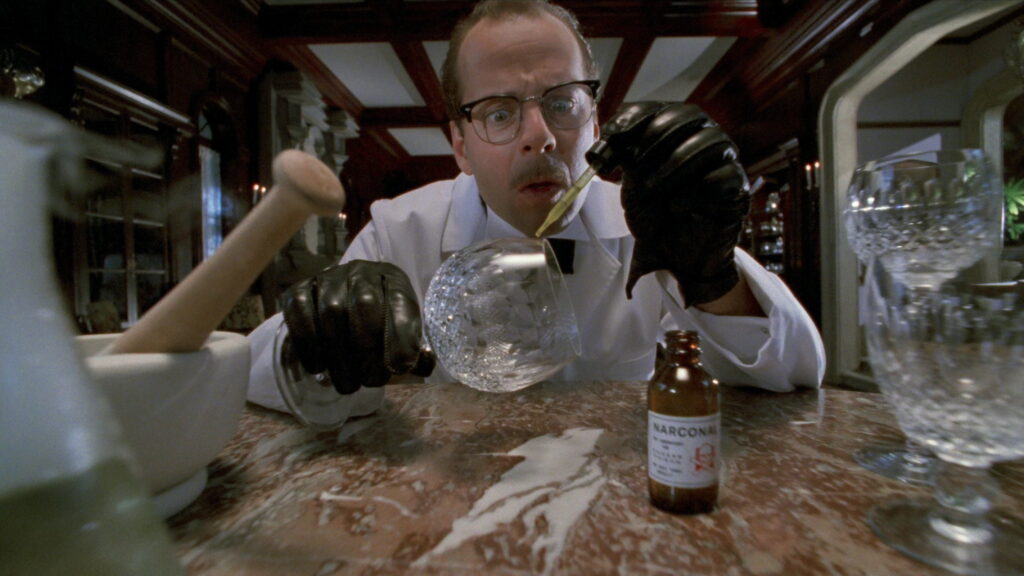
The ending of Death Becomes Her does no favors to Zemeckis in this regard: Ernest escapes Helen and Madeline, and thirty-seven years later, at his own funeral, we get the eulogy for a life of love and achievement and sobriety while the harpies rot. Maybe the guy we watched plot a murder should have received some karmic justice? (To be fair, Zemeckis filmed a less bitter ending, but it bombed with test audiences.) The movie is heightened enough to establish that it’s making it as part of an elaborate, ironic, structural joke, and the final punchline is great, but awareness isn’t absolution.
The craft and production are absolutely marvelous even setting aside the great effects. Dean Cundey (he of Halloween, Jurassic Park, and Adam Sandler’s Jack & Jill) shoots the Menville mansion like a Dracula castle in the style of Hollywood studio era glamour: a two-story foyer shot with a swooping jib, a glorious spiral staircase the movie can’t wait to throw somebody down. Alan Silvestri’s magnificent score, maybe the best of his career, captures gothic menace tempered with jaunt, something like Danny Elfman’s Batman blended with Bernard Herrmann’s Psycho and topped with some Tin Pan Alley ditties. Every set is a delectable triumph you want to spend hours poking around, from Helen’s gross apartment to Lisle’s purple-and-green art deco tower rising into the misty sky.
The special effects won an Oscar for the team of Ken Ralston, Doug Chiang, Douglas Smythe, and Tom Woodruff Jr., and deserved to. Madeline’s tumble down that staircase runs a preposterous eighteen seconds of ragdoll physics and shattering bone, maybe the funniest and longest stair stumble in cinema history. Then her crumpled corpse rises in soft focus behind Ernest while he’s on the phone is one hysterical, unsettling unbroken shot. A few minutes later we get the effect whose production most wrinkled my brain: Helen has a shotgun-blasted hole in her midsection you can see clean through, and Zemeckis can’t resist using it, sending a busted piece of the shovel from their brawl sailing right through the gap while she’s parked on the couch. ILM’s work holds up because Zemeckis deploys it so relentlessly and smoothly until you stop registering it as an effect at all.
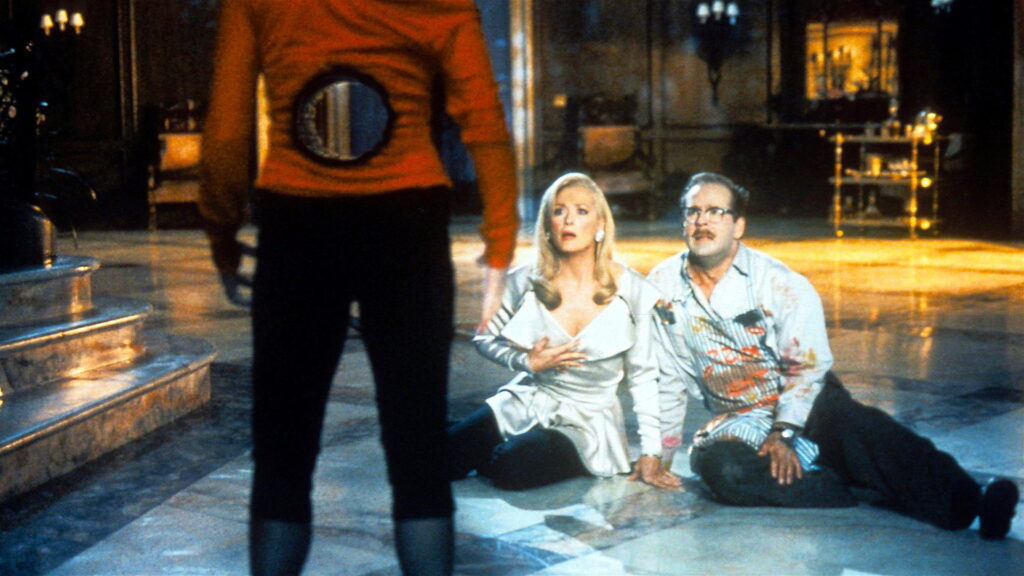
In the cast, Streep is the biggest highlight: the 21-time Oscar nominee offers a very funny performance with proper intensity and weight, playing Madeline’s vanity as something more human and frightening than mugging farce. Willis works against his typical screen persona to delightful effect: He’s a stammering nebbish with a comb-over and a habit of muttering “oh boy” that gets funnier as the scenario gets more preposterous. He also thrives delivering vintage slapstick in a way I wouldn’t have guessed: He executes some terrific silent-comedy business in the deep background of shots he isn’t the focus of. Hawn is the weakest of the three, but merely by process of elimination: She, too, is quite funny and invested. The movie gives most of its screentime just to those three, but my favorite small performance comes from Sydney Pollack, uncredited, as he turns a single ER visit into the funniest scene in the movie, checking up on Madeline’s wrist full of bone shards and lack of pulse with mounting professional desperation.
As much as I adore the film (and despite my complaints, I do), I can’t quite call it a masterpiece. The tone is a little too mean-spirited, and the movie always errs on the side of being clever and barbed than empathetic. And yet, Death Becomes Her is firing at a level Zemeckis hit only a few other times: the effects, the score, the sets, three great actors doing some of their most game work. And it ultimately earns the very final shot it goes out on: two severed but immortal heads at the bottom of a church staircase, sniping at each other, locked into a rivalry that now literally cannot end.
- Review Series: Robert Zemeckis
Is It Good?
Exceptionally Good (7/8)
Dan is the founder and head critic of The Goods. Follow Dan on Letterboxd. Join the Discord for updates and discussion.
5 replies on “Death Becomes Her (1992)”
I had cause recently to see what beat Batman Returns for Best VFX for 1992, and when I saw it was this, I said, “Oh right! Well, good God, I’d hope it did.” Is this actually more impressive than Jurassic Park? I mean, it really might be.
I’ve also never been a fan of the last stretch of it, which drags it down *considerably,* but the first two-thirds or even four-fifths are dynamite.
Dean Cundey’s ascent to the apex of American cinematography on the back of great work for over a decade, and his extremely hard fall afterwards, has always been difficult for me to understand. Like, he still had *a* career, maybe he just fell into 90s kids adventure and didn’t manage to resurface. But you’d think he made a pass at Kate Capshaw or something.
Many great cinematographers have a catalog filled with “wait, they also shot THAT?” entries (everyone’s gotta pay the bills). Though I do think Cundey takes the cake. But I had never really looked up just how fast it happened, and you’re right. He shot Jurassic Park (93), then Casper and the Flintstones, then Apollo 13 (95), then an abyss of kids movies and forgettable comedies.
If nothing else we can thank this film for also inspiring the music video to ‘taste’ (My pick for the greatest horror comedy short of the 21st century so far) and for seeing la Belle Rossellini wearing mostly jewellery, for both of which blessings I am deeply grateful.
Also, it’s just a d*** good movie.
Funny you mention those two points (“Taste” and Rossellini’s near-nudity) as an earlier draft of this had references to BOTH of those that I couldn’t manage to fit in, haha. I enjoy the “Taste” video as well.
I am, of course, taking your admiration of la Rossellini (Who is a rather amusing Mephistophelean figure into the bargain) for granted.
Also, COYOTE Vs ACME is Actively Good: if your little co-author fancies a trip to the cinema, I can happily recommend it.