
Up in the Éire
Hokum is what I like to call a line graph movie, by which I mean you could chart my engagement with it as a literal line graph, peaks and valleys neatly labeled. That’s usually a tell that a film is no more than the sum of its parts, and Hokum is very possibly less than the sum of them. The movie divides with unusual cleanliness into three acts, hard, rigorous segments, like chapters in a book, and I walked out holding three different opinions of each section .
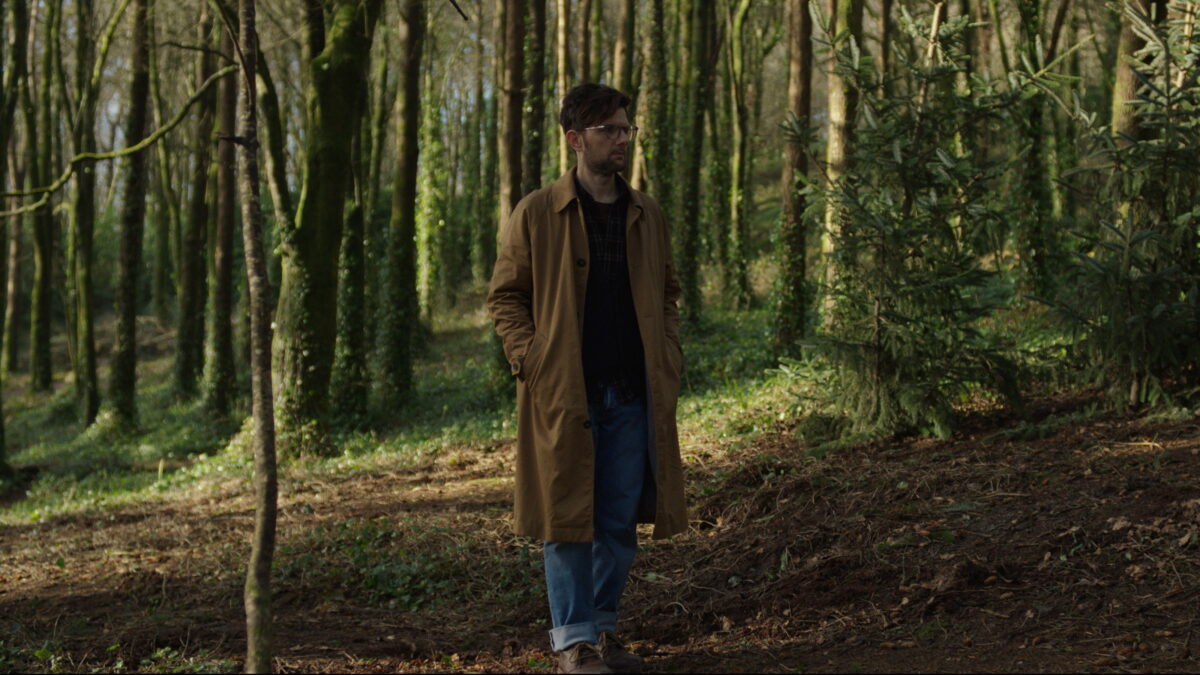
The story tracks a few very eventful days in the life of Ohm Bauman (Adam Scott), a horror novelist with an acerbic demeanor and a tragic backstory… which is to say he’s basically a Stephen King protagonist. Ohm battles demons, literal and figurative, inside the ghostly trap of an old Irish inn where he’s visited to scatter his parents’ ashes. The trip starts normal enough, but the staff’s tales of a witch haunting the honeymoon suite begin burrowing into his skull, and then the scenario turns dark. (Spooky Pictures, the shingle behind Barbarian, produced Hokum; I have no idea if they encourage their writers to adopt an episodic structure, but both movies lean into it.)
The first third consists of Scott being a witty asshole to the locals, and I confess this is my favorite act of the film, owing mostly to my own inclinations. I love Adam Scott bantering; he crafts instantly sharp characters who stay charming even at their most curmudgeonly, his casting as Ohm is perfect. Bauman’s condescending treatment of basically everyone he meets works because of Scott’s comedic screen presence. The Irish setting, shot gorgeously on location in County Cork, gives this stretch great specific flavor, too. And the act closes with a wrenching, shocking image and plot twist, my only audible gasp of the whole film.
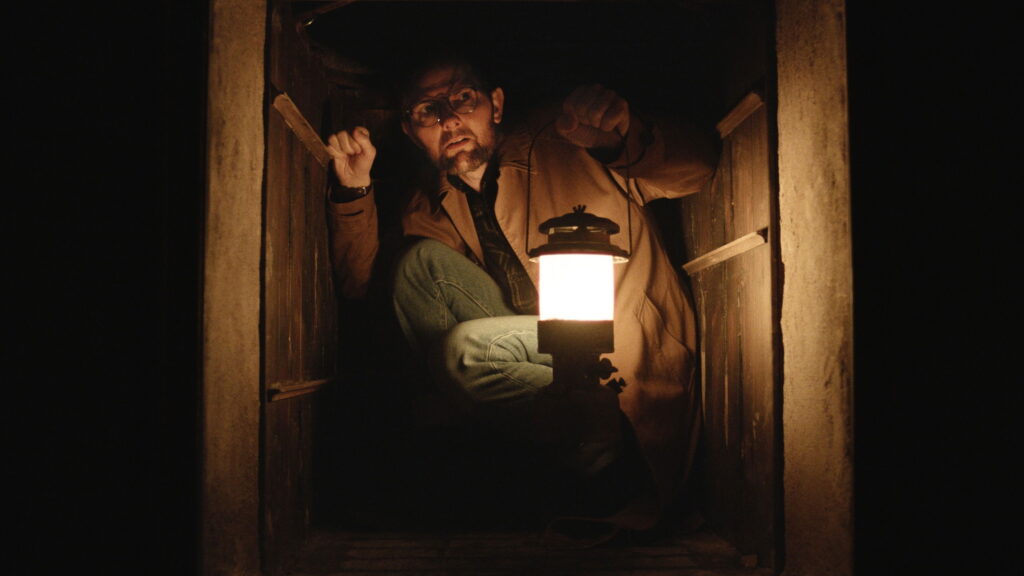
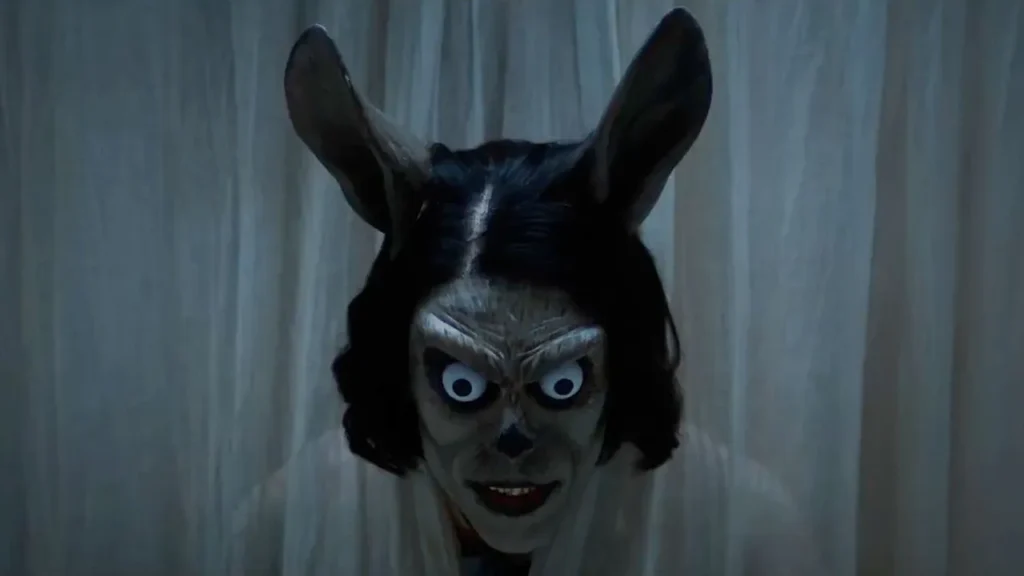
The middle act locks Bauman in a dark room while horror phantasmagoria churns around him. This is surely the most distinctive and craft-forward portion of the film. Colm Hogan’s cinematography stays welded to Bauman’s point of view, all negative space and shadow, so that we’re never more certain than he is about what the hell is actually happening in this dark room. It’s also where the witch lore gets its teeth, doled out in jump-scare glimpses. I respect all of it. But pitch-black claustrophobic terror is simply not my preferred mode of horror, and this stretch gives Scott almost no room to do his Adam Scott thing. Adam Scott doing his thing is always a positive.
The third act strikes a good balance of the first two, shifting into something closer to a kidnapping thriller, with Bauman working to outsmart his dark captor. It’s also where the movie’s emotional core finally cashes in, Ohm’s smarm revealed as a defense mechanism over grief and guilt, the inn functioning not merely as a haunted location but as a metaphor for his trapped shame. McCarthy delivers a memorable and satisfying finale in both the climax proper and a denouement that’s funny and touching in equal measure.
One last structural wrinkle: the film opens and closes with silly swords-and-sandals segments dramatizing Bauman’s novel-in-progress. They illuminate nothing and extend the runtime. I kind of enjoyed them anyway. They enhance the movie’s goofy flavor.
McCarthy’s buzz is sky-high right now, with Hokum positioned as the next leap following the positive waves that Caveat and Oddity made (though I never saw either). On a scene-by-scene level, I get it: the man is clearly gifted at creating atmosphere and rich settings and evocative spooks. Hokum feels like wandering into a Celtic-horror haunted house, more thrill ride than dark night of the soul. But what I see is admirable formal control betrayed by strangely shapeless storytelling. Average out my line graph across the runtime and it floats comfortably above the positive rating axis. It’s just that McCarthy constructs his film like we’re browsing a marketplace, checking out all the nifty little gizmos as we wander an atmospheric setting. You browse and you move on. It’s a pleasing commotion but missing the sweep to make it great, and I wanted just a little bit more character.
Is It Good?
Good (5/8)
Dan is the founder and head critic of The Goods. Follow Dan on Letterboxd. Join the Discord for updates and discussion.
2 replies on “Hokum (2026)”
Sounds very Barbarian-coded (which isn’t a positive, in my book).
It is in structure, and honestly a couple of scares, but not really in tone; I liked Hokum’s tone a lot more. Or maybe I just like Adam Scott.