
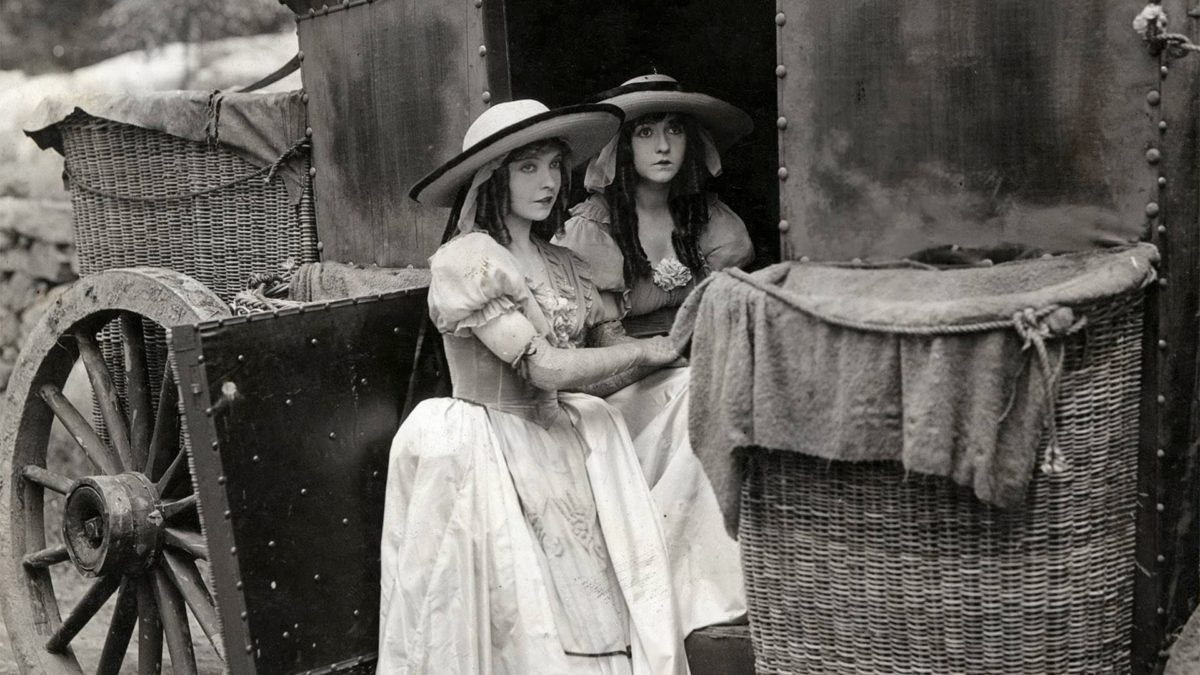
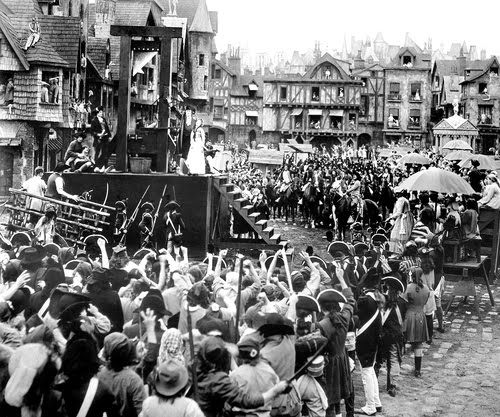
The French Revolution turns out to be a very good match for DW Griffith. The iconic historical images — the storming of Bastille, the tribunals, the guillotine — and the extravagant period details of late 18th-century Paris are exactly in the wheelhouse of Griffith. Epic; visionary. The film’s closest parallel is The Birth of a Nation minus the blatant racism: a melodrama with both family and romantic themes against the backdrop of a historical crossroads climaxing with a hurricane of violent mobs. The film is also a showcase of some of Griffith’s most annoying traits: His heavy-handed, anti-progressive moralizing; and his repeated use of mistreated damsels in distress as plot devices. Still, it is ultimately one of his most watchable films despite its 2.5 hour runtime.
Griffith’s film grammar experiences no major evolutions here, just refinement: His pace of editing and use of close-up is stronger than ever. We get some striking montages, particularly in the film’s historical moments, as we see various characters’ involvement and reaction to the political tension. There’s a particularly brilliant and tense segment near the end of the film as Lillian Gish’s Henriette is slowly prepared for execution as a frenzy rushes from the tribunal to the guillotine to call it off. I thought of the quiet-loud apple-eating segment of Snow White.
And while the camera rarely moves, it leaves an impact when it does. Gently swooping shots make us feel directly in the Parisian streets and parties of these astounding sets.
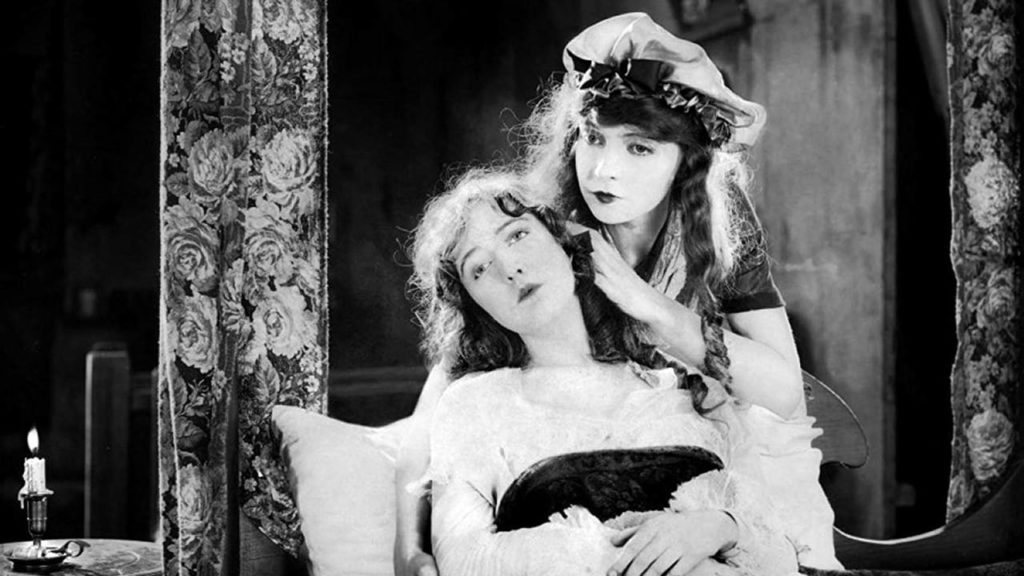
The film stars regular Griffith muse Lillian Gish, who is as brilliant as ever, though slightly less in the spotlight as she was in Way Down East. This time, she’s joined by her real-life sister Dorothy Gish to play her in-film sister — though, oddly, they play adoptive sisters, not sisters by birth. Dorothy also shines here as a downtrodden blind girl who suffers the worst of the films characters. The sisters have great chemistry.
Among Griffith’s historical epics, this is easily the most palatable to modern eyes — the coherent, well-structured narrative has a steady pace and memorable cast of characters. The palatial production values and set pieces are a treat. And though there’s some of Griffith’s political commentary, it’s not as much of a burden as in Intolerance or, of course, Birth of a Nation. What a relief, too, that the film mostly avoid racist caricature (minus the beggar woman who abducts Dorothy Gish’s Louise and is a clear Romani stereotype).
The runtime is daunting, sure, and that’s the biggest mark against it. If you have an appetite for the practice, I think this movie is a strong candidate for sped up playback; just be sure to slow it to regular speed for the full effect of the outstanding montages at the climax.
Orphans of the Storm marks the fifth and final Griffith film I will view during my tour of 1001 Movies You Must See Before You Die. Though I’m not sad to leave behind certain elements of his craft and tone, it has been enlightening to view the evolution of the medium in the hands of an early master. From the riveting final hour of the bloated Intolerance to the closet scene of Broken Blossoms and more, Griffith brought a grand, evocative, occasionally intimate vision of cinema to viewers. Whether he pushed the medium of cinema in those directions himself or simply rode the wave is a distinction I’ll leave to the academic film historians to make. It would be crazy to call him underrated given just how much acclaim he received in the first 50 years of cinema, but I would probably co-sign a take that he’s under-seen and misunderstood given the wide ripple his craft made on the form. I’m not averse to checking out more Griffith films in the future, problematic and outdated though the director is.
- Review Series: D.W. Griffith
Is It Good?
Good (5/8)
A few words on "Is It Good?" ratings for early cinema.
Dan is the founder and head critic of The Goods. Follow Dan on Letterboxd. Join the Discord for updates and discussion.