
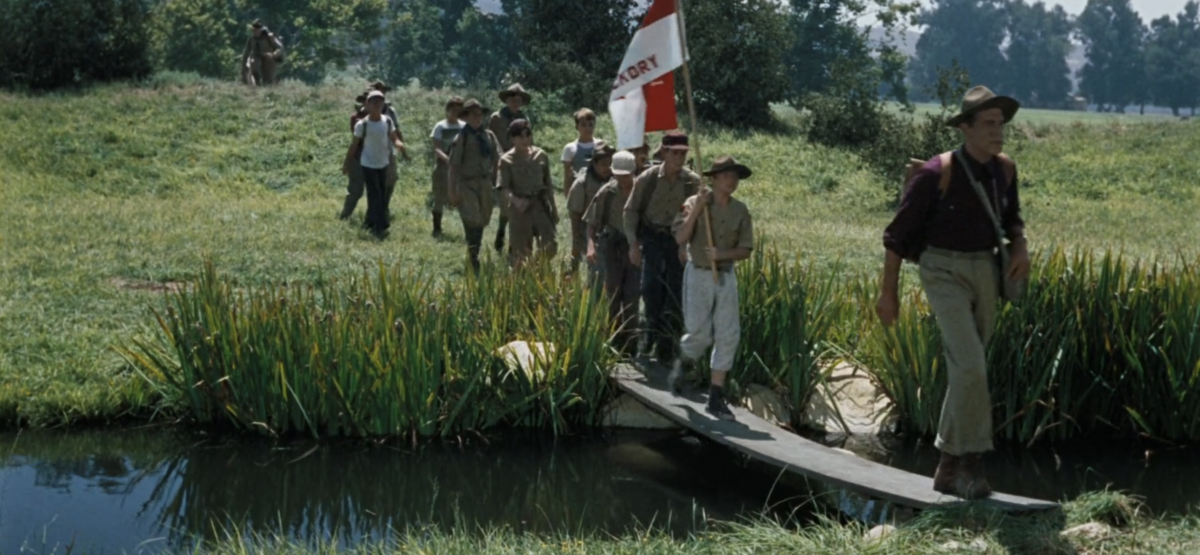
Trustworthy, loyal, helpful, friendly, courteous, kind...
Walt Disney died two weeks after this movie opened, which makes it the last film his studio put into theaters while he was alive to see it. The next year, Bonnie and Clyde and The Graduate upended mainstream American cinema. Every movie is the last one before something, but Follow Me, Boys! really does feel like an elegy: for the old studio system, and for the America it represented. I found Follow Me, Boys! almost unbearably wholesome, and I mostly mean that as a compliment.
Lem Siddons (Fred MacMurray) steps off a band bus into a small town around 1930, decides on the spot that this is where he lives now, spots a “clerk wanted” sign in a general store window, walks in, and has a job. Within a reel he has also selected his future wife, Vida Downey (Vera Miles) who works at the bank, and volunteered to run the town’s new Boy Scout troop. Then twenty years go by, and Lem lives a life filled with community and service. The end.

The economics of Follow Me, Boys! are the most striking, almost alien, piece of this movie. Lem sweeps floors and works a register, and on that he buys a house, supports a small family, and becomes a respected member of the community. This is how your parents and their parents told you to get a job: firm handshake, sign in the window. Watching this stops being quaint somewhere in the second act and turns into science fiction. A parallel thread about the town funding its own youth programs was presumably civic table-setting in 1966. Today it’s essentially agitprop. (Good agitprop, to be clear; let’s fund those schools and programs.)
The film’s structure is episodic almost to a fault, and it drops the thread entirely during a bizarre diversion in the second half, when the scout troop wanders into a military war game being run entirely on the outskirts of this small town. The picture thus spends fifteen minutes in a cartoonish Ernest Goes to Camp side plot, including Lem detained as a suspected spy and made to wear a hand-lettered POW sign around his neck. It’s a wacky grenade in an otherwise gently calibrated film. (It does pay off on a setup from earlier in the film: a sheep-shank knot Lem could never figure out how to tie.)
Elsewhere the movie is a little more empathetic than you might expect. Edward White Sr. (Sean McClory) is the town drunk and the father of troubled scout Whitey (Kurt Russell), and the film’s position on him is so ambivalent that it accidentally arrives at a kind of enlightenment: Edward isn’t the cruel or hapless monster most drunk movie dads are. He tells his kid to straighten up and join the scouts. He shows up to cheer him on. He’s a man with a sickness the town can’t accommodate, and somehow Follow Me, Boys! ends up blaming the town more than the drunk. Later, Edward dies, which kicks off the most moving thread of the film: Lem and Vida have learned by this point that they can’t have children of their own, a scenario depicted with compassion towards everyone, Lem’s job in it to hold steady for his wife. The pair decide to take Whitey in, and the surrogate fatherhood the movie has spent an hour building becomes the real deal.

The film has some of the storytelling savvy the Disney name promises. For example, it charts the growth of Lem’s troop, and his influence on the community, almost entirely through wardrobe: the first scout meeting has exactly one boy in uniform, the rest of the kids in ragged street clothes. The next meeting has two. Nobody is fully kitted out until after the film’s first big time jump. Director Norman Tokar, working from Louis Pelletier’s adaptation of MacKinlay Kantor’s novel God and My Country, marks time in small accumulations like that throughout the picture.
MacMurray, who I mostly think of as the heel in The Apartment, plays the exact inverse and is lovable as a man of unimpeachable, chipper decency. (Though it’s hilarious when he’s written as roughly thirty and looks a hard fifty; then nearly as funny when twenty years pass and this fit, healthy fifty-year-old is put out to pasture.)
Hetty Seibert (Lillian Gish) owns the land the troop camps on, and I got a spin of vertigo watching D.W. Griffith’s great silent muse turn up in a wholesome Technicolor Disney talkie in 1966. Future Thing-star Russell is fourteen here, in his first Disney film, at the front end of the ten-year contract that would make him the studio’s biggest star. And speaking of notable talent in the film, The Sherman Brothers supply a lone song, the title march, doled out a verse at a time across two decades, repeated as often as That Thing You Do‘s title track. Just like that song, it’s an earworm.
The closing stretch has the approximate effect of It’s a Wonderful Life, a summation of the protagonist’s kind acts, and it gets roughly halfway as far as that movie in how moving it is. You get the part where a man discovers how many lives he touched without really realizing it, though of course you don’t get the part where he’s shown the world without him, if he never got off that band bus. Even so, it got me. The Lem Siddons Day procession across the camp bridge is a wonderful moment, where even quasi-villain Ralph Hastings (Elliott Reid) has to shuffle along in the parade he spent twenty years trying to prevent.
But where the ending really slayed me and nearly brought me to tears was the return of Whitey. He is back from war, grown, squared away, bringing a lovely wife home to meet the people who took him in. His family. The movie’s argument is that pouring yourself into the young people of the community is a legitimate way to spend a life. It never makes that argument with any sort of rhetorical rigor. Instead, it just keeps showing you, one annoyingly catchy verse at a time.
Is It Good?
Good (5/8)
Related Articles
Dan is the founder and head critic of The Goods. Follow Dan on Letterboxd. Join the Discord for updates and discussion.
3 replies on “Follow Me, Boys! (1966)”
It may amuse you to know that Mr Fred MacMurray appears to have had a screen persona generally-wholesome enough that he was a key physical model for the original Captain Marvel, Champion of SHAZAM!
In other words a cape who makes other capes look like The Man With No Name by comparison.
I never knew that. I guess Zachary Levi does kinda resemble MacMurray.
Not half as much as the Big Red Cheese does!