

Esprit de corpse
You know the premise of Weekend at Bernie’s. So does everyone else who is at least a little tuned in with pop culture. It’a one of those films whose title has become a shorthand for its key narrative idea. It’s not a transplantable template the way Groundhog Day or It’s a Wonderful Life or Rear Window, other “title is shorthand” movies, are: Nobody is taking the Weekend at Bernie’s story concept and moving it to a spaceship or to the Shrek franchise. (Though maybe they should.) It’s a narrower and weirder idea than that. It’s the one-and-only (except its sequel and Swiss Army Man) corpse puppet movie. And because the gimmick is so specific and, frankly, ridiculous, the film has spent thirty-five years carrying the reputation of a one-joke comedy and an example of Hollywood phoning it in with a stupid gimmick.
As with many widespread reputations about things sucking, this one is wrong, deader-than-Bernie wrong. Weekend at Bernie’s rules. It is funny, well-made, and genuinely piercing as satire. It’s also not not stupid; it’s a comedy from the ’80s, after all. But that’s part of the fun.
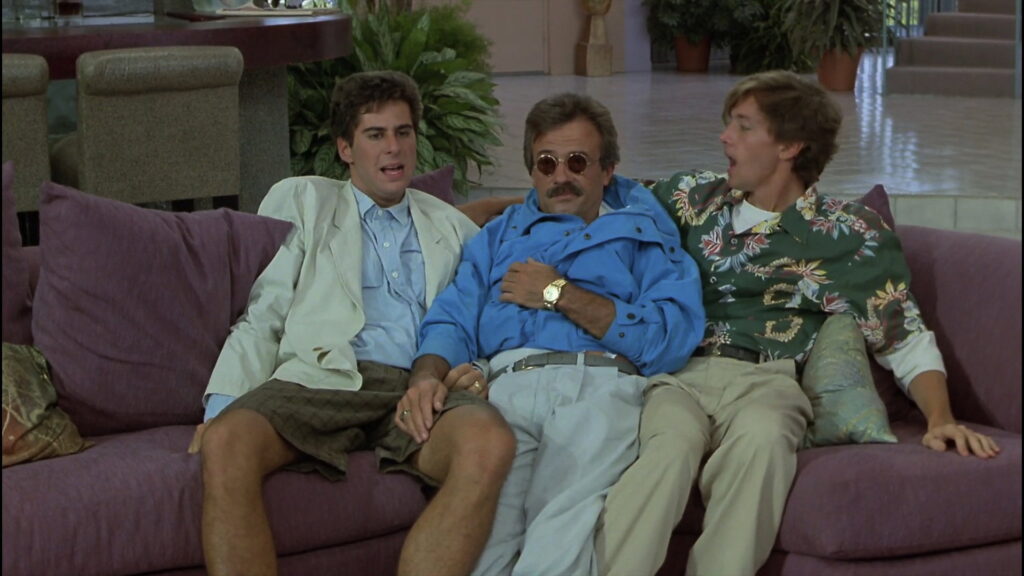
Despite its well known premise, the movie takes nearly half the runtime to get to the dead body posing as living. We’ve got a whole story in here. Richard Parker (Jonathan Silverman) and Larry Wilson (Andrew McCarthy) are bottom-rung insurance drones who find fraud in the company books, bring it to the CEO, and get invited out to his beach house on a long summer weekend as thanks. Bernie Lomax (Terry Kiser) is of course the one running the scam, and the hitman he orders up to silence the pair arrives with a different name on the contract: Bernie’s. The even-higher-up crooks want Bernie dead for playing loose with their money and messing around with their wives.
All this means the first half has to run on basic comedy storytelling alone, and it does. Richard is the uptight one who has been at the company nineteen months and a week, and can tell you such; Larry is the one who, asked the same question, might reply he’s there for a good time, not a long time. It’s a Bert-and-Ernie dynamic, or whatever odd couple you prefer, and one achievement of the screenplay is that the friction is very well articulated but always affectionate: Richard is rigid without being unlikable, Larry a goofball without being frustratingly obtuse. I’d watch these two get up to antics with no corpse involved at all.
Another surprise is how little arbitrary machinery it takes to get to the famous scenario. No plot turn feels truly implausible, and no decision Richard and Larry make is indefensible inside the scenario they’re in: They’re not good decisions, exactly, but explicable, and also sympathetic: For example, despite the image you might have in your head, the pair, never tip into actively exploiting the body (the iconic limb-manipulating puppetry is in fact a single throwaway moment by Larry), though they do refuse to acknowledge or act on his death once they discover it. Combine that with the party culture around them, where everyone drifts from open house to open house, boozing and hooking up, and nobody looks closely at anything, and you get a film that’s genuinely provocative satire on the way hedonism and decadence has stripped us Americans of our humanity. Nobody notices Bernie is dead. Nobody cares. What was his life if his absence changes nothing? That’s some bleak, existential subtext: life of a corporate shill and boozy hedonist mattering so little that the world doesn’t even pretend to notice.

Perhaps spun another way, the dead body lurking as money and sex flow around it is a different metaphor: the lingering monstrosity that the masses haven’t perceived or understood yet, but which rots at the heart of the horny, coked up ’80s party scene, destined to ruin it. Am I saying that Bernie is, in fact, AIDS? Yes I am.
The movie wouldn’t work if it didn’t have a steady-handed helmsman, and Ted Kotcheff, a real-ass director for this real-ass movie, also made the very real-ass First Blood and Wake in Fright, and it shows(-ass). What a tactile delight Bernie’s is: the melting tar on the office roof, the gritty night out in the city, the glass Hamptons mansion with its conversation pit and ocean vistas and floor-to-ceiling natural light. I always reward movies for taking place in settings I personally want to hang out in, and Weekend at Bernie’s has some of the same appeal that Forgetting Sarah Marshall gets out of its Hawaiian resort. It just has polish the way comedies should but very often don’t: the gags feel structured, written, and storyboarded rather than improvised into existence: e.g., the still, patient shot of the corpse floating in with the tide behind a couple making out; the *plunk, plunk, plunk* sound effect of Bernie clonking against the buoys while the guys slowly work out what they’re hearing. The final half-hour remembers that good comedy ought not lag; it’s constantly moving, cars to boats, and it never cheats with rear projection or over-obvious editing gimmicks in that energy.

I need to be careful not to get carried away. It’s Weekend at Fucking Bernie’s, not Vertigo or Persona. It actively shies away from getting pensive (see: Swiss Army Man for what this movie might look like if it was weirder, grosser, and unabashedly earnest). The film mostly eschews gross-out gags, making the necrophilia scene especially jarring (and also the film’s biggest violation of suspension of disbelief), though I confess it is doing heavy satirical work on how shallow these relationships are. The film also noticeably never bothers considering the actual degradation of the human body, which feels important; the fragile integrity of our vessels is an inescapable part of human existence. A body dragged and dropped and shot this many times would inevitably stop cooperating. Overall, the film has a waxy coat of unseriousness that is charming but ultimately limiting in how trenchant it can be. It aims for shenanigans, and that’s what it achieves.
The cruel joke is that we’ve done to this movie exactly what the movie’s partygoers do to Bernie: propped it up in the corner, waved its arms around at parties for thirty-five years, never once checked for a pulse. Unlike Bernie, it’s alive.
Is It Good?
Very Good (6/8)
Related Articles
Dan is the founder and head critic of The Goods. Follow Dan on Letterboxd. Join the Discord for updates and discussion.
2 replies on “Weekend at Bernie’s (1989)”
Yep, a genuinely good movie that has been shabbily treated, somewhat mystifyingly so, used as a sort of stand-in for every non-canonical dumb 80s comedy (“but not the ones I personally like”) despite being 1)funny, 2)more visually-driven than comedies can sometimes be, though visually-driven comedies were more common in the 20th century, and 3)having a well-articulated if not outright-signposted point of view that, extra-weirdly, most of the people who slag on it would agree with! (It’s probably not AIDS, though.)
Now do II! (I have almost literally no memory of II.)
Glad to encounter a fellow appreciator. As for a review of II? (Rubs hands together like a scheming Wile E. Coyote)