
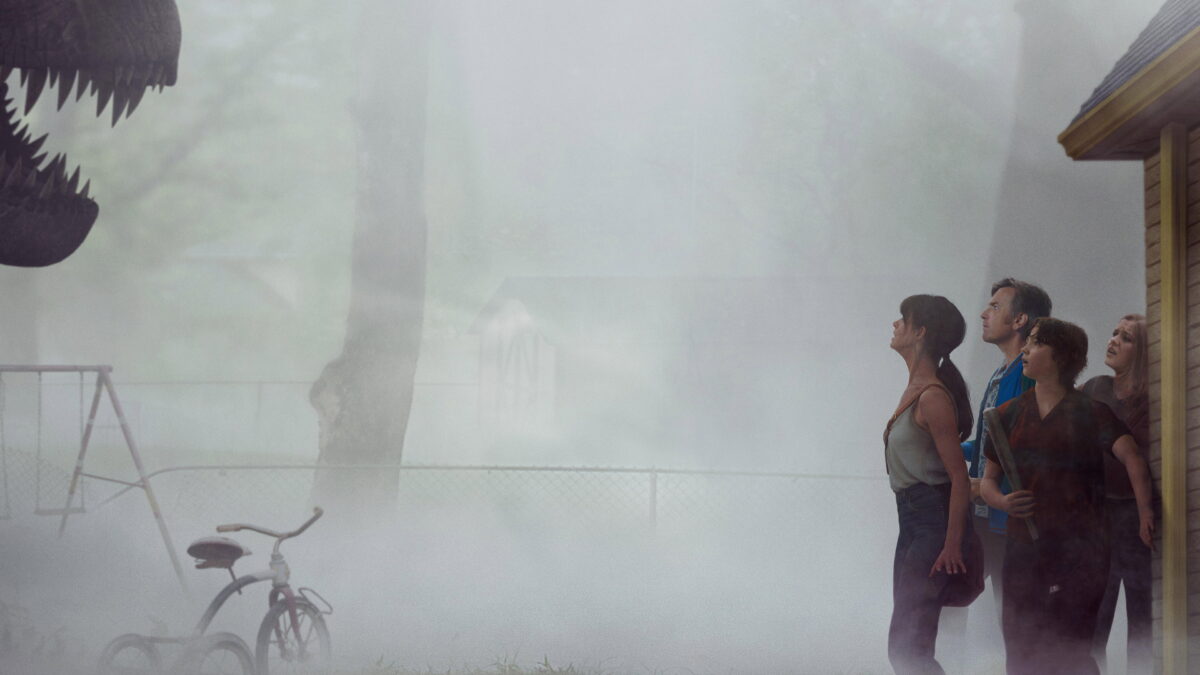
It swallows
Well, everyone knows Jurassic Park debuted in 1993 to rave reviews and box office records, ensuring that any future movie about dinosaurs eating people would be made in tribute to Steven Spielberg’s legendary achievement. What The End of Oak Street presupposes is… maybe it didn’t?
In his fourth feature, David Robert Mitchell makes what is easily his most conventional film to date. And yet I still detect in it a coy, almost cerebral relationship with its audience’s touchstones and expectations. Each of his movies, from The Myth of the American Sleepover to It Follows to Under the Silver Lake, has been a hall of mirrors, paying homage to well-worn and well-known cinematic idioms at the same time as it subverts them. This time, he cheekily imagines the dinosaur movie Spielberg might have made ten years earlier. Indeed, the film pays tribute to the Amblin era (Spielberg’s ’80s and early ’90s flicks and the likes of The Goonies) to such a degree that you might accuse it of cashing in on Stranger Things’ whole operation. Call it “Amblin-core.” (It’s produced by J.J. Abrams, who has built a whole cottage industry out of Spielberg pastiche. See: Super 8.)
That’s the joke, of course: a Jurassic Park movie for a world where Jurassic Park never happened, which gives Mitchell license to raid it freely. He pulls countless beats and moments from the dino mega-series, sometimes recreating them almost exactly, sometimes making a left turn at the last second, and sometimes just inventing something completely new. He cuts away most expository chaff; it’s sufficient to know hungry dinos are on the prowl. The result is a tremendously fun and direct piece of popcorn entertainment that perfectly threads the needle between vintage throwback and postmodern exercise.
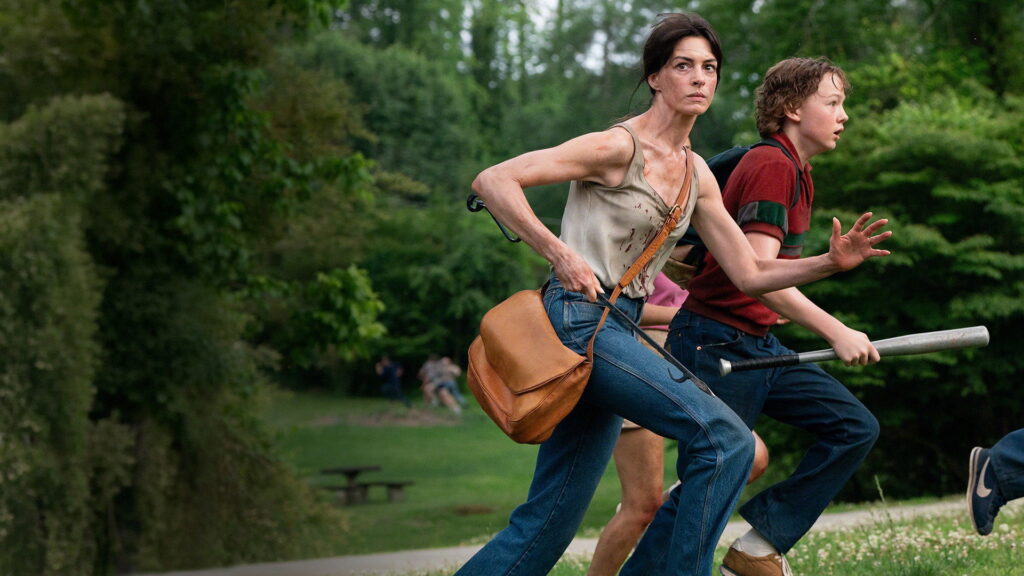
The year is 1982, and the titular Oak Street sits in one of those perfect ’80s suburbs, the kind E.T. wandered into that very same year. The Platts, however, are less than perfect. Denise (Anne Hathaway) and Greg (Ewan McGregor) are a married couple whose relationship is fraying, and their kids, teenage Audrey (Maisy Stella) and her younger brother Brian (Christian Convery), are desperately clinging to normalcy. Then, following a couple of strange flashes of light and the sudden appearance of long-extinct flora, the whole neighborhood gets ripped out of suburbia and dropped somewhere (or rather, somewhen) prehistoric. Before long, dinosaurs are picking off the neighbors one by one, and the Platts are boarding up their windows and doors.
The most Spielbergian touch of all is that if the dinosaurs are symbolic of anything, it’s divorce: a violent monster that tears asunder a nuclear family. Spielberg has spent half a century working through his own parents’ split on screen (E.T. is practically a divorce movie with an alien in it, and The Fabelmans simply is a divorce movie), and Mitchell tunes into that theme as well. The Platts’ marriage is already on the rocks before the first dinosaur shows up: Greg and Denise lock each other out as they privately grapple with financial and emotional woes. Greg lies to Denise about getting laid off. He drives around delivering pizzas to keep his family’s checkbook (and his own pride as breadwinner) afloat. Denise, meanwhile, has been writing a novel about a suburban mom who fantasizes about leaving her husband and kids, a manuscript she’s shared with a neighbor down the block. It’s fiction, she insists, but we know better. The monsters give the threat of a family being torn apart literal teeth.
The dinos look pretty darn great, though Mitchell has put himself at the disadvantage of being compared to one of cinema’s great blockbuster effects achievements in JP (which maybe reveals why not as many non-Jurassic brand dinosaur movies have bothered; it’s tough to come at the king). None of Oak Street’s dinos are quite so daunting or tactile as that T-rex in the rain, but the fact that it’s even worth having that conversation is a huge win for Mitchell. These are savage, bloodthirsty beasts. Their most distinctive visual trait is that they sport feathers and fuzz, which is how paleontologists have come to picture many dinosaurs in the years since the scaly-dino ’90s.
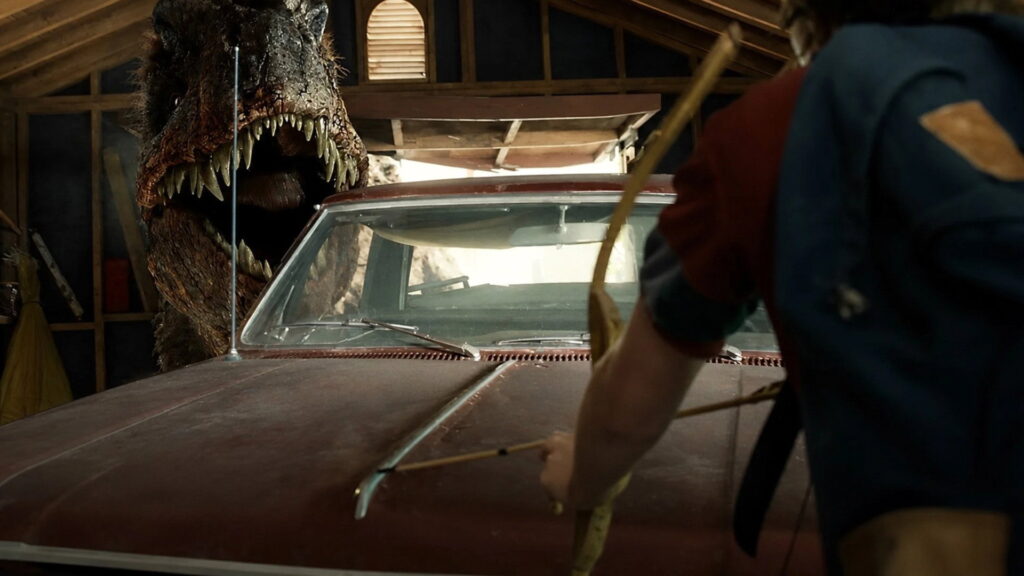
It’s hard to narrow down a best chase or survival sequence, as the movie is simply jam-packed with them, and they’re all good. Shoutout to the allosaurs: they force the Platts into some tight squeezes and give the family a few good cardio workouts. If pressed, though, my favorite of the monsters is a gigantic albino serpent from the film’s second half. I have absolutely no idea if this is a real dinosaur (I suspect not), but I do not especially care, as it makes for great cinema either way. Much of its menace is that it slithers so quietly the characters don’t detect it at first. When the serpent opened its fang-filled mouth for the first time, I physically recoiled, so frightening it looks. Kudos to Mitchell for not beating around the bush or softening the danger. These dinos just want to eat humans, and that’s it. And that’s why we buy tickets to dinosaur movies.
Mitchell has always had an impish, almost prankster sensibility, though it certainly peaked in Under the Silver Lake. Some of that comes through in The End of Oak Street as well: Both dinosaur poop and dinosaur sex get dedicated scenes. And an abrupt, gory death late in the runtime lands with the rhythm of a cruel punchline.
I enjoy that the movie defies some of the expected beats, mostly in small ways. Brian totes around a bow and arrow, yet rather than getting a heroic payoff, he spends the movie unable to land a single shot. Meanwhile, his attempts to flirt with Jeannette (Jordan Alexa Davis), the new girl in the neighborhood and a fellow survivor, flounder almost cruelly. She never becomes his love interest. He’s too much of a dweeb, with bad aim and no game. I actually think Jeannette is here mostly as a misdirection, and not only romantically: Her presence makes you think, “Ah, she’s how we’ll witness the real agony of loss,” as if she’s there to absorb the movie’s grief so the Platts don’t have to, when the specter of loss is very much afoot for the family.
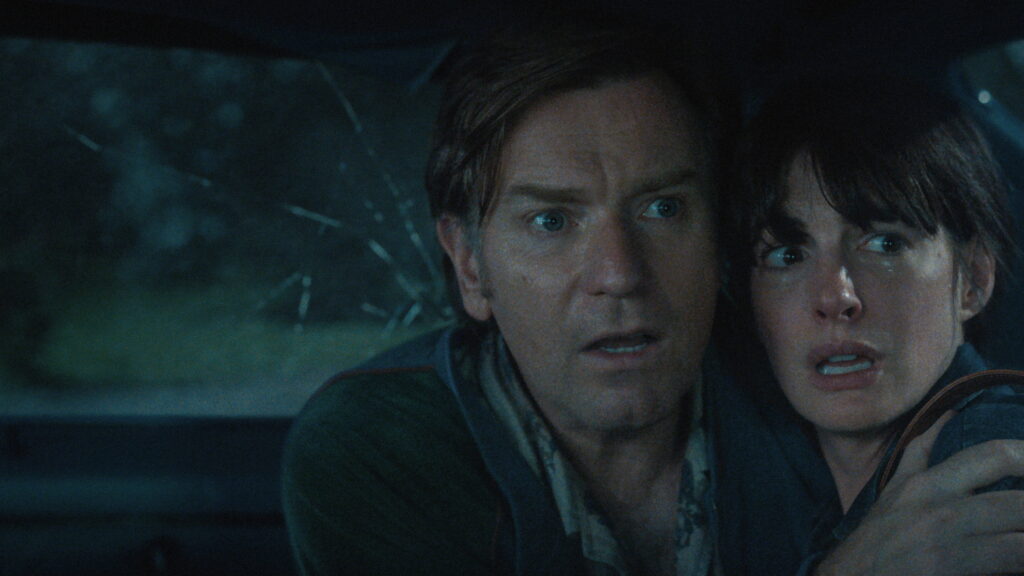
Audrey, meanwhile, is painted as a geek obsessed with time travel and Carl Sagan, so surely she’ll be the one to resolve the wormhole dilemma. (She has a spark with Jeannette that another, slower movie would potentially have investigated with a queer lens.) In fact, the resolution to the dilemma boils down to chance and instinct, with roughly the scientific rigor of squinting at something and saying, “Hey, that looks like a portal.”
One thing that didn’t really bother me, though maybe it should have: The residents of Oak Street barely ever leave their houses, let alone band together. I bought it in the moment, because the movie sold me on the idea that anyone who stepped outside would get eaten on the spot, at least until the Platts… go outside and don’t get eaten on the spot. Call it the Jurassic Park lesson: The writing can be a little dumb, so long as the one thing that really matters, the palpable danger of bloodthirsty dinos, works like gangbusters.
My favorite moment in the film, though, is a sad, quiet one with a pitch-perfect needle drop. Amid the carnage, Audrey sneaks into the garage, turns the key in the family car, and tearily sings along to Steve Winwood’s “Valerie” on the cassette deck. For just a minute, the movie pauses amidst the apocalyptic wreckage around its characters, and it gives everything a little more human impact.
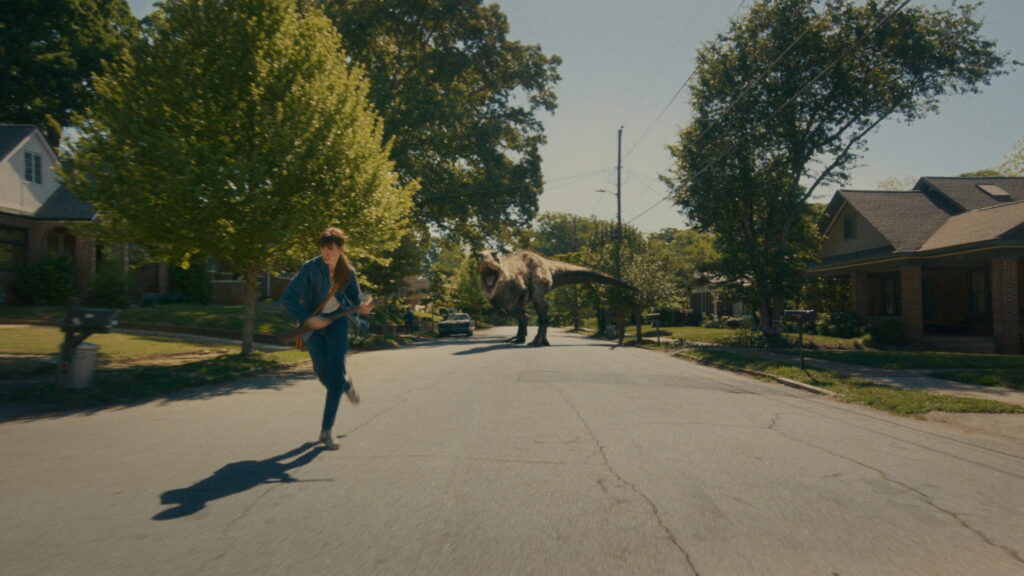
Speaking of music, Michael Giacchino’s score is outstanding. It is as much a throwback-meets-update as the film around it, blending the kind of soaring, deeply Romantic themes John Williams brought to Spielberg films with textures more modern and expansive. It’s another masterful outing for a composer who I just keep finding more reasons to respect. (His employment might be a dinosaur movie reference in and of itself: Giacchino also scored the entire Jurassic World trilogy.)
Visually, Mitchell and his regular cinematographer Michael Gioulakis update their distinct, panning camera technique for capturing the chaos of blockbuster action. The tracking shots make the action feel tremendously kinetic. Gioulakis and Mitchell also lean quite a bit on a glorious old-school trick: the split diopter, a half-lens attachment that holds two planes of the frame, one near and one far, in sharp focus at the same time. They go to that well frequently (roughly 20 times, according to one viewer’s count), and it feels novel every time, capturing focus on two different ideas within the same frame without racking back and forth between them. This is a fun touch from a movie that wears its ’80s influences this proudly. But it also suits a movie about a family at risk of getting split at a seam.
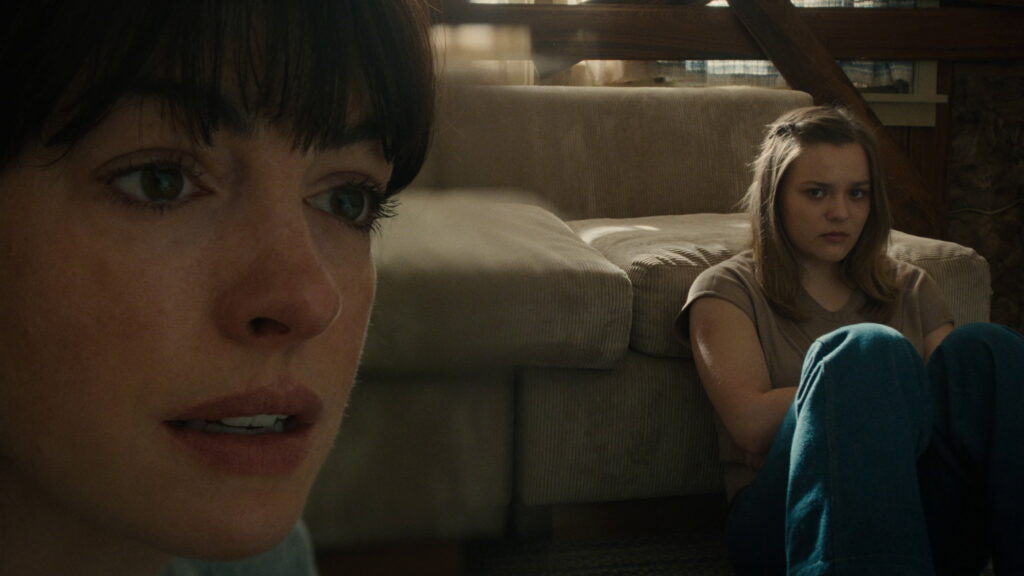
The cast is contained to four or five members for most of the runtime, and they’re all solid, with most of the movie’s dramatic heft falling on the shoulders of McGregor and Hathaway. McGregor is fine as a slightly dopey, prideful dad with just a nip of alcoholism. But Hathaway (who is having quite the year: this, Mother Mary, The Devil Wears Prada 2, and The Odyssey already, with Verity coming shortly) is really excellent as a mother with barbed cynicism who’s barely holding it together. As for the kids, I warmed to Stella as a shy, geeky teen here more than I did when she was an annoyingly normal one in My Old Ass. Convery (the kid from Cocaine Bear) makes a perfectly pitched dweeb.
The ending is a bit kooky with its sci-fi shenanigans, and it would be vulnerable to accusations of undercutting the stakes with time-travel tomfoolery if it didn’t stick the landing. But I think it does. The finale ultimately transforms the film into a life-affirming, family-affirming bit of fantasy that just happens to feature some really grisly gore and dismemberment. The stuff all great family films are made of.
Is It Good?
Very Good (6/8)
Dan is the founder and head critic of The Goods. Follow Dan on Letterboxd. Join the Discord for updates and discussion.
One reply on “The End of Oak Street (2026)”
For my money this is a decent film that could have done a better job of integrating the last act twist in a way that would help better explain why Oak Street seems so empty even before the dinosaurs and other prehistoric life forms get to work.
Also, for the record, there ARE simply enormous snakes in the fossil record: look up ‘Titanboa’ if you want some nightmares (Though it bears pointing out that there’s a peculiar mix of species in the film that I suspect is meant to indicate that it wasn’t just humans who got snatched back to somewhere strange, alien and dangerous).