
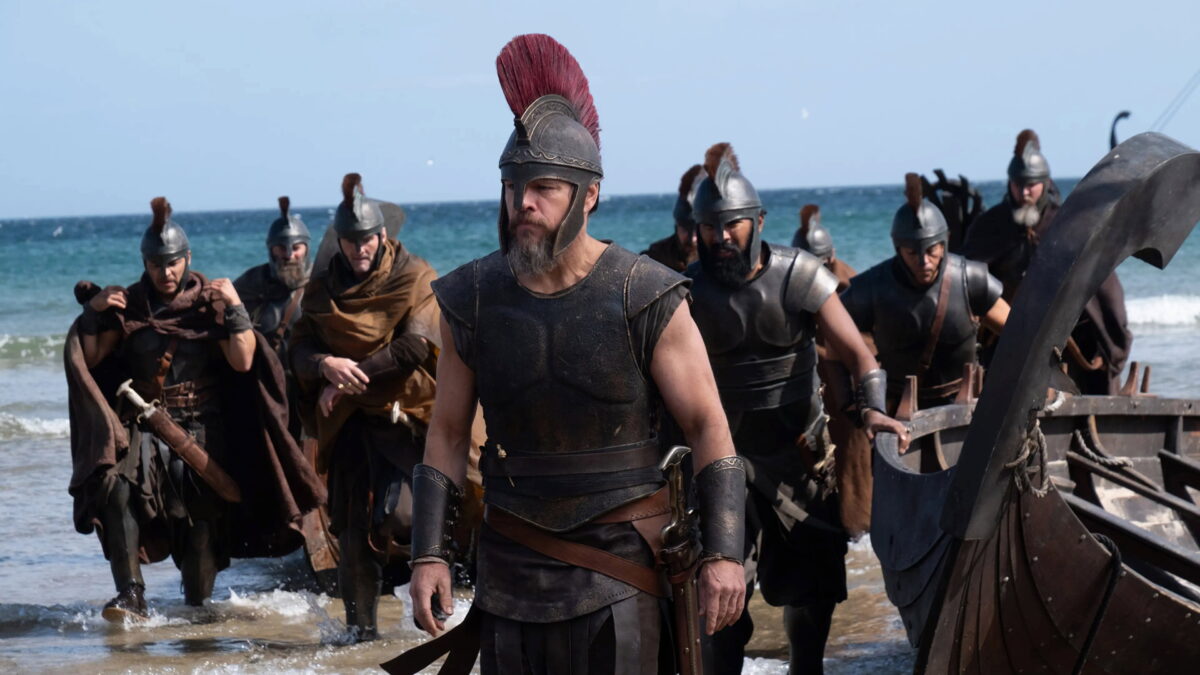
Sing to me of the man
When I saw The Dark Knight in 2008, I stepped into the Airbus IMAX theater in Chantilly, Virginia and saw the story of a great man, a flawed hero, trying to hold together a world increasingly filled with chaos and rot, only to become a figure of darkness in the film’s closing minutes as he passed the mantle of heroism to a figure representing a newer and brighter path forward. When I saw The Odyssey 18 years later, I stepped into the Airbus IMAX theater in Chantilly, Virginia, and saw the same.
It is not a one-to-one comparison, though I do think The Odyssey is his most Dark Knight-ish film since The Dark Knight. (Yes, even more than Rises.) Above all other thoughts and reactions, The Odyssey made me nostalgic and appreciative of a director who has been remarkably sturdy in his brand of epic, quasi-cerebral blockbuster filmmaking, grounded in practical production and an unceasing fascination with the grit that makes us human, dirty and flawed, set against operatic themes of light and dark locked in eternal, cyclical struggle with each other. Christopher Nolan, the biggest name in Hollywood, has evolved, and I’d even say matured, but what a blessing for movie lovers that he is still doing his thing and doing it well. Though I’ll never love his films as much as I did when I was 20, I am grateful for him.
What’s interesting is that you could come up with strong parallels between The Odyssey and all of Nolan’s films; I could have written the opening paragraph of this review in a similar style about literally any of Nolan’s pictures that I’ve seen dating back to Memento. (I promise I’ll see Following one of these days.) Heck, this is at least the fifth Nolan movie I’ve seen at Airbus IMAX, the biggest screen in Virginia. Put another way, The Odyssey feels like a summation of Nolan’s career even as it is very obviously doing some things no Christopher Nolan movie has ever done before.
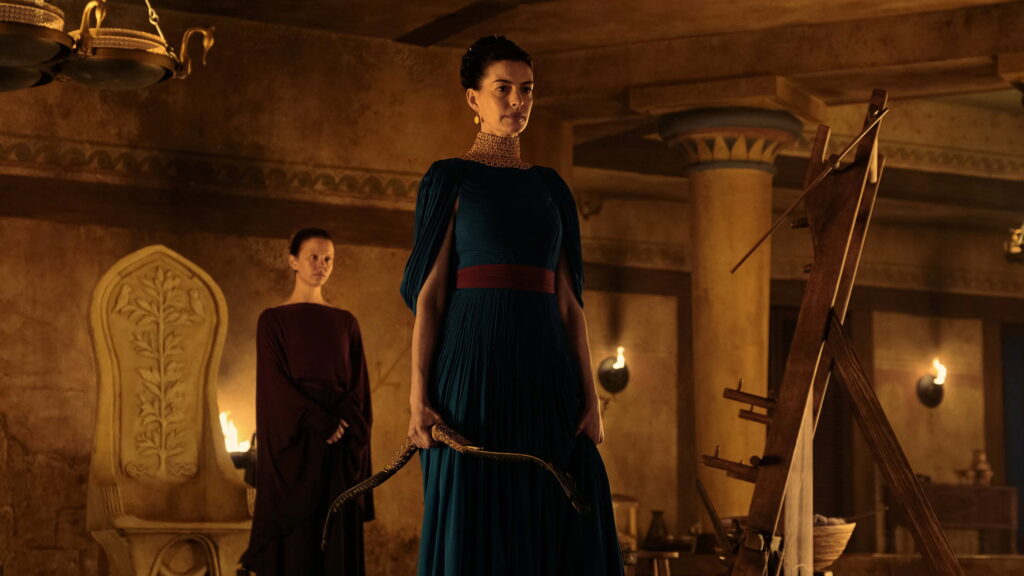
For example, The Odyssey is the first time any of Nolan’s movies have been set in ancient times, which gives the director some tremendous new playgrounds for crafting his world-class spectacle: ancient burning cities, boats adrift at sea, giant mythical monsters, slaughter by sword blades and arrows. He also constructs a certain horse near the city of Troy that you may have heard of. All of this grandeur is as great and overpowering as you would hope, especially in the much-ballyhooed all-IMAX format. And this, I suppose, is the reason we still show up in droves: whatever Christopher Nolan makes is going to be huge and exhaustingly, triumphantly rewarding as cinema of scope.
But between the new stuff Nolan is trying and the way his telling of the story threads through all of his thematic preoccupations, I couldn’t help but feel that The Odyssey is a bit of an indecisive film. Look no further than the opening title card, which reads “an age of apparent magic.” That is as close to a point-blank confession as we’re going to get that he couldn’t quite wrap his filmmaking arms around the entire mythical scope of the Odyssey while still tying it into his own schema. We all wondered what a fantasy Christopher Nolan film would look like; it turns out that he was wondering that, too, and none of us really got clear answers.
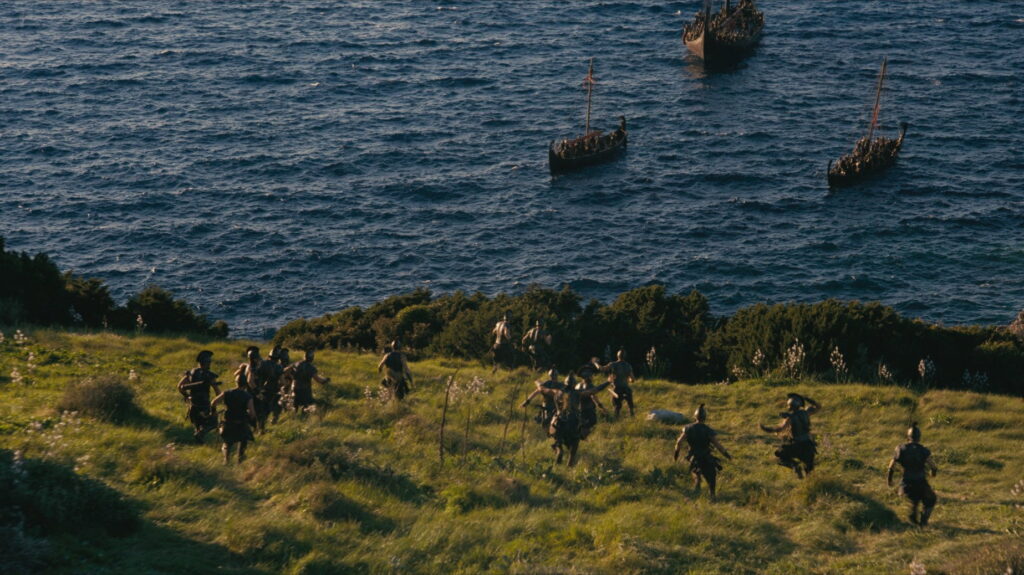
And that leads me to the wobbliest part of the movie: the episodic opening hour. It’s almost as if Nolan had little patience for the most iconic bits of the Odyssey, because they feel the most askew with what the second half of the movie chooses to focus upon. Christopher Nolan has to pay the Homer tax of showing us a cyclops if he wants to investigate the complicated morality of Trojan War hero Odysseus (Matt Damon). And so we end up with some really impressively staged, but not quite right, sequences on various islands. They inevitably end with lots of death and the surviving soldiers sprinting to the coastline while they shout “run away!” like they’re in Monty Python and the Holy Grail.
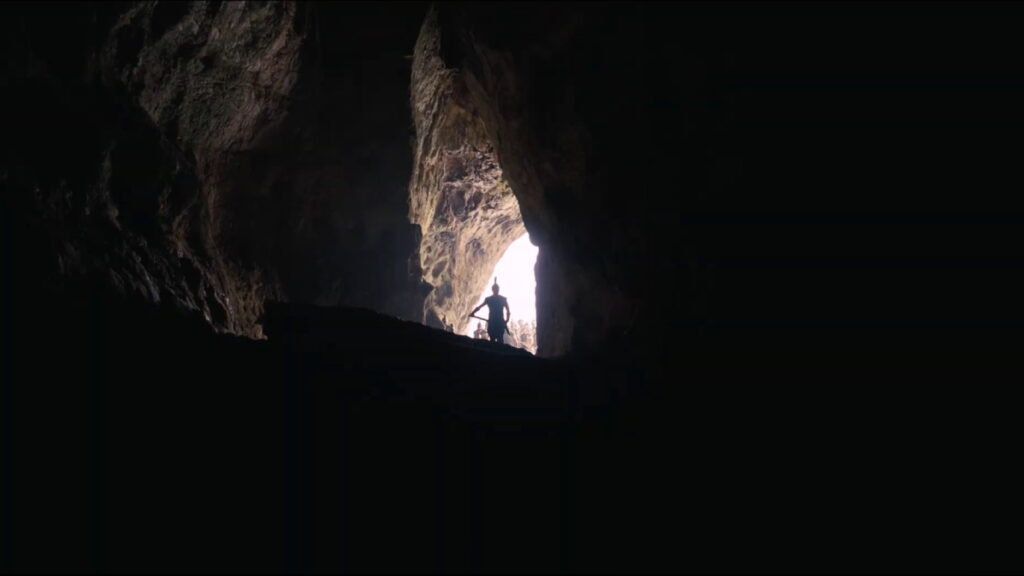
On their own, each of these early encounters is an achievement of production and vision. The cyclops is not quite so verbal as you might remember him, and indeed the well-known part of the story where Odysseus becomes a trickster and tells the cyclops that his name is Nobody is nowhere to be found. But that largely animatronic and puppet-based design of the cyclops is a triumph, uncanny and alien, and always shot to look impossibly large. And it says something about Nolan’s priorities that the man he cast as Polyphemus is Bill Irwin, a stage clown physical performers alive: this is a monster conceived for the body rather than the mouth. Meanwhile, the encounter with the witch Circe (Samantha Morton) treads into horror territory. Nolan can’t quite nail the Robert Eggers effect of transporting you into the mind and soul of a lost culture, but he’s at least trying to make it feel like these misadventures are out of a legend.
The problem with these early episodes is that they don’t track with the overall arc Nolan is ultimately sending Odysseus on. The attempts to connect each episode to the way Odysseus is processing his spiritual burden about his treachery and violent destruction of Troy end up very thin. Of course, as Homer wrote them, those episodes truly are standalone stories that are only loosely tied together in the larger epic poem framework. But Nolan has clearly latched onto telling the Odyssey in modern terms and narrative structures and values as the key thrust of his story, an approach that only intermittently works. So these episodes, these encounters with monsters and ghosts on one-off islands, end up neither fish nor fowl: they are individually memorable scenes in a movie where what is most memorable is, in fact, nothing individual, but the overall sweep of the story that these episodes don’t quite fit into, and thus they actually reduce the arc Odysseus goes through rather than deepening it.
This brings me to the overall structure of The Odyssey. For a while, I thought Nolan was going to use Citizen Kane as a model, where we get an external overview of the story followed by in-depth tellings and reframings of key moments through the eyes of other characters, mainly ones that Telemachus (Tom Holland) talks to or hears from. But that only really lasts through Menelaus (Jon Bernthal) telling him the story of the Trojan horse. After that, Nolan just goes kind of freeform with the structure, mixing various flashbacks with the present-day ordeals on Ithaca.
The film ratchets up quite a bit in the second half, and it’s better to go out strong like The Odyssey than to go out slow and drawn out like Oppenheimer, though I ultimately put the two of them in a similar tier, and the pair are astonishingly thematically linked despite “sword-and-sandals epic” and “biopic” being two genres on opposite ends of the cinematic spectrum. Both are about complicated men reckoning with the violence they hath wrought, the destroyer of worlds they have become.
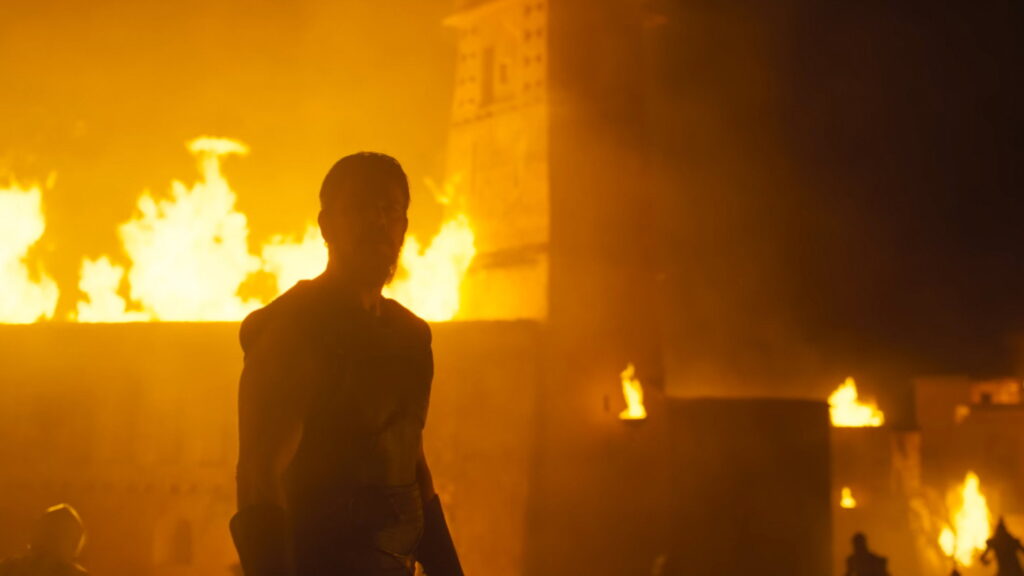
The entire final hour of The Odyssey has hardly a wrong note, though it does have at least one: the double-whammy fakeout of Odysseus’s possible death is a stinker of a beat. Nolan couldn’t quite steer the ship into port without a collision, but it’s a mere scuff on the hull in the grand scheme of a great ending, a slow-pedaled emotional payoff eventually full of righteous vengeance.
“In the grand scheme” is the operative term because The Odyssey is the kind of movie that asks you to submit to its sweep, details be damned. It is a movie infinitely susceptible to “deconstruction” as Mitch, the host of The Movie Call Podcast, likes to say (i.e. seeking out flaws and contradictions). Any movie that takes as broad of a swing as The Odyssey does, with so many goals and ideas, is vulnerable to pointing out, e.g. “Why the hell did Odysseus shoot the cyclops one last time after he’d made it out alive?” “Why did he not plug his own ears with wax?” “Why do these monsters look like Power Ranger villains?” “Is it just me or is that whirlpool not actually that big?”
But Nolan’s “grand scheme” approach to the material also highlights the ways in which he is one of cinema’s great writers. His dialogue occasionally clanks, his vision might be blurry on the intricate curvature of gods and guilt in “an age of bronze,” but he is writing a script to match the ambition of his own camera, and it’s a perfect fit. He captures the massive, unsinkable, operatic struggles he’s long been fascinated with, and does so with muscle and confidence, if not grace. Nolan sees his concepts and his cinema interlocking, sometimes in unison and sometimes in tension, like a boat in the sea, swept along but battered.
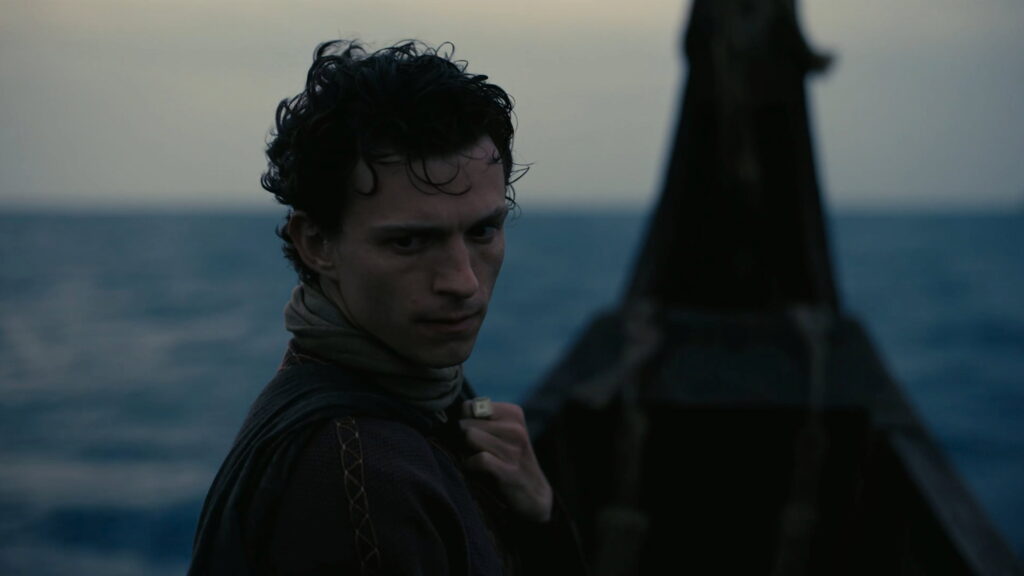
And the modernity that Nolan injects into the story does goose the tale in a way that a textbook adaptation wouldn’t. It results in a mirror of current headlines and struggles. The movie opens in Penelope’s court with a rapper as a bard (Travis Scott) performing the legend, suggesting a lineage between oral history and modern hip hop. Generally, though, the echoes are grimmer. I don’t think it’s too much of a projection to see Nolan grappling, in a world-weary way, with greedy political firebrands picking at an institution already scarred by violence and grief. The first victim of the Ithaca massacre takes a puncture wound to the neck, an unmistakable echo of Charlie Kirk’s assassination. The rest of the violence in Ithaca reads an inverse January 6, where the angry political upstarts invading the governing hall get mowed down by the legitimate power. The film’s populace, meanwhile, cries out about “sea people” arriving to ruin their people and their culture: when Odysseus and his men are, of course, the “sea people.” This is America’s relationship with immigration discourse in a nutshell.
One simply cannot discuss this Odyssey without the requisite salutes to its cinematic achievements: We can start with acting. This is the starriest movie cast since The Departed, almost all doing a good version of what the story asks of them. Holland is the most replacement-level performance, but mostly because Telemachus is a replacement-level protagonist as the prince of Ithaca. Damon is great, very obviously up to the task of carrying all the weird responsibilities the story lays upon him in a way that had me thinking of Christian Bale’s performance as Batman. Anne Hathaway is tremendous as Penelope, as are many of the supporting turns, with my favorites off the top of my head being Bernthal and John Leguizamo, though I don’t really have any stinkers. And I haven’t even gotten to Robert Pattinson as Antinous, chief among the suitors and the closest thing this movie has to a proper villain. The closest I have to a complaint is, sadly, Zendaya as Athena; she has the statuesque poise and beauty but doesn’t convey any Olympian grace and authority (and given that we ultimately see her as the imagined reflection of an ordinary casualty of war, that could be an intentional tension by Nolan).
Another of the “requisite salutes” is the IMAX cinematography by Hoyte van Hoytema, shooting his fifth straight film for Nolan, though I will hedge a little here. I have a strong hunch that the limitations of the IMAX camera caused some challenges in shooting even for a cinematographer of van Hoytema’s caliber: the visual focus of a shot sometimes stumbles around like a seasick sailor, with characters and props going blurry at odd moments. The vertical IMAX framing does work well, vacuuming you into the screen and marveling at the hugeness of buildings and boats and machines of war, though I wonder if an enveloping widescreen depiction of the wine-dark sea might have been lost in the IMAX full frame.
I have far fewer reservations about the score and the sound design, though. (Except, maybe, that it’s very loud and aggressive; but this is a loud and aggressive movie.) Ludwig Göransson, my boy from Community, once again delivers a candidate for the score of the year, a blend of ancient instrumentation and modern epic cinematic flair. It’s a rousing, aching achievement. The theme that soars when Odysseus plucks his bow elicits chills every single damn time.
The editing is likewise outstanding by Jennifer Lame, at least within the framework of IMAX film’s three-hour projection limit. The pace is propulsive and rhythmic, giving you that maelstrom of portent and the surging toward climaxes that Oppenheimer also had (which, indeed, Lame also edited and won an Oscar for; she is surely one of several odds-on Academy Award favorites from this movie). And yet I think the three-hour constraint is a bit of a problem: part of the trouble with the opening hour of this film is that the seafaring and its various episodes have been cut to the bone, so the sensation of time passage and grueling distance is lost. It’s a rare movie that I think might be better if it were 10 to 15 minutes longer, not shorter, if only to expand the “epic” feeling of the story.
So The Odyssey is great, and it is also messy and funky in the way a lot of great movies are. Nolan makes his own Ten Commandments here: an unrestrained, blank-check piece of spectacle following his Best Picture win, the same move Cecil B. DeMille made when he cashed his Greatest Show on Earth Oscar. And if Nolan’s attempt to lasso this ancient epic into a character study in his own voice doesn’t always work, I’d still rather watch him use all his magisterial blockbuster powers on it than any other living filmmaker. I walked out of that Chantilly Airbus IMAX the same way I did in 2008: rattled, a little deafened, and already thinking about when I could go back.
- Review Series: Christopher Nolan
Is It Good?
Very Good (6/8)
Dan is the founder and head critic of The Goods. Follow Dan on Letterboxd. Join the Discord for updates and discussion.
12 replies on “The Odyssey (2026)”
“ But Nolan’s “grand scheme” approach to the material also highlights the ways in which he is one of cinema’s great writers. His dialogue occasionally clanks, his vision might be blurry on the intricate curvature of gods and guilt in “an age of bronze,” but he is writing a script to match the ambition of his own camera, and it’s a perfect fit. He captures the massive, unsinkable, operatic struggles he’s long been fascinated with, and does so with muscle and confidence, if not grace. Nolan sees his concepts and his cinema interlocking, sometimes in unison and sometimes in tension, like a boat in the sea, swept along but battered.”
Well put and you makes some meaningful deconstructions a throughout. Nolan is a great writer. Dan is also a great writer.
Thanks Mitch; you are very generous. You knew I had to address the question of whether Nolan is one of our great writers after the Discord debate on the matter.
Loved the use of drawing parallels from today’s current events to the destruction Odysseus caused. Lots of scenes hopping Island to Island with destruction and sacrifice made me think about some of corrupt political rule and events today as well. All these heinous acts of terror masked under the simple motives of upholding a position of authorial rule. The Odyssey really is a story that never ages beyond its years because of how true it always is to the selfish human nature choosing darkness for personal gain and pride
Thanks Eli. I think that’s a good insight that certain aspects of the Odyssey text remain always relevant; I think it’s not too much of a stretch to see the island hopping as mirroring sometihng like colonial pillaging of resources.
Great review, Dan, it got me thinking about the way some of the early scenes feel hemmed in by the requirements of adaptation.
I’ve been reflecting about the appeal of Christopher Nolan as a director, and I have a back-of-a-napkin theory. His movies are popular, not because he’s a genius, but because… well… he *isn’t.*
He’s undoubtedly a very smart guy, and a very talented director, who takes on enormously ambitious projects and mostly sticks the landing. But “mostly” is the operative word. He makes films that feel smart while you watch them, but on the drive back home, you have questions. There’s clumsiness and imperfection when you look past the spectacle; the kind of imperfections you or I might make if we helmed a $250 million project.
I think that’s catnip to movie fans. His product is 95% pure, but that missing 5% makes it approachable in a way that a film can’t be if it’s inscrutably perfect. When everyone’s a critic, they’ll turn up in droves for a movie that will let them formulate criticisms.
Thanks, Thrash, I think I’m with you on your take on Nolan’s not-quite-perfect intellectualism. I’ve been calling it “quasi-cerebral” because it makes you think but I’m not sure it always is that smart. I really like your idea that the fact that he makes you feel smart is a big part of the appeal, like it gives everyone something to chew on, and that his biggest strengths are in production and spectacle.
“The Odyssey is the first time any of Nolan’s movies have been set prior to the 20th century”
Well, *technically*… but the 1890s are close enough.
Cosigned on it feeling not unlike an dour and hyper-expensive Holy Grail, though, and I could almost imagine Nolan wishing he could also end the movie with somebody showing up to arrest Odysseus. I’ve said it elsewhere, but I’m still really perplexed that the tradition of Odysseus attempting to dodge the Trojan draft, the most important piece of non-Odyssey material and possibly just the most important piece of material period coloring our modern understanding of the character, isn’t in this movie where the whole point is that the Trojan War was a crime and Odysseus sucks for being a crucial part of the system that committed it. Also, “our Age of Bronze is collapsing” is the worst line in a movie I’ve heard in years.
But yeah, still works, and as a collection of great scenes along with less-great scenes or less-great parts of great scenes it can still, uh, sing.
Oh dang. Going to change that wording. I event thought through his movies and somehow skipped over The Prestige despite it being one of my favs of his.
“Our age of bronze is collapsing” is such a Chris Nolan dumb-smart line. You couldn’t have cooked it up in a lab better.
I have your review open in a tab but haven’t read through it yet.
I admire this film a great deal and love it for letting Mr Nolan dive into pure Fairy Tale Horror with Circe – only the Best for THE SERPENT QUEEN herself! – as well as allowing us to make jokes about the Zendaya-Holland-Bernthal triple act.*
*It actually struck me today that Zendaya might be more my image of Hera than Athena – I suspect she’d have far more fun chewing into a Queenly, antagonistic role than the more cerebral, ambivalent Athena of this film.
Also, this film gets Argus right and that poor, wretched, beloved dog has been pouring out the tears for the better part of three millennia with no sign of quitting yet because we love him for being the Best Boy.
Also, it’s fascinating that while their plots completely fail to mesh this film and the Wolfgang Petersen TROY work strangely well as a double feature (But then I have a terrible weakness for the latter film, which undoubtedly has my favourite depiction of Achilles in action**).
**It’s part of the evidence for my Rule of Cinema that the scarier a Mother****** a Brad Pitt character gets to be, the better the film.
My favorite Zendaya performance is probably Challengers where she gets to antagonize men so I think you might be onto something.
Never seen Troy but the success of The Odyssey and the interesting behind the scenes connections to it (Nolan was at one point lined up to direct Troy before he went to Batman) made me curious. I was rewatching some Pitt scenes from Babylon and it just made me want to watch another Brad Pitt movie haha.
You could do worse than TROY: it’s not perfect, but there’s a good deal to recommend it as an Action Movie and it’s graced with some fine performances, as well as one outstandingly delicious hammy one.
Not a perfect movie, but quite an entertaining epic of the Old School (and you may be interested to observe the tonal differences between it and THE ODYSSEY, despite proceeding from surprisingly similar assumptions).
It’s only fair to mention that this film left me with a little bit of a crush on Ms Diane Kruger, despite strong competition from Ms Saffron Burrows and even stronger competition from Ms Rose Byrne.
Looking up Troy’s cast, and it was really loaded. Wow.